
[Paper Review] Predict-and-Update Network: Audio-Visual Speech Recognition Inspired by Human Speech Perception
This paper proposes the Predict-and-Update Network (P&U net), a novel end-to-end audio-visual speech recognition model inspired by human speech perception, where visual signals predict and guide audio processing. By using visual embeddings to condition audio representations via a cross-modal Conformer, the model achieves state-of-the-art performance, reducing WER by over 10% on clean and 40% on noisy conditions compared to prior methods.
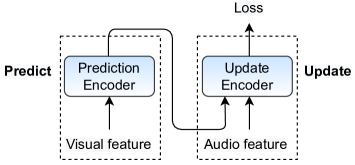
Audio and visual signals complement each other in human speech perception, so do they in speech recognition. The visual hint is less evident than the acoustic hint, but more robust in a complex acoustic environment, as far as speech perception is concerned. It remains a challenge how we effectively exploit the interaction between audio and visual signals for automatic speech recognition. There have been studies to exploit visual signals as redundant or complementary information to audio input in a synchronous manner. Human studies suggest that visual signal primes the listener in advance as to when and on which frequency to attend to. We propose a Predict-and-Update Network (P&U net), to simulate such a visual cueing mechanism for Audio-Visual Speech Recognition (AVSR). In particular, we first predict the character posteriors of the spoken words, i.e. the visual embedding, based on the visual signals. The audio signal is then conditioned on the visual embedding via a novel cross-modal Conformer, that updates the character posteriors. We validate the effectiveness of the visual cueing mechanism through extensive experiments. The proposed P&U net outperforms the state-of-the-art AVSR methods on both LRS2-BBC and LRS3-BBC datasets, with the relative reduced Word Error Rate (WER)s exceeding 10% and 40% under clean and noisy conditions, respectively.
Motivation & Objective
- To address the challenge of robust speech recognition in noisy environments where audio quality degrades.
- To model the human-like visual cueing mechanism, where lip movements anticipate and guide auditory processing.
- To improve audio-visual speech recognition by integrating early fusion with predictive visual priming, rather than simple late or early fusion.
- To validate that visual cueing enhances robustness in low SNR conditions, especially when audio is corrupted.
- To demonstrate that visual signal interaction is more effective than mere signal complementarity in AVSR.
Proposed method
- The P&U net first predicts character posteriors from visual signals using a visual encoder, generating a visual embedding that acts as a predictive cue.
- This visual embedding is then used to condition the audio stream via a novel cross-modal Conformer block, which updates audio representations through a factorized-excitation FFN.
- The cross-modal Conformer replaces standard FFN layers with a factorized-excitation mechanism to enable dynamic, modality-aware feature recalibration.
- The model employs early fusion by integrating visual predictions before audio processing, simulating the human brain’s anticipatory attention mechanism.
- The architecture is trained in a teacher-forcing mode using cross-entropy loss on character-level posteriors, with pre-trained unimodal models used for initialization.
- Cosine similarity between audio-visual context representations is used to analyze modality alignment, especially under varying SNR conditions.

Experimental results
Research questions
- RQ1Can visual signals be used not just as complementary input but as predictive cues to guide audio processing in AVSR?
- RQ2Does a visual cueing mechanism that anticipates audio input improve recognition robustness in noisy environments?
- RQ3How does the position of visual conditioning within the network architecture affect performance?
- RQ4To what extent does the dimensionality of visual embeddings influence recognition accuracy?
- RQ5Is the visual cueing mechanism more effective than standard early or late fusion strategies in AVSR?
Key findings
- The P&U net achieves a relative WER reduction of over 10% on the LRS2-BBC dataset under clean conditions and more than 40% under noisy conditions compared to state-of-the-art methods.
- The model outperforms the baseline AV Conformer by maintaining higher cosine similarity between audio-visual representations under low SNR, indicating better modality alignment.
- The P&U net (late) variant shows superior robustness in noisy conditions, with cosine similarity dropping more slowly than the baseline as SNR decreases.
- The dimension of the visual embedding (K=16 to 128) has minimal impact on performance, suggesting that a moderate-sized embedding is sufficient for effective cueing.
- Replacing the first FFN layer with the factorized-excitation module yields better performance than replacing the second or both, confirming the benefit of early visual cueing.
- Replacing both FFN layers with the factorized-excitation module degrades performance, indicating that visual cueing should be applied selectively rather than universally.
Read this paper
Open the full text in the Nubint reader and ask about any passage as you read.
Read this paper on NubintThis review was generated by AI from the original paper. Please check the paper before citing it.