
[Paper Review] Prediction can be safely used as a proxy for explanation in causally consistent Bayesian generalized linear models
This paper investigates whether prediction can reliably serve as a proxy for explanation in Bayesian generalized linear models. Using large-scale simulations, it finds that prediction is a valid proxy for explanation only when models are causally consistent with the true data-generating process, highlighting causality as the critical link between prediction and explanation in model selection.
Bayesian modeling provides a principled approach to quantifying uncertainty in model parameters and model structure and has seen a surge of applications in recent years. Within the context of a Bayesian workflow, we are concerned with model selection for the purpose of finding models that best explain the data, that is, help us understand the underlying data generating process. Since we rarely have access to the true process, all we are left with during real-world analyses is incomplete causal knowledge from sources outside of the current data and model predictions of said data. This leads to the important question of when the use of prediction as a proxy for explanation for the purpose of model selection is valid. We approach this question by means of large-scale simulations of Bayesian generalized linear models where we investigate various causal and statistical misspecifications. Our results indicate that the use of prediction as proxy for explanation is valid and safe only when the models under consideration are sufficiently consistent with the underlying causal structure of the true data generating process.
Motivation & Objective
- To determine under what conditions prediction can be used as a reliable proxy for explanation in Bayesian model selection.
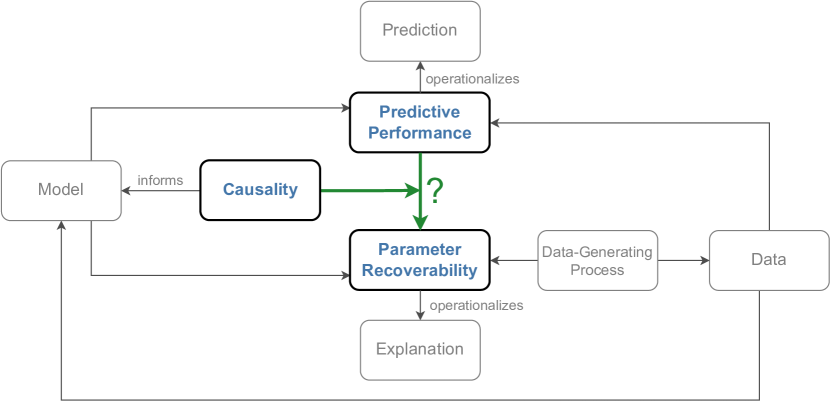
- To investigate the relationship between predictive performance and parameter recoverability (explanation) under various causal and statistical misspecifications.
- To assess whether causality serves as the missing link connecting prediction and explanation in statistical modeling.
- To develop and validate a simulation framework for studying Bayesian model performance under controlled causal structures.
- To provide empirical evidence on the conditions under which model selection based on prediction yields models that also explain the underlying data-generating process.
Proposed method
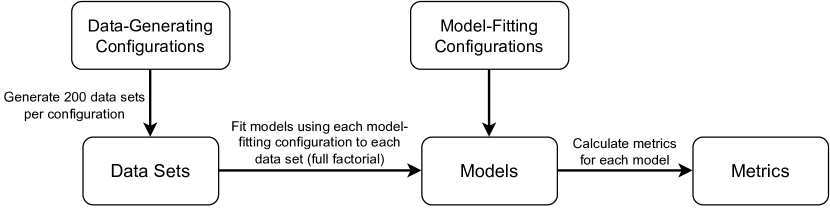
- Conducting large-scale simulations of Bayesian generalized linear models under controlled, known data-generating processes (DGPs).
- Systematically varying causal structures and statistical assumptions to assess model performance under misspecification.
- Measuring predictive performance (PP) using out-of-sample prediction accuracy and parameter recoverability (PR) as a proxy for explanation.
- Comparing PP and PR across models with different causal assumptions to evaluate their relationship.
- Using R packages developed for simulation studies to ensure reproducibility and scalability of the experimental setup.
- Applying cross-validation and out-of-sample prediction metrics to evaluate predictive performance while accounting for model uncertainty.
Experimental results
Research questions
- RQ1Under what conditions is prediction a valid proxy for explanation in Bayesian model selection?
- RQ2How does causal consistency between the assumed and true data-generating process affect the relationship between prediction and explanation?
- RQ3Does improved predictive performance necessarily imply better parameter recoverability when causal structures differ?
- RQ4How do different likelihood shapes in the data-generating process influence the prediction-explanation relationship?
- RQ5To what extent do prior distributions or regularization affect the link between prediction and explanation in model evaluation?
Key findings
- Prediction can be safely used as a proxy for explanation only when models are causally consistent with the true data-generating process.
- When causal structures are consistent, improved prediction is associated with improved explanation, indicating a strong link between the two.
- In the presence of causal misspecification—such as including colliders—prediction may improve while explanation deteriorates, undermining the proxy assumption.
- The relationship between prediction and explanation breaks down when models differ in their underlying causal assumptions, even if all are unbiased.
- Floor and ceiling effects in certain scenarios (e.g., true/false positive rates) limited the interpretability of results in extreme cases, though overall conclusions remained robust.
- The findings suggest that causality is the key factor determining whether prediction reliably reflects explanatory power in model selection.
Read this paper
Open the full text in the Nubint reader and ask about any passage as you read.
Read this paper on NubintThis review was generated by AI from the original paper. Please check the paper before citing it.