
[Paper Review] Preprocessing Enhanced Image Compression for Machine Vision
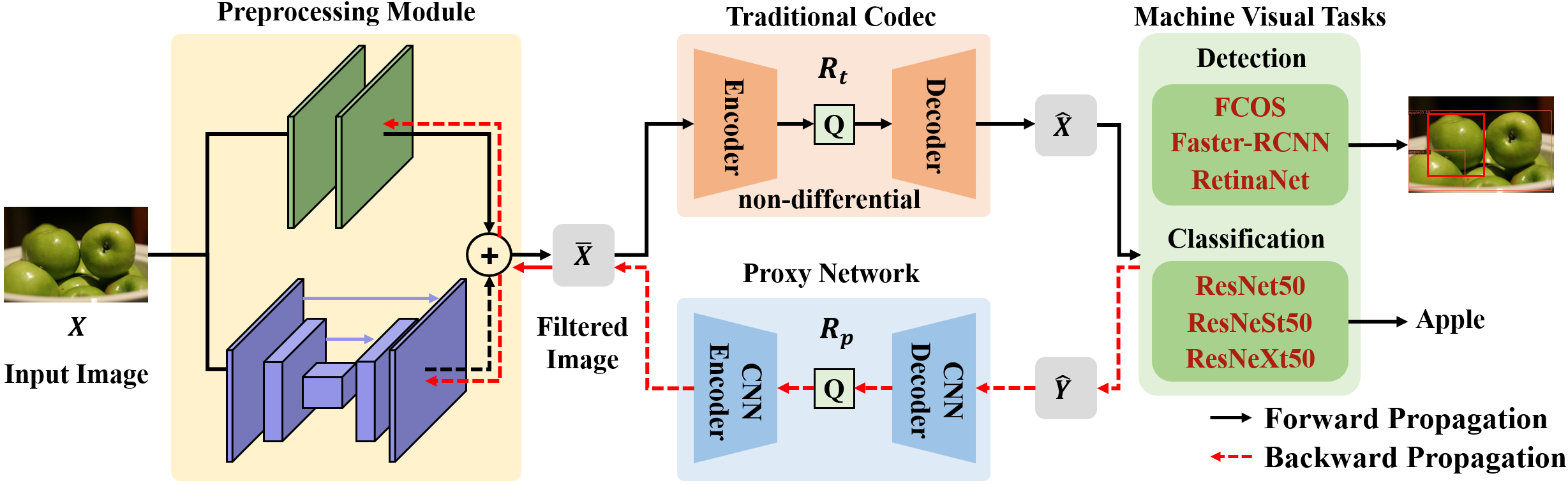
This paper proposes a preprocessing-enhanced image compression framework that integrates a neural preprocessing module (NPP) before standard codecs like BPG and JPEG to optimize for machine vision tasks. By using a proxy network to enable end-to-end backpropagation through non-differentiable codecs, the method achieves ~20% bitrate reduction over BPG while maintaining or improving downstream detection and classification performance, with strong generalization across codecs, backbones, and tasks.
Recently, more and more images are compressed and sent to the back-end devices for the machine analysis tasks~( extit{e.g.,} object detection) instead of being purely watched by humans. However, most traditional or learned image codecs are designed to minimize the distortion of the human visual system without considering the increased demand from machine vision systems. In this work, we propose a preprocessing enhanced image compression method for machine vision tasks to address this challenge. Instead of relying on the learned image codecs for end-to-end optimization, our framework is built upon the traditional non-differential codecs, which means it is standard compatible and can be easily deployed in practical applications. Specifically, we propose a neural preprocessing module before the encoder to maintain the useful semantic information for the downstream tasks and suppress the irrelevant information for bitrate saving. Furthermore, our neural preprocessing module is quantization adaptive and can be used in different compression ratios. More importantly, to jointly optimize the preprocessing module with the downstream machine vision tasks, we introduce the proxy network for the traditional non-differential codecs in the back-propagation stage. We provide extensive experiments by evaluating our compression method for two representative downstream tasks with different backbone networks. Experimental results show our method achieves a better trade-off between the coding bitrate and the performance of the downstream machine vision tasks by saving about 20% bitrate.
Motivation & Objective
- Address the gap in traditional image codecs, which optimize for human visual quality (e.g., PSNR) rather than machine vision performance.
- Overcome the non-differentiable nature of standard codecs (e.g., BPG, JPEG) that prevents joint optimization with deep learning models.
- Develop a generalizable, standard-compatible compression pipeline that enhances machine perception without requiring learned end-to-end codecs.
- Enable quantization-adaptive preprocessing to support variable compression ratios across different QP settings.
- Demonstrate the effectiveness of the framework across diverse downstream tasks (object detection, image classification) and backbone networks.
Proposed method
- Introduce a neural preprocessing module (NPP) that filters input images before standard codec encoding to preserve machine-relevant semantic features and suppress irrelevant content.
- Use a proxy network to approximate the non-differentiable behavior of traditional codecs (e.g., BPG) during backpropagation, enabling gradient flow to the NPP module.
- Train the NPP end-to-end with downstream machine vision tasks using the proxy network, optimizing for both low bitrate and high task accuracy.
- Design the NPP module to be quantization-adaptive, allowing it to work across different QP values in BPG without retraining.
- Apply the same NPP model trained on BPG to JPEG with no fine-tuning, demonstrating transferability across codecs.
- Use a proxy network that mimics the BPG decoding process in the forward pass, while still allowing gradients to backpropagate through the NPP for optimization.

Experimental results
Research questions
- RQ1Can a neural preprocessing module improve machine vision performance when used with standard, non-differentiable codecs like BPG and JPEG?
- RQ2How effective is the proxy network in enabling end-to-end training of the NPP module through non-differentiable codecs?
- RQ3To what extent can a single NPP model generalize across different compression ratios (QP values) and downstream tasks?
- RQ4Can an NPP model trained for one task (e.g., object detection) be effectively transferred to another (e.g., image classification) without fine-tuning?
- RQ5How does the proposed method compare to standard codecs in terms of bitrate savings while maintaining or improving downstream task accuracy?
Key findings
- The proposed method achieves approximately 20% bitrate reduction compared to BPG for both object detection and image classification tasks while maintaining the same model accuracy.
- The NPP module trained on BPG generalizes well to JPEG without fine-tuning, achieving over 8.5% bitrate savings compared to standard JPEG.
- Transfer learning between tasks (e.g., using a detection-optimized NPP for classification) results in more than 10% bitrate reduction, demonstrating strong cross-task generalization.
- The proxy network enables effective backpropagation through BPG, allowing the NPP to be jointly optimized with downstream tasks, which is not feasible with standard codecs.
- The NPP module introduces minimal computational overhead, with only 5.17ms inference time on 224×224 images and 9.42M parameters, making it practical for real-world deployment.
- While PSNR and MS-SSIM drop due to task-specific optimization, perceptual metrics like LPIPS show a narrowing gap—our method uses only 8% more bitrate than BPG in LPIPS terms, indicating acceptable visual quality trade-offs.
Read this paper
Open the full text in the Nubint reader and ask about any passage as you read.
Read this paper on NubintThis review was generated by AI from the original paper. Please check the paper before citing it.