
[Paper Review] Probability estimation and structured output prediction for learning preferences in last mile delivery
This paper proposes a two-stage approach for learning driver and planner preferences in last-mile delivery by first estimating zone transition probabilities using a Markovian model and then applying structured output prediction to optimize stop-level routing with zone penalties. The method improves routing quality over baseline TSP using travel times alone, with structured prediction further enhancing performance by tuning penalty weights.
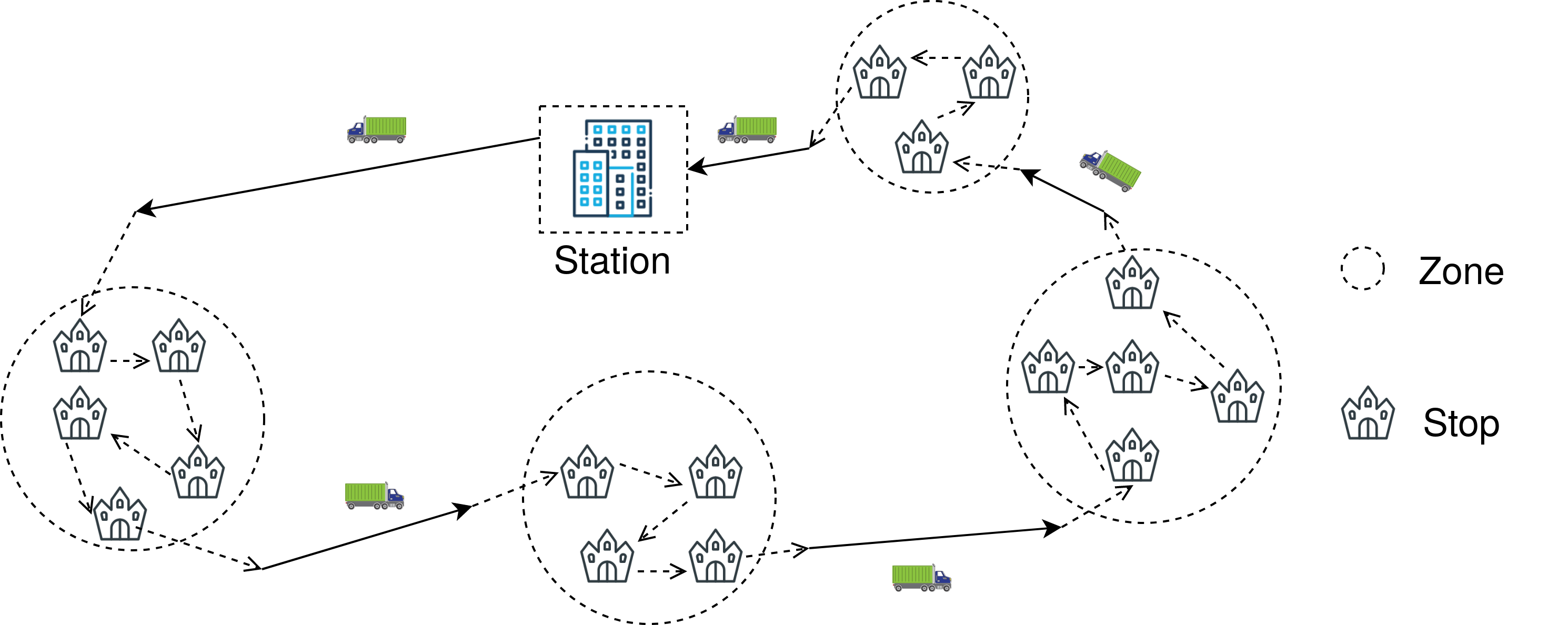
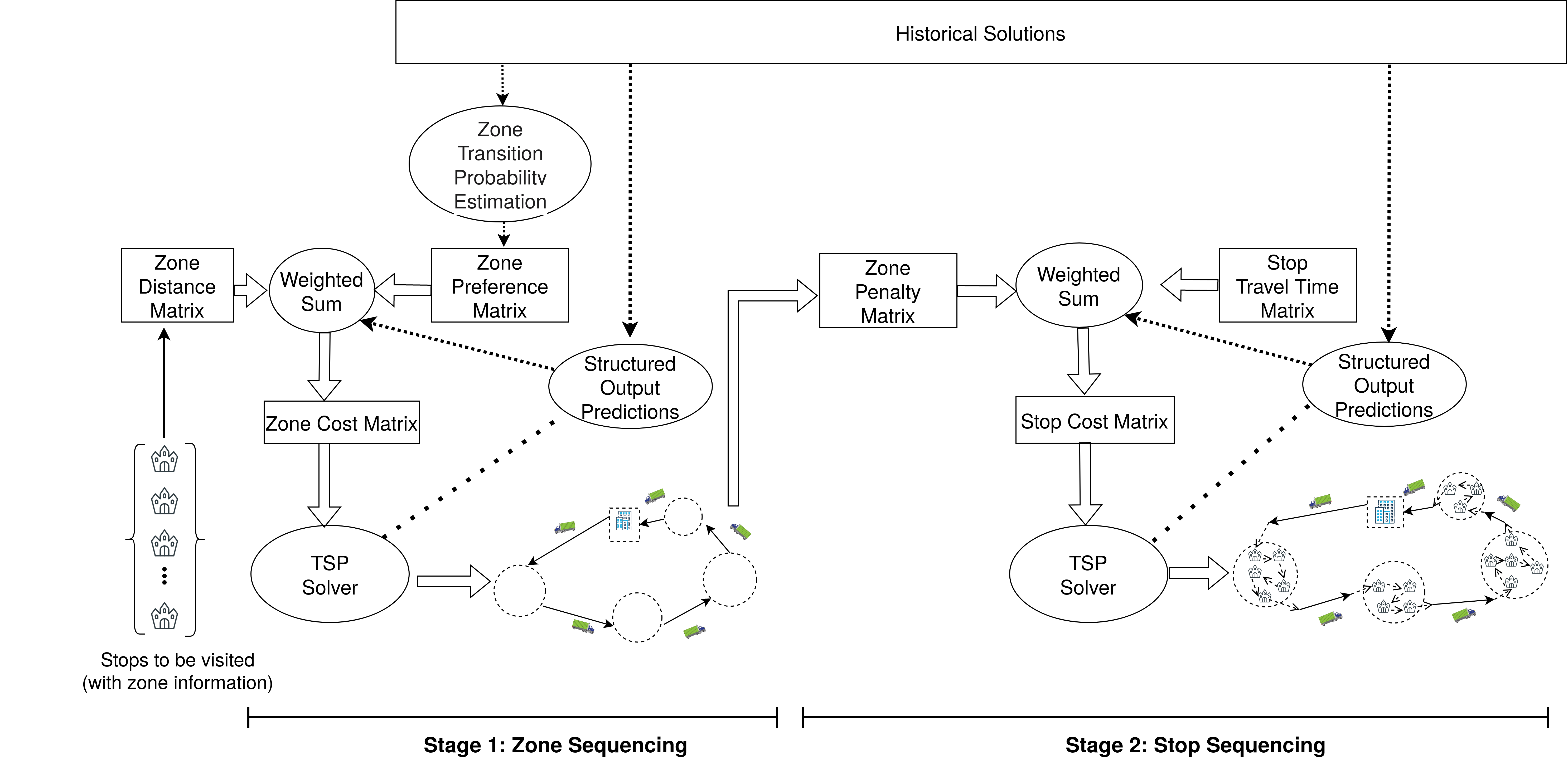
We study the problem of learning the preferences of drivers and planners in the context of last mile delivery. Given a data set containing historical decisions and delivery locations, the goal is to capture the implicit preferences of the decision-makers. We consider two ways to use the historical data: one is through a probability estimation method that learns transition probabilities between stops (or zones). This is a fast and accurate method, recently studied in a VRP setting. Furthermore, we explore the use of machine learning to infer how to best balance multiple objectives such as distance, probability and penalties. Specifically, we cast the learning problem as a structured output prediction problem, where training is done by repeatedly calling the TSP solver. Another important aspect we consider is that for last-mile delivery, every address is a potential client and hence the data is very sparse. Hence, we propose a two-stage approach that first learns preferences at the zone level in order to compute a zone routing; after which a penalty-based TSP computes the stop routing. Results show that the zone transition probability estimation performs well, and that the structured output prediction learning can improve the results further. We hence showcase a successful combination of both probability estimation and machine learning, all the while using standard TSP solvers, both during learning and to compute the final solution; this means the methodology is applicable to other, real-life, TSP variants, or proprietary solvers.
Motivation & Objective
- To model implicit preferences of drivers and planners in last-mile delivery using historical routing decisions.
- To address data sparsity in stop-level preference learning by clustering stops into zones.
- To develop a two-stage TSP framework that learns zone-level preferences first, then stop-level routing with zone penalties.
- To combine probability estimation and structured output prediction to optimize multi-objective routing.
- To ensure compatibility with standard or proprietary TSP solvers by using them as black boxes during learning and inference.
Proposed method
- Use historical data of daily delivery routes to estimate zone transition probabilities via a Markovian model, treating zone sequences as Markov chains.
- Construct a zone-level objective function combining travel distances and estimated transition probabilities to generate preference-aligned zone sequences.
- Apply structured output prediction (SOP) to learn optimal weights for a linear preference function over distances and transition probabilities using gradient descent.
- In the second stage, solve a TSP at the stop level with a cost matrix that includes travel times and zone transition penalties derived from the learned zone order.
- Use a black-box TSP solver in every SOP update step to evaluate candidate solutions and compute gradients for weight optimization.
- Implement a two-stage pipeline: first learn zone routing via probability estimation, then compute stop routing via penalty-based TSP with learned weights.
Experimental results
Research questions
- RQ1Can zone-level transition probabilities be effectively estimated from sparse historical routing data to model driver preferences?
- RQ2How well does combining zone transition probabilities with travel distances improve zone-level routing compared to distance-only routing?
- RQ3Can structured output prediction effectively learn optimal penalty weights for zone transitions in stop-level TSP routing?
- RQ4Does the two-stage approach—first zone-level learning, then stop-level routing with penalties—outperform conventional TSP using only travel times?
- RQ5To what extent can the method be applied to real-world TSP variants or proprietary solvers without requiring architectural changes?
Key findings
- The zone transition probability estimation method significantly outperforms distance-only routing in generating high-quality zone sequences.
- The structured output prediction method further improves results by learning optimal penalty weights, especially reducing same-zone penalties and adjusting previous/next zone weights.
- The combination of Markov-based zone estimation and SOP-based stop-level optimization achieved the best performance, with stop scores closer to zero in the histogram distribution.
- Using zone penalties derived from a distance-based zone ordering already improved results over pure distance-based TSP, indicating the value of zone-level preferences.
- The two-stage approach with both probability estimation and structured prediction led to higher-quality stop sequences than any single method alone.
- The method remains compatible with any TSP solver, as it uses the solver as a black box during both learning and solution generation.
Read this paper
Open the full text in the Nubint reader and ask about any passage as you read.
Read this paper on NubintThis review was generated by AI from the original paper. Please check the paper before citing it.