
[Paper Review] PromptCBLUE: A Chinese Prompt Tuning Benchmark for the Medical Domain
PromptCBLUE introduces the first Chinese prompt tuning benchmark for medical NLP, reimagining the CBLUE benchmark to evaluate multi-task capabilities of Chinese LLMs across medical entity recognition, text classification, natural language inference, dialogue understanding, and generation. It demonstrates that fine-tuned open-source LLMs outperform even GPT-4 in some tasks, and that chain-of-thought prompting and structured output design significantly improve performance.
Biomedical language understanding benchmarks are the driving forces for artificial intelligence applications with large language model (LLM) back-ends. However, most current benchmarks: (a) are limited to English which makes it challenging to replicate many of the successes in English for other languages, or (b) focus on knowledge probing of LLMs and neglect to evaluate how LLMs apply these knowledge to perform on a wide range of bio-medical tasks, or (c) have become a publicly available corpus and are leaked to LLMs during pre-training. To facilitate the research in medical LLMs, we re-build the Chinese Biomedical Language Understanding Evaluation (CBLUE) benchmark into a large scale prompt-tuning benchmark, PromptCBLUE. Our benchmark is a suitable test-bed and an online platform for evaluating Chinese LLMs' multi-task capabilities on a wide range bio-medical tasks including medical entity recognition, medical text classification, medical natural language inference, medical dialogue understanding and medical content/dialogue generation. To establish evaluation on these tasks, we have experimented and report the results with the current 9 Chinese LLMs fine-tuned with differtent fine-tuning techniques.
Motivation & Objective
- To address the lack of high-quality, non-leaked, multi-task benchmarks for Chinese medical LLMs.
- To overcome limitations of existing benchmarks that are English-only, focused on knowledge probing, or contaminated by pre-training data.
- To establish a standardized, online evaluation platform for Chinese medical LLMs using prompt tuning.
- To provide a comprehensive baseline evaluation across diverse medical NLP tasks using state-of-the-art Chinese LLMs and fine-tuning methods.
Proposed method
- Rebuilt the CBLUE benchmark into a prompt-tuning-focused dataset with 82,600 samples across 5 medical NLP tasks.
- Kept test set labels private and non-public to prevent data leakage, ensuring generalization evaluation.
- Hosted the benchmark on an online platform with leaderboard support for real-time model evaluation.
- Applied five prompt tuning techniques: P-tuning, P-tuning-v2, Adapter, LoRA, and AdaLoRA, with consistent hyper-parameters.
- Used a unified training setup across all methods: batch size 64, initial LR 3e-4, weight decay 1e-4, AdamW optimizer, linear decay schedule.
- Selected model checkpoints 200 steps after the lowest validation loss to improve inference quality.
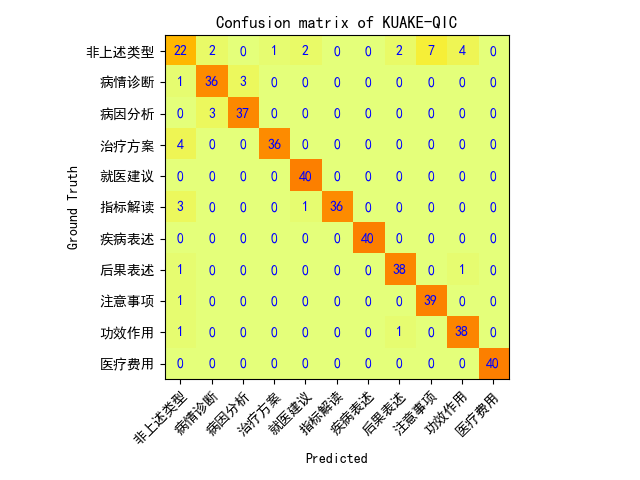
Experimental results
Research questions
- RQ1Can prompt tuning effectively evaluate the multi-task capabilities of Chinese medical LLMs across diverse biomedical NLP tasks?
- RQ2How do fine-tuned open-source LLMs compare to proprietary models like GPT-4 in Chinese medical reasoning and extraction tasks?
- RQ3To what extent do chain-of-thought prompting and structured output formats improve performance on medical information extraction?
- RQ4Does further pre-training on medical domain data significantly improve LLM performance in the current few-shot prompt tuning regime?
- RQ5What are the failure patterns of LLMs in medical dialogue and reasoning tasks, and how can they be mitigated?
Key findings
- Fine-tuned open-source LLMs outperform both ChatGPT and GPT-4 on several tasks in the PromptCBLUE benchmark, indicating that fine-tuning remains essential despite model scale.
- Chain-of-thought prompting and explicit output format design significantly improve performance on medical entity recognition and information extraction tasks.
- Further pre-training on medical data did not yield consistent performance gains, contrasting with findings from the BERT era.
- The best-performing models achieved a test F1 score of 71.10 on the total PromptCBLUE benchmark, with task-specific scores ranging from 27.71 (MedDG) to 105.08 (S-V2-MRG).
- Case studies revealed that LLMs often fail in complex reasoning and dialogue coherence, especially when handling multi-turn medical consultations with conflicting symptoms.
- The benchmark is released with code and an online evaluation platform to support ongoing research and community contributions.
Read this paper
Open the full text in the Nubint reader and ask about any passage as you read.
Read this paper on NubintThis review was generated by AI from the original paper. Please check the paper before citing it.