
[Paper Review] PromptStyler: Prompt-driven Style Generation for Source-free Domain Generalization
PromptStyler proposes a prompt-driven style generation method for source-free domain generalization that synthesizes diverse image styles in a joint vision-language space using learnable style word vectors, without requiring any source domain images. By maximizing style diversity and preserving content consistency in CLIP's latent space, it achieves state-of-the-art performance on PACS, VLCS, OfficeHome, and DomainNet benchmarks.
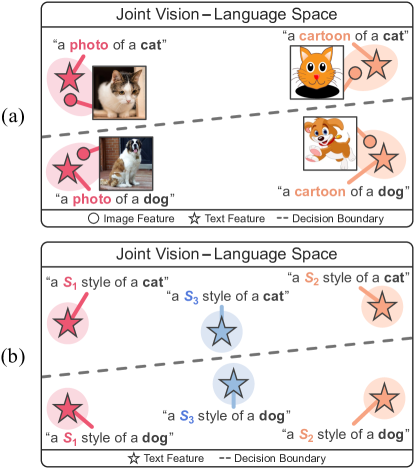
In a joint vision-language space, a text feature (e.g., from "a photo of a dog") could effectively represent its relevant image features (e.g., from dog photos). Also, a recent study has demonstrated the cross-modal transferability phenomenon of this joint space. From these observations, we propose PromptStyler which simulates various distribution shifts in the joint space by synthesizing diverse styles via prompts without using any images to deal with source-free domain generalization. The proposed method learns to generate a variety of style features (from "a S* style of a") via learnable style word vectors for pseudo-words S*. To ensure that learned styles do not distort content information, we force style-content features (from "a S* style of a [class]") to be located nearby their corresponding content features (from "[class]") in the joint vision-language space. After learning style word vectors, we train a linear classifier using synthesized style-content features. PromptStyler achieves the state of the art on PACS, VLCS, OfficeHome and DomainNet, even though it does not require any images for training.
Motivation & Objective
- To address the challenge of domain generalization when no source domain data is available during training.
- To simulate diverse distribution shifts in the latent space of a pre-trained vision-language model without accessing real images.
- To preserve content information while generating diverse, realistic styles through learnable style word vectors.
- To achieve state-of-the-art performance on multiple domain generalization benchmarks using only text prompts and pre-trained features.
Proposed method
- Learns style word vectors for pseudo-words $\boldsymbol{S_{*}}$ to generate style features via prompts like 'a $\boldsymbol{S_{*}}$ style of a [class]' in a joint vision-language space.
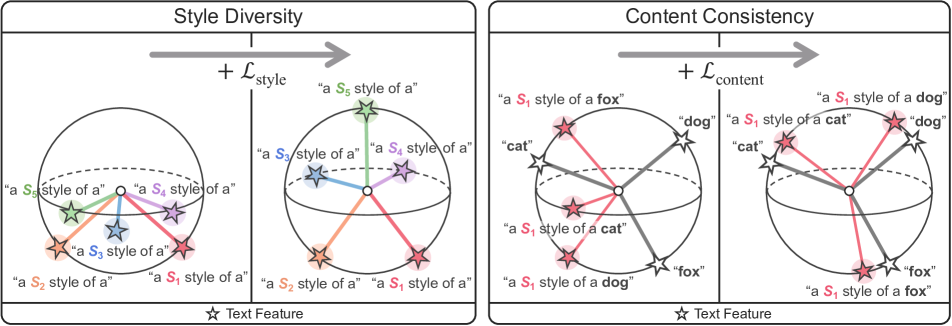
- Maximizes style diversity by encouraging orthogonal style features in the hyperspherical latent space using $\mathcal{L}_{\mathrm{style}}$.
- Enforces content consistency by ensuring style-content features remain close to their corresponding content features using $\mathcal{L}_{\mathrm{content}}$.
- Trains a linear classifier on synthesized style-content features using class labels from content prompts, enabling inference on real images via image encoders.
- Uses CLIP's pre-trained text and image encoders to project prompts and images into a shared embedding space.
- Optimizes style word vectors using both style diversity and content consistency losses, enabling effective domain shift simulation without real data.
Experimental results
Research questions
- RQ1Can we effectively simulate domain shifts in the latent space of a pre-trained vision-language model without using any source domain images?
- RQ2How can we generate diverse yet content-preserving styles using only learnable word vectors and text prompts?
- RQ3Can a prompt-driven approach achieve state-of-the-art performance in source-free domain generalization?
- RQ4What is the impact of style diversity and content consistency on model generalization in zero-shot domain adaptation settings?
Key findings
- PromptStyler achieves state-of-the-art accuracy on PACS (93.2%), VLCS (82.3%), OfficeHome (73.6%), and DomainNet (49.5%) without using any source domain images.
- The method outperforms CLIP by a large margin on all benchmarks, including a 30.5% top-1 accuracy on Terra Incognita, despite not using any source data.
- Using only 5 learned style word vectors, PromptStyler already surpasses CLIP's performance, indicating high sample efficiency.
- Abllation studies confirm that both $\mathcal{L}_{\mathrm{style}}$ and $\mathcal{L}_{\mathrm{content}}$ are essential: omitting either leads to degraded performance.
- The method achieves optimal performance with just 20 style word vectors and 20 training iterations per vector, indicating fast convergence and low computational cost.
- The use of ArcFace loss further improves accuracy over standard Softmax, demonstrating the benefit of hyperspherical embedding optimization.
Read this paper
Open the full text in the Nubint reader and ask about any passage as you read.
Read this paper on NubintThis review was generated by AI from the original paper. Please check the paper before citing it.