
[Paper Review] Pure Message Passing Can Estimate Common Neighbor for Link Prediction
This paper demonstrates that pure message passing in Graph Neural Networks can effectively estimate Common Neighbor (CN) features for link prediction by leveraging quasi-orthogonal node vectors. The proposed Message Passing Link Predictor (MPLP) outperforms state-of-the-art methods on benchmark datasets by approximating joint structural features through inner products of propagated quasi-orthogonal vectors.
Message Passing Neural Networks (MPNNs) have emerged as the {\em de facto} standard in graph representation learning. However, when it comes to link prediction, they often struggle, surpassed by simple heuristics such as Common Neighbor (CN). This discrepancy stems from a fundamental limitation: while MPNNs excel in node-level representation, they stumble with encoding the joint structural features essential to link prediction, like CN. To bridge this gap, we posit that, by harnessing the orthogonality of input vectors, pure message-passing can indeed capture joint structural features. Specifically, we study the proficiency of MPNNs in approximating CN heuristics. Based on our findings, we introduce the Message Passing Link Predictor (MPLP), a novel link prediction model. MPLP taps into quasi-orthogonal vectors to estimate link-level structural features, all while preserving the node-level complexities. Moreover, our approach demonstrates that leveraging message-passing to capture structural features could offset MPNNs' expressiveness limitations at the expense of estimation variance. We conduct experiments on benchmark datasets from various domains, where our method consistently outperforms the baseline methods.
Motivation & Objective
- To investigate whether pure message-passing GNNs can approximate heuristic link prediction features like Common Neighbor (CN), despite their permutation invariance.
- To address the limitation of MPNNs in capturing joint structural features such as CN, which are critical for link prediction.
- To develop a novel link prediction model that leverages message passing to estimate CN-like features without relying on explicit heuristics.
- To establish a new paradigm where message passing encodes link-level structural information through vector orthogonality and inner products.
- To empirically validate that the proposed method surpasses existing GNN-based and heuristic link prediction models.
Proposed method
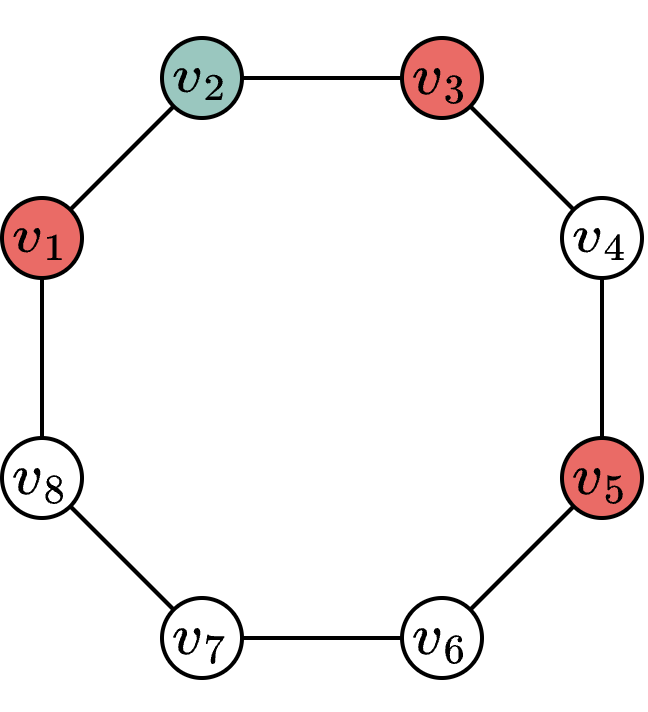
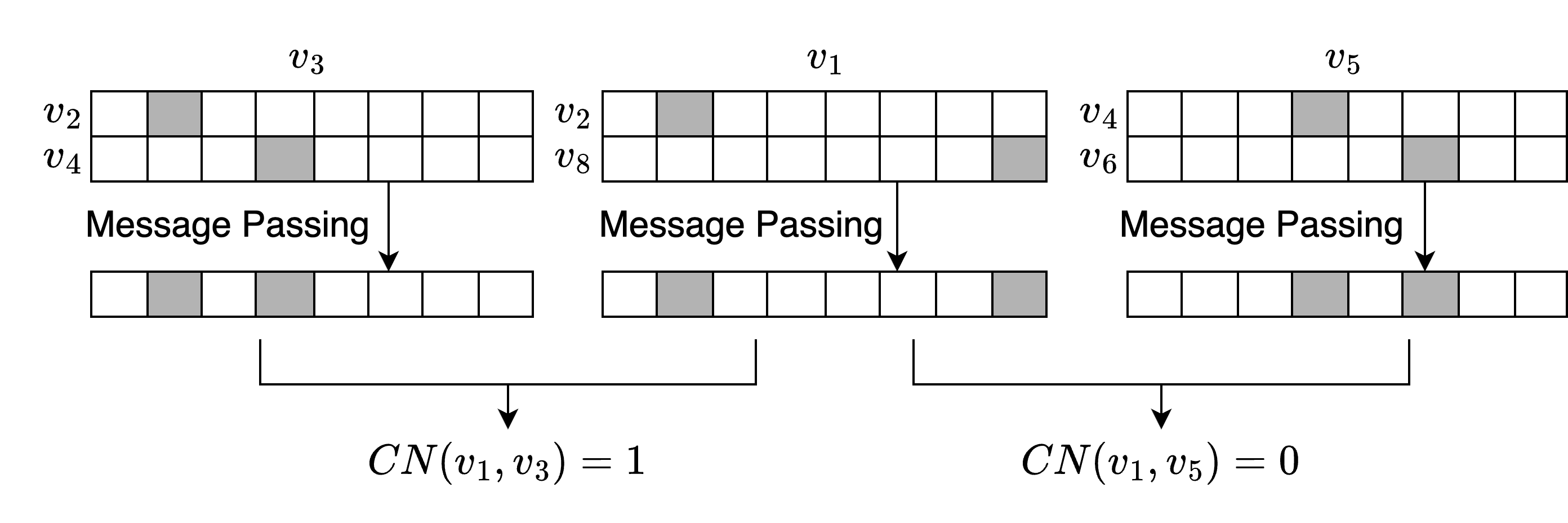
- Assigns quasi-orthogonal (QO) vectors to nodes as initial representations, exploiting the exponential growth of almost-orthogonal vector families in high-dimensional space.
- Uses standard message passing to propagate these QO vectors, where each node aggregates the vectors of its neighbors through summation.
- Estimates the Common Neighbor count between two nodes as the inner product of their final hidden representations after message passing.
- Theoretically justifies that the expected inner product of node representations approximates the number of common neighbors, with variance bounded by graph structure.
- Introduces a training strategy that removes shortcut edges for positive links to ensure accurate estimation of structural features during learning.
- Employs a modified training procedure to avoid distribution shift and improve generalization, with a variant (MPLP+) that reduces computational cost at the expense of performance.
Experimental results
Research questions
- RQ1Can pure message-passing GNNs approximate the Common Neighbor heuristic, a fundamental link prediction feature, without explicit design for it?
- RQ2To what extent does the orthogonality of node representations enable message-passing networks to capture joint structural features like CN?
- RQ3How does the variance of the inner product estimation depend on graph structure, particularly in dense or hub-rich graphs?
- RQ4Can a message-passing model achieve state-of-the-art performance in link prediction by estimating CN through vector operations alone?
- RQ5What are the trade-offs between training cost and inference accuracy in such a message-passing framework?
Key findings
- The expected inner product of node representations after message passing approximates the true Common Neighbor count, with theoretical bounds on variance.
- The method achieves state-of-the-art performance on multiple benchmark datasets, consistently outperforming both GNN baselines and heuristic methods like CN.
- The variance of the estimation increases in dense graphs or those with high-degree hubs, indicating structural sensitivity.
- Despite the theoretical and empirical success, the training cost of MPLP is significantly higher than inference due to dynamic graph structure changes during training.
- A variant, MPLP+, reduces training cost by masking positive links but shows suboptimal performance, suggesting a trade-off between efficiency and accuracy.
- The study establishes that pure message passing can encode link-level structural features, challenging the assumption that MPNNs inherently lack such capability.
Read this paper
Open the full text in the Nubint reader and ask about any passage as you read.
Read this paper on NubintThis review was generated by AI from the original paper. Please check the paper before citing it.