
[Paper Review] Putting the Object Back into Video Object Segmentation
Cutie proposes a video object segmentation (VOS) network that uses object-level memory reading via a query-based object transformer to improve robustness in challenging scenarios with occlusions and distractors. By combining high-level object queries with high-resolution pixel features and foreground-background masked attention, Cutie achieves 8.7 J&F improvement over XMem and 4.2 J&F over DeAOT on the MOSE dataset while running three times faster than DeAOT.
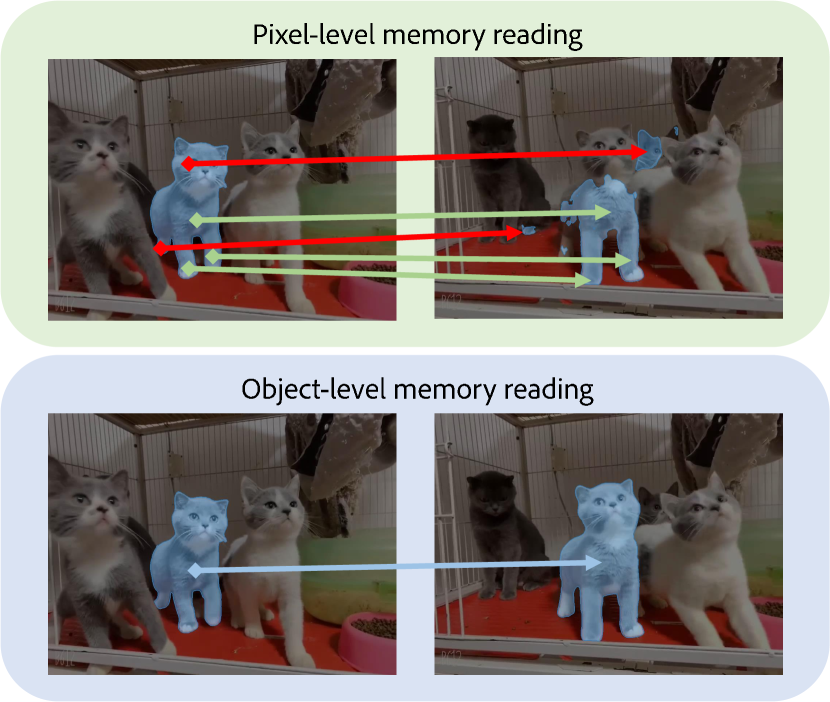
We present Cutie, a video object segmentation (VOS) network with object-level memory reading, which puts the object representation from memory back into the video object segmentation result. Recent works on VOS employ bottom-up pixel-level memory reading which struggles due to matching noise, especially in the presence of distractors, resulting in lower performance in more challenging data. In contrast, Cutie performs top-down object-level memory reading by adapting a small set of object queries. Via those, it interacts with the bottom-up pixel features iteratively with a query-based object transformer (qt, hence Cutie). The object queries act as a high-level summary of the target object, while high-resolution feature maps are retained for accurate segmentation. Together with foreground-background masked attention, Cutie cleanly separates the semantics of the foreground object from the background. On the challenging MOSE dataset, Cutie improves by 8.7 J&F over XMem with a similar running time and improves by 4.2 J&F over DeAOT while being three times faster. Code is available at: https://hkchengrex.github.io/Cutie
Motivation & Objective
- To address the limitations of pixel-level memory reading in VOS, which suffers from matching noise and poor generalization under distractors and occlusions.
- To introduce object-level reasoning into video object segmentation by modeling the target object as learnable queries that interact with pixel-level features.
- To improve long-term tracking robustness and semantic separation between foreground and background using a compact object memory and masked attention.
- To maintain high inference efficiency while significantly outperforming state-of-the-art methods on challenging benchmarks like MOSE.
Proposed method
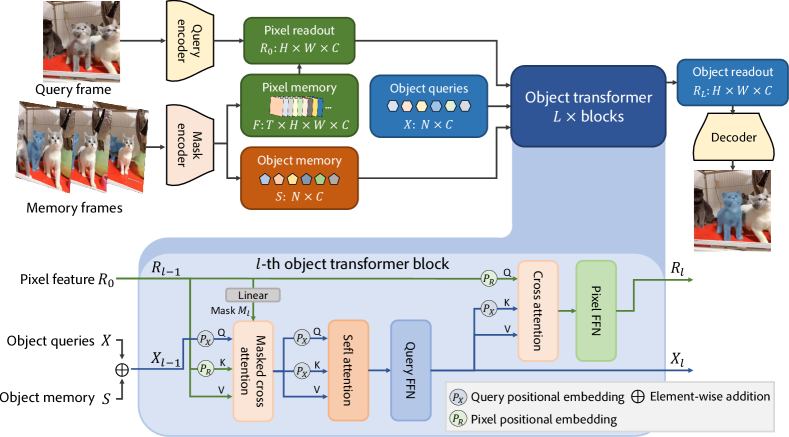
- Cutie employs a query-based object transformer (qt) that iteratively refines a pixel-level memory readout using a small set of learnable object queries for top-down guidance.
- The model uses a dual memory mechanism: a pixel memory for low-level feature retrieval and a compact object memory that summarizes target-specific features for long-term representation.
- Foreground-background masked attention is introduced, allowing separate attention flows for foreground and background, enabling clean semantic separation and richer feature interaction.
- Object queries are updated via cross-attention with the pixel-level readout, enabling bidirectional communication between high-level object concepts and low-level spatial details.
- The decoder uses a reduced-channel architecture (128 channels) with skip connections and upsampling blocks to efficiently reconstruct high-resolution segmentation masks.
- The network is trained end-to-end with a cross-entropy loss focused on uncertain regions, similar to XMem and DeAOT, but enhanced by the object query refinement process.
Experimental results
Research questions
- RQ1Can object-level reasoning improve robustness in video object segmentation under heavy occlusion and distractor conditions?
- RQ2How does object-level memory reading compare to traditional pixel-level matching in terms of segmentation accuracy and noise resilience?
- RQ3Can a compact object memory effectively maintain long-term target representations without degrading inference speed?
- RQ4Does foreground-background masked attention improve semantic separation and reduce background confusion in complex scenes?
Key findings
- Cutie achieves a +8.7 J&F improvement over XMem on the challenging MOSE dataset, demonstrating significant gains in robustness to distractors and occlusions.
- Cutie improves by 4.2 J&F over DeAOT on MOSE while running three times faster, indicating superior efficiency-accuracy trade-off.
- The model maintains competitive performance on standard benchmarks like DAVIS-2017 and YouTubeVOS, confirming generalization across datasets.
- The use of object queries and masked attention leads to cleaner foreground-background separation, reducing false positives in cluttered scenes.
- Reducing decoder channels from 256 to 128 does not degrade performance, confirming that improved feature quality from the object transformer compensates for reduced capacity.
- The compact object memory enables stable long-term tracking without retraining, and can be reused across multiple objects with no additional cost.
Read this paper
Open the full text in the Nubint reader and ask about any passage as you read.
Read this paper on NubintThis review was generated by AI from the original paper. Please check the paper before citing it.