
[Paper Review] QMoE: Practical Sub-1-Bit Compression of Trillion-Parameter Models
QMoE introduces a scalable compression framework that achieves sub-1-bit quantization (0.8 bits per parameter) of trillion-parameter Mixture-of-Experts (MoE) models like SwitchTransformer-c2048, reducing model size from 3.2TB (bfloat16) to under 160GB with minimal accuracy loss. It enables efficient, end-to-end inference on a single commodity GPU server with less than 5% runtime overhead via a custom compression format and optimized GPU kernels.
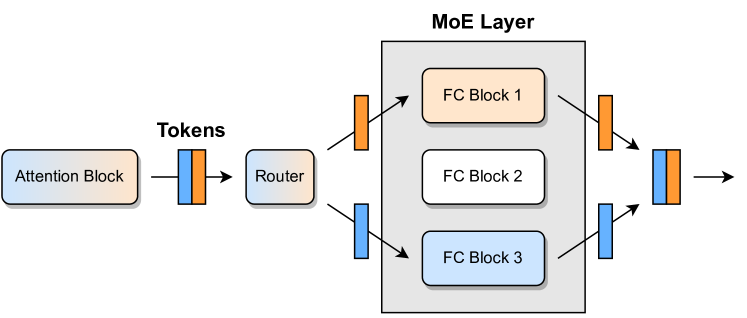
Mixture-of-Experts (MoE) architectures offer a general solution to the high inference costs of large language models (LLMs) via sparse routing, bringing faster and more accurate models, at the cost of massive parameter counts. For example, the SwitchTransformer-c2048 model has 1.6 trillion parameters, requiring 3.2TB of accelerator memory to run efficiently, which makes practical deployment challenging and expensive. In this paper, we present a solution to this memory problem, in form of a new compression and execution framework called QMoE. Specifically, QMoE consists of a scalable algorithm which accurately compresses trillion-parameter MoEs to less than 1 bit per parameter, in a custom format co-designed with bespoke GPU decoding kernels to facilitate efficient end-to-end compressed inference, with minor runtime overheads relative to uncompressed execution. Concretely, QMoE can compress the 1.6 trillion parameter SwitchTransformer-c2048 model to less than 160GB (20x compression, 0.8 bits per parameter) at only minor accuracy loss, in less than a day on a single GPU. This enables, for the first time, the execution of a trillion-parameter model on affordable commodity hardware, like a single server with 4x NVIDIA A6000 or 8x NVIDIA 3090 GPUs, at less than 5% runtime overhead relative to ideal uncompressed inference. The source code and compressed models are available at github.com/IST-DASLab/qmoe.
Motivation & Objective
- Address the high memory and computational cost of trillion-parameter Mixture-of-Experts (MoE) models, which limits practical deployment and research access.
- Overcome the challenge of achieving accurate compression below 1 bit per parameter, a barrier for existing post-training quantization techniques.
- Design a scalable, retraining-free compression pipeline that maintains model accuracy while enabling efficient on-device inference on commodity hardware.
- Develop a custom compression format and GPU-optimized decoding kernels to enable fast, low-overhead inference of compressed MoE models.
- Demonstrate the feasibility of running massive MoE models like SwitchTransformer-c2048 on a single server with 4x A6000 or 8x 3090 GPUs, enabling broader research and deployment.
Proposed method
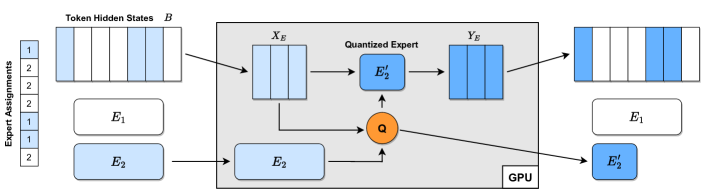
- Propose a scalable, retraining-free compression algorithm that quantizes MoE weights to less than 1 bit per parameter using a custom compression format designed for low-bitwidth sparsity and accelerator efficiency.
- Design a bespoke GPU kernel for on-the-fly decompression and inference, minimizing runtime overhead by exploiting natural sparsity in low-bit quantized weights.
- Co-design the compression format and decoding kernels to ensure compatibility with existing HuggingFace-based inference pipelines and GPU memory access patterns.
- Apply the compression pipeline to the 1.6 trillion parameter SwitchTransformer-c2048 model, achieving 20× compression (from 3.2TB to <160GB) using only a single GPU in under a day.
- Optimize the quantization process to preserve model accuracy, with only minor increases in pretraining validation loss and zero-shot evaluation loss.
- Integrate the framework into the HuggingFace ecosystem to ensure broad accessibility and ease of deployment for researchers and practitioners.
Experimental results
Research questions
- RQ1Can trillion-parameter MoE models be compressed to less than 1 bit per parameter without significant accuracy degradation?
- RQ2Is it feasible to achieve sub-1-bit compression of MoE models using retraining-free, post-training quantization techniques?
- RQ3Can a custom compression format and GPU-optimized kernels enable efficient, low-overhead inference of compressed MoE models on commodity hardware?
- RQ4What is the runtime overhead of compressed inference compared to idealized uncompressed execution on high-end hardware?
- RQ5Can the resulting compressed model be deployed and executed end-to-end on a single server with consumer-grade GPUs?
Key findings
- The 1.6 trillion parameter SwitchTransformer-c2048 model was compressed from 3.2TB (bfloat16) to less than 160GB using QMoE, achieving a 20× compression rate and 0.8 bits per parameter.
- The compression was achieved in less than a day on a single GPU using a retraining-free, post-training quantization pipeline with minimal accuracy loss on pretraining validation and zero-shot benchmarks.
- End-to-end inference of the compressed model was successfully executed on a single server with 8× NVIDIA RTX 3090 or 4× NVIDIA A6000 GPUs, demonstrating practical deployment on commodity hardware.
- The runtime overhead of the compressed inference was less than 5% compared to an idealized uncompressed execution, which would require approximately 20× more GPUs.
- The custom compression format and GPU kernels enabled efficient on-the-fly decoding, avoiding slow offloading and maintaining high throughput.
- The QMoE framework is open-source and integrated with HuggingFace, significantly lowering the barrier to entry for research and deployment of large-scale MoE models.
Read this paper
Open the full text in the Nubint reader and ask about any passage as you read.
Read this paper on NubintThis review was generated by AI from the original paper. Please check the paper before citing it.