
[Paper Review] QPGesture: Quantization-Based and Phase-Guided Motion Matching for Natural Speech-Driven Gesture Generation
This paper proposes QPGesture, a quantization-based and phase-guided motion matching framework for natural speech-driven 3D gesture generation. By using a VQ-VAE to compress gestures into discrete units and Levenshtein distance on audio quantization for speech-gesture alignment, it effectively reduces jitter and handles asynchrony; phase guidance further improves naturalness, achieving state-of-the-art performance on the BEAT dataset with superior human-likeness and appropriateness in user studies.
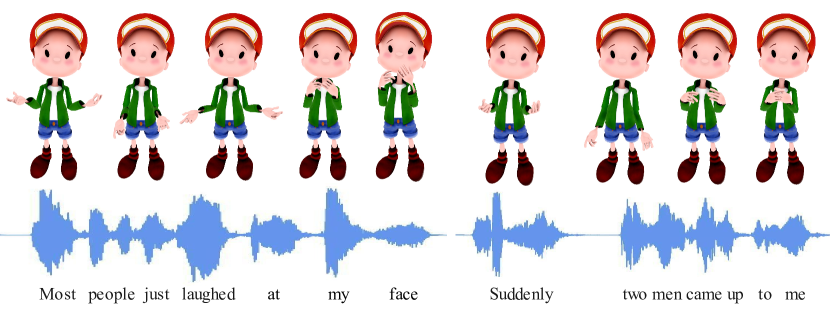
Speech-driven gesture generation is highly challenging due to the random jitters of human motion. In addition, there is an inherent asynchronous relationship between human speech and gestures. To tackle these challenges, we introduce a novel quantization-based and phase-guided motion-matching framework. Specifically, we first present a gesture VQ-VAE module to learn a codebook to summarize meaningful gesture units. With each code representing a unique gesture, random jittering problems are alleviated effectively. We then use Levenshtein distance to align diverse gestures with different speech. Levenshtein distance based on audio quantization as a similarity metric of corresponding speech of gestures helps match more appropriate gestures with speech, and solves the alignment problem of speech and gestures well. Moreover, we introduce phase to guide the optimal gesture matching based on the semantics of context or rhythm of audio. Phase guides when text-based or speech-based gestures should be performed to make the generated gestures more natural. Extensive experiments show that our method outperforms recent approaches on speech-driven gesture generation. Our code, database, pre-trained models, and demos are available at https://github.com/YoungSeng/QPGesture.
Motivation & Objective
- To address random motion jittering in speech-driven gesture generation by learning discrete, meaningful gesture units through unsupervised VQ-VAE.
- To solve the inherent asynchrony between speech and gestures by using Levenshtein distance on audio quantization for robust speech-gesture alignment.
- To improve gesture naturalness by incorporating phase information to guide optimal selection between audio-based and text-based gesture candidates.
- To achieve state-of-the-art performance in both quantitative metrics and human evaluation on the BEAT benchmark dataset.
- To enable controllable gesture generation through discrete code manipulation in the learned codebook space.
Proposed method
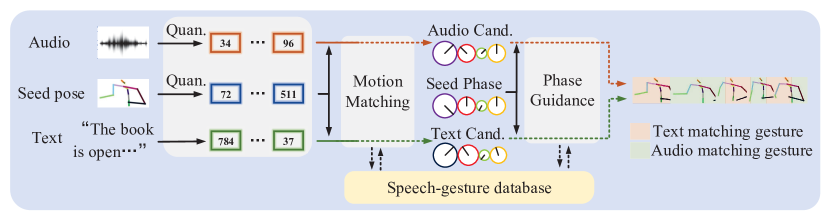
- A VQ-VAE module is used to learn a discrete codebook that represents unique, meaningful gesture poses, reducing input redundancy and mitigating random jittering.
- Audio is quantized using the same codebook, and Levenshtein distance is computed between audio quantization sequences to match gestures to speech with high temporal alignment accuracy.
- Text embeddings are used alongside audio to generate candidate gestures, with cosine similarity measuring textual relevance to the speech context.
- Phase values derived from motion curves are used to guide the selection of the optimal gesture candidate between audio- and text-based options, ensuring rhythmic and semantic consistency.
- The final gesture sequence is generated by selecting the best-matching code from the codebook based on phase-guided fusion of audio and text candidates.
- The framework supports controllable generation by directly manipulating discrete codes in the codebook, enabling targeted gesture editing or synthesis.
Experimental results
Research questions
- RQ1Can a learned discrete codebook effectively represent meaningful gesture units and reduce motion jittering in speech-driven gesture generation?
- RQ2Can Levenshtein distance on audio quantization improve temporal alignment between speech and gestures compared to end-to-end neural networks?
- RQ3Does phase-guided selection between audio- and text-based gesture candidates enhance the naturalness and semantic appropriateness of generated gestures?
- RQ4How does the proposed motion matching framework compare to end-to-end generative models in terms of gesture quality and controllability?
- RQ5To what extent do individual components (audio quantization, phase guidance, text matching) contribute to the overall performance in human evaluation and quantitative metrics?
Key findings
- The proposed QPGesture framework achieves state-of-the-art performance on the BEAT benchmark, outperforming recent neural network-based models in both quantitative metrics and human evaluation.
- User studies show significant improvements in human-likeness and upper-body appropriateness, with the full model achieving high MOS scores comparable to ground truth.
- Ablation studies confirm that removing audio quantization or Levenshtein distance leads to performance drops, validating their critical role in alignment and quality.
- Phase guidance improves gesture naturalness, as shown by reduced Hellinger distance and FGD scores in comparisons without phase guidance, though the effect is subtle.
- The model without motion matching (i.e., using a GRU-based generator) performs significantly worse than the matching-based approach, with a 107% increase in FGD on raw data space.
- The framework enables controllable gesture editing by replacing specific codes in the sequence, demonstrating practical utility in gesture manipulation and interpretation.
Read this paper
Open the full text in the Nubint reader and ask about any passage as you read.
Read this paper on NubintThis review was generated by AI from the original paper. Please check the paper before citing it.