
[Paper Review] Quantum anomaly detection in the latent space of proton collision events at the LHC
The paper proposes an unsupervised quantum machine learning pipeline for anomaly detection in LHC data, using a classical autoencoder to a latent space followed by quantum kernel machines and quantum clustering, and reports a consistent quantum advantage in certain regimes, including a hardware demonstration.
The ongoing quest to discover new phenomena at the LHC necessitates the continuous development of algorithms and technologies. Established approaches like machine learning, along with emerging technologies such as quantum computing show promise in the enhancement of experimental capabilities. In this work, we propose a strategy for anomaly detection tasks at the LHC based on unsupervised quantum machine learning, and demonstrate its effectiveness in identifying new phenomena. The designed quantum models, an unsupervised kernel machine and two clustering algorithms, are trained to detect new-physics events using a latent representation of LHC data, generated by an autoencoder designed to accommodate current quantum hardware limitations on problem size. For kernel-based anomaly detection, we implement an instance of the model on a quantum computer, and we identify a regime where it significantly outperforms its classical counterparts. We show that the observed performance enhancement is related to the quantum resources utilised by the model.
Motivation & Objective
- Motivate anomaly detection for new physics at the LHC with minimal signal bias.
- Develop a quantum-assisted anomaly detection pipeline operating on latent representations of LHC data.
- Benchmark quantum methods against classical counterparts across multiple BSM scenarios.
- Explore how latent space dimensionality and training size affect quantum vs classical performance.
Proposed method
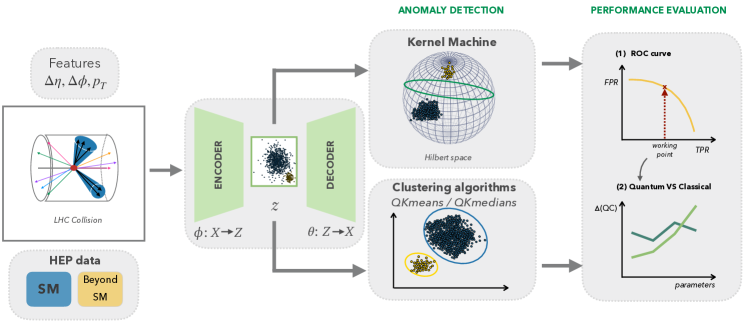
- Project high-dimensional LHC event data to a low-dimensional latent space with a convolutional autoencoder trained on QCD sideband data.
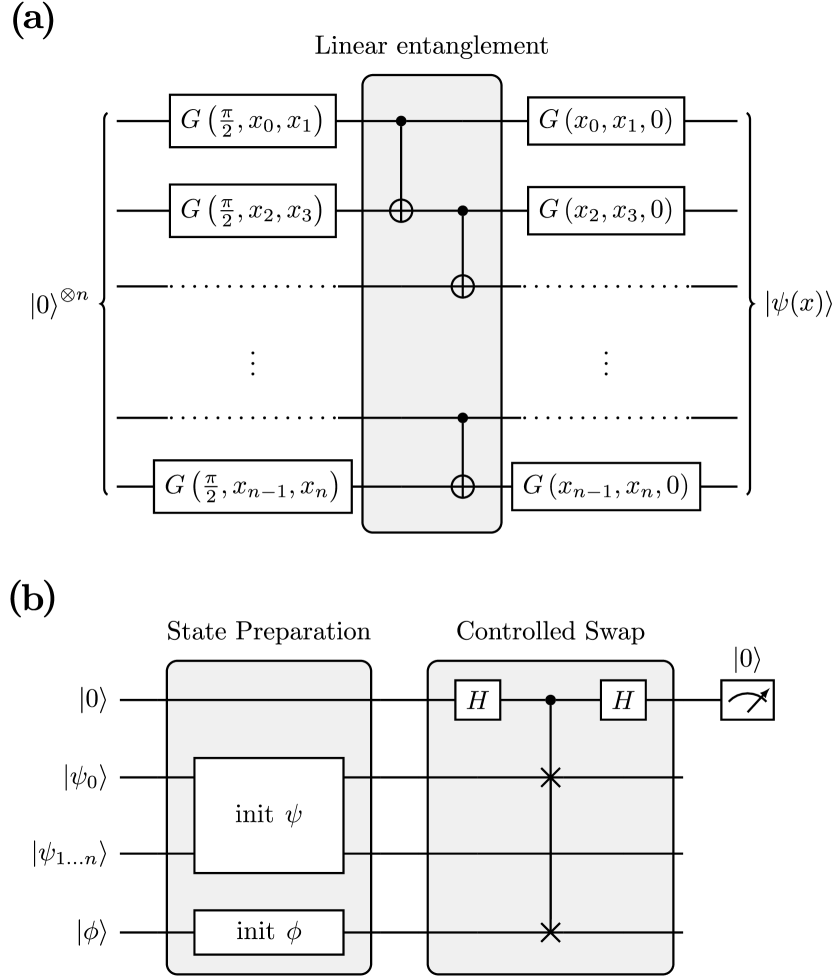
- Implement an unsupervised quantum kernel machine using a novel data-encoding circuit to map inputs to a quantum feature space.
- Develop two quantum clustering algorithms (QK-means and QK-medians) that operate on amplitude-encoded quantum states to assign cluster labels.
- Evaluate anomaly detection performance using ROC metrics and background rejection at fixed signal efficiency, comparing quantum and classical baselines.
- Demonstrate a hardware-enabled instance of the quantum kernel machine on an IBM quantum processor to assess feasibility and quality of quantum features.
Experimental results
Research questions
- RQ1Can unsupervised quantum anomaly detection in the latent space of autoencoded LHC data outperform classical methods across representative BSM scenarios?
- RQ2What impacts do latent space dimensionality and training sample size have on quantum versus classical anomaly detection performance?
- RQ3Is there an identifiable regime where quantum feature maps and circuit properties (entanglement, expressibility) yield a tangible quantum advantage?
- RQ4Can a realistic hardware implementation of quantum anomaly detection be executed with current quantum devices while preserving meaningful discrimination?
Key findings
- An unsupervised quantum kernel machine shows a consistent performance advantage over the best-performing classical kernel baseline in a defined parameter region.
- Quantum performance gains correlate with intrinsic circuit properties such as entanglement and expressibility of the data-encoding circuit, and are sensitive to the number of qubits.
- Clustering-based quantum methods (QK-means and QK-medians) also show improvements in certain setups, particularly with smaller training datasets.
- Increasing latent space dimensionality generally improves quantum model performance, with best results observed around a latent dimension of 8 in several tests.
- A hardware demonstration on IBMQ confirms the feasibility of the quantum kernel approach on near-term devices, albeit with limitations due to noise and testing statistics.
- The results illustrate that quantum models can reject more background events at fixed signal efficiency (up to fivefold in some comparisons) and that the advantage is tied to quantum-specific properties of the encoding circuit.
Read this paper
Open the full text in the Nubint reader and ask about any passage as you read.
Read this paper on NubintThis review was generated by AI from the original paper. Please check the paper before citing it.