
[Paper Review] Quantum Repeater with Encoding
This paper proposes a fast, encoding-based quantum repeater protocol that uses Calderbank-Shor-Steane (CSS) codes to encode logical qubits and perform entanglement connection at the encoded level, enabling long-distance quantum communication with high key generation rates. By replacing slow entanglement purification with classical error correction during simultaneous entanglement swapping, the protocol achieves a key generation rate above 100 bits/sec over 10^3–10^6 km using only 30–150 physical qubits per station, scaling logarithmically with distance.
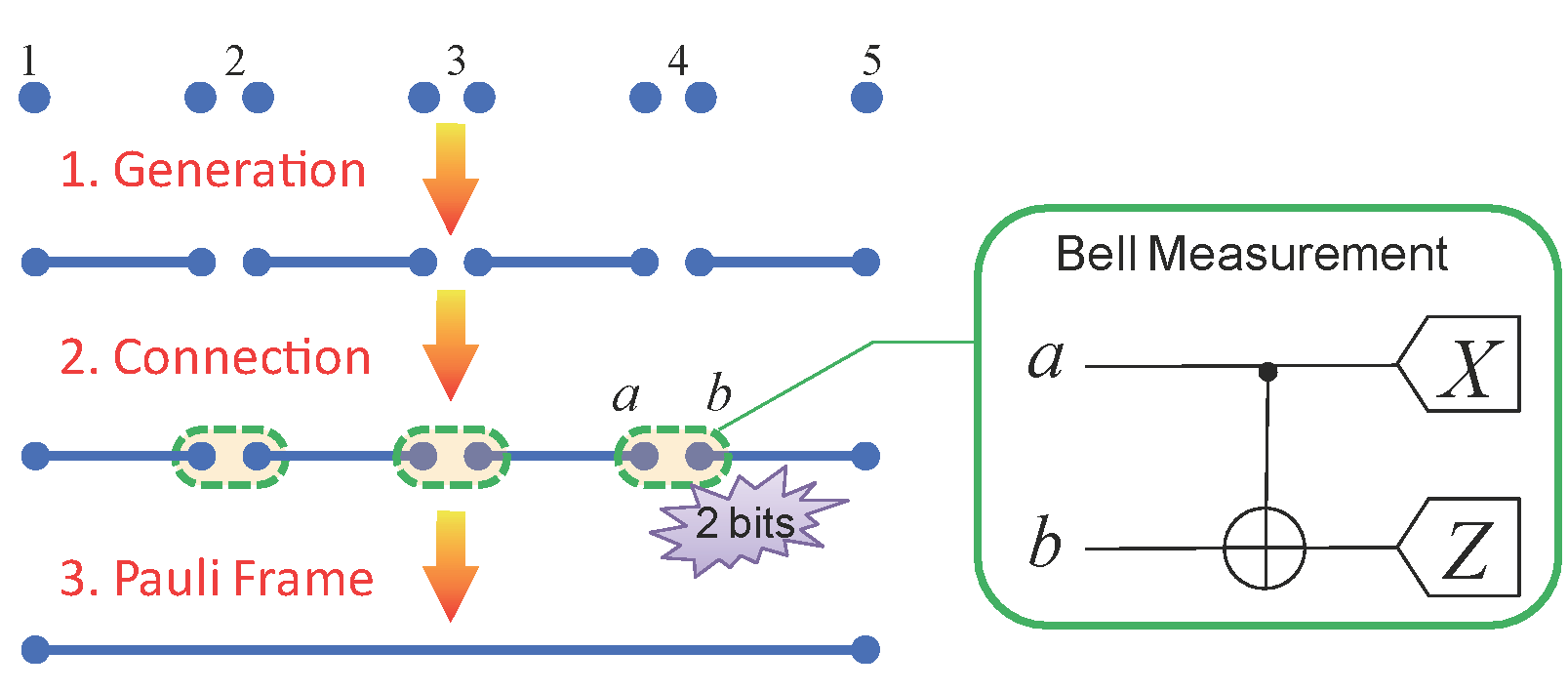
We propose a new approach to implement quantum repeaters for long distance quantum communication. Our protocol generates a backbone of encoded Bell pairs and uses the procedure of classical error correction during simultaneous entanglement connection. We illustrate that the repeater protocol with simple Calderbank-Shor-Steane (CSS) encoding can significantly extend the communication distance, while still maintaining a fast key generation rate.
Motivation & Objective
- To overcome the exponential decay in key generation rate caused by fiber attenuation in long-distance quantum communication.
- To eliminate the need for slow two-way classical communication in entanglement purification, which limits performance due to quantum memory coherence times.
- To develop a protocol that maintains high fidelity and fast key generation over distances up to 10^6 km using finite, scalable resources.
- To demonstrate that classical error correction at the encoded level can replace quantum error correction and entanglement purification, significantly improving efficiency.
Proposed method
- The protocol uses small Calderbank-Shor-Steane (CSS) codes to encode logical qubits, protecting against both bit-flip and dephasing errors.
- Entanglement connection (swapping) is performed at the encoded level, preserving logical Bell pair fidelity.
- Classical error correction is applied during the entanglement connection process to correct errors introduced by imperfect operations and memory decoherence.
- The protocol operates in a one-way communication mode, avoiding the time delays of two-way classical communication used in conventional purification protocols.
- Failure probability for generating sufficient purified Bell pairs is calculated using a recursive model based on success probabilities of purification steps and operational error rates.
- Key generation rate is estimated by modeling the cycle time for entanglement generation and purification, with resource scaling based on the number of qubits per station and required fidelity.
Experimental results
Research questions
- RQ1Can a quantum repeater protocol using CSS encoding and classical error correction achieve high-fidelity long-distance entanglement without relying on slow entanglement purification?
- RQ2What is the maximum communication distance achievable with finite local resources (e.g., 30–150 qubits per station) using encoded entanglement swapping?
- RQ3How does the key generation rate scale with distance when using one-way classical communication and encoded operations, compared to conventional protocols?
- RQ4What is the required number of initial Bell pairs per station to achieve a target failure probability (e.g., 10^{-5}) for generating a sufficient number of purified pairs?
- RQ5Can the protocol maintain a key generation rate above 100 bits/sec over distances of 10^3–10^6 km using logarithmic resource scaling?
Key findings
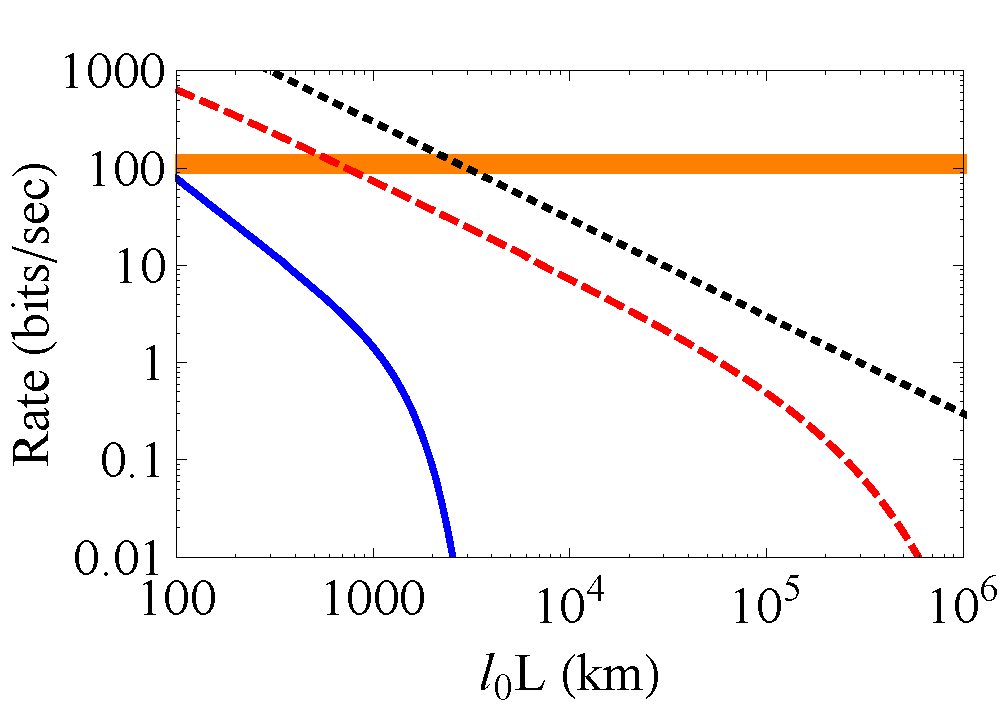
- The proposed protocol achieves a key generation rate above 100 bits/sec over distances ranging from 10^3 km to 10^6 km, significantly outperforming conventional protocols that suffer from exponential rate decay.
- With 30–150 physical qubits per station, the protocol scales logarithmically with distance, enabling long-range communication with finite, manageable resources.
- The failure probability for generating n purified Bell pairs drops exponentially with the number of initial unpurified pairs N₀, and N₀/n ≈ 15 is sufficient to ensure P_fail < 10^{-5} for a wide range of n.
- The cycle time τ_c ≈ 7 ms is achievable with approximately 6n physical qubits per station (n ≈ 10–20), supporting a key generation rate of 100 bits/sec.
- The fidelity of the final Bell pair can be made arbitrarily close to unity using large, efficient CSS codes, demonstrating scalability in fidelity.
- The protocol operates in a one-way communication mode, making its key generation rate independent of distance and allowing it to surpass the classical communication time limit, unlike conventional protocols.
Read this paper
Open the full text in the Nubint reader and ask about any passage as you read.
Read this paper on NubintThis review was generated by AI from the original paper. Please check the paper before citing it.