
[Paper Review] Quiescent or dusty? Unveiling the nature of extremely red galaxies at $z>3$
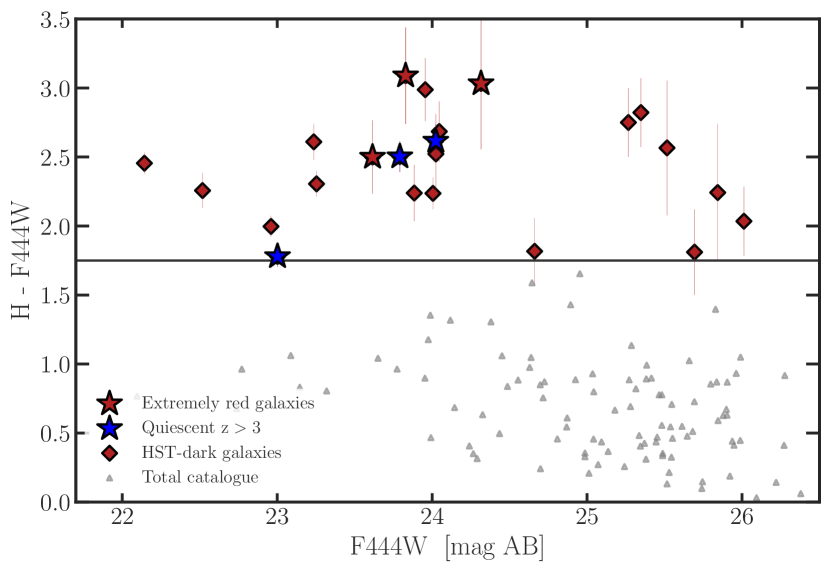
The paper presents JWST/NIRSpec PRISM spectroscopy of 23 HST-dark galaxies (H-F444W>1.75), revealing that most are dusty and a substantial minority are quiescent, with accurate redshifts and dust measurements; one quiescent source shows AGN activity.
The advent of the JWST has revolutionised our understanding of high-redshift galaxies. In particular, the NIRCam instrument on-board JWST has revealed a population of Hubble Space Telescope (HST)-dark galaxies that had previously evaded optical detection, potentially due to significant dust obscuration, quiescence, or simply extreme redshift. Here, we present the first NIRSpec spectra of 23 HST-dark galaxies ($\mathrm{H-F444W>1.75}$), unveiling their nature and physical properties. This sample includes both dusty and quiescent galaxies with spectroscopic data from NIRSpec/PRISM, providing accurate spectroscopic redshifts with $\mathrm{\overline{z}_{spec} = 4.1 \pm 0.7}$. The spectral features demonstrate that, while the majority of HST-dark galaxies are dusty, a substantial fraction, $\mathrm{13^{+9}_{-6} \%}$, are quiescent. For the dusty galaxies, we have quantified the dust attenuation using the Balmer decrement ($\mathrm{Hα/ Hβ}$), finding attenuations $\mathrm{A_{V} > 2\ mag}$. We find that HST-dark dusty galaxies are $\mathrm{Hα}$ emitters with equivalent widths spanning the range $\mathrm{ 68 A < EW_{Hα} < 550 A }$, indicative of a wide range of recent star-formation activity. Whether dusty or quiescent, we find that HST-dark galaxies are predominantly massive, with 85\% of the galaxies in the sample having masses $\mathrm{log(M_{*}/M_{\odot}) > 9.8}$. This pilot NIRSpec program reveals the diverse nature of HST-dark galaxies and highlights the effectiveness of NIRSpec/PRISM spectroscopic follow-up in distinguishing between dusty and quiescent galaxies and properly quantifying their physical properties. Upcoming research utilising higher-resolution NIRSpec data and combining JWST with ALMA observations will enhance our understanding of these enigmatic and challenging sources.
Motivation & Objective
- Identify the redshift distribution of HST-dark galaxies (z>3) using NIRSpec PRISM spectra.
- Distinguish dusty versus quiescent HST-dark galaxies through spectroscopic features.
- Quantify dust attenuation and basic physical properties (masses, SFRs) of the sample.
- Assess the presence of AGN activity among HST-dark galaxies.
- Provide a benchmark for future JWST+ALMA studies of red galaxies at high redshift.
Proposed method
- Obtain low-resolution (R~100) NIRSpec PRISM spectra (1–5 μm) for 23 HST-dark galaxies selected from NIRCam imaging.
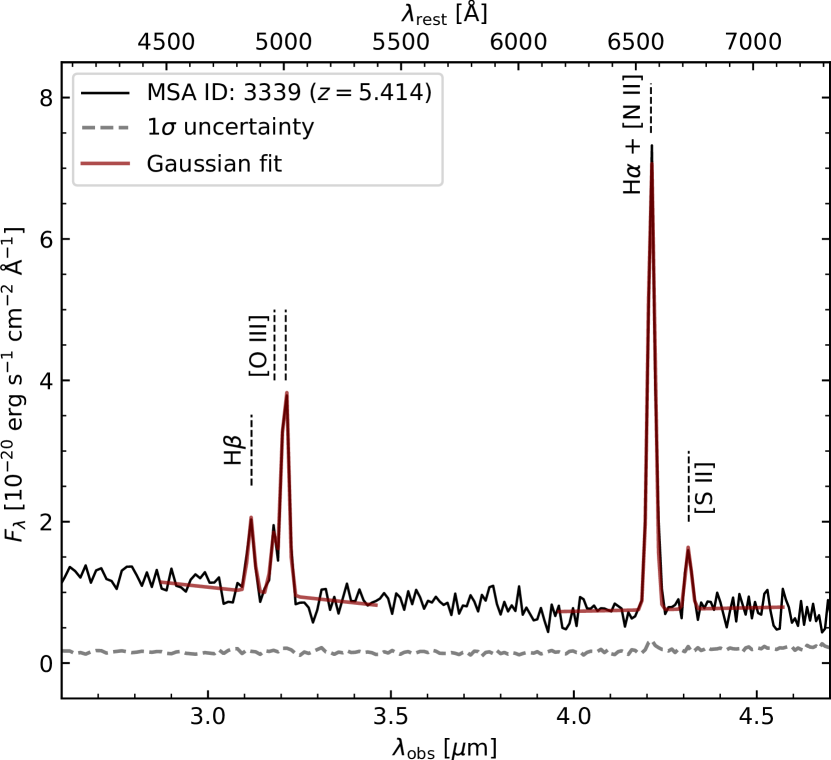
- Extract emission lines and continuum, fitting Hβ, [OIII], Hα, [NII], and [SII] to measure line fluxes and Balmer decrements.
- Classify galaxies as dusty or quiescent based on emission lines and Balmer break features.
- Perform SED fitting with BAGPIPES using spectroscopic redshifts and multi-band photometry to derive M*, SFR, and A_V.
- Use Balmer decrement (Hα/Hβ) to derive A_V via Calzetti attenuation, and account for [NII] blending with Hα photometry.
- Incorporate a delayed SFH model with a wide τ range, metallicities 0.2–2.5 Z⊙, and CLOUDY nebular emission in the SED analysis.
Experimental results
Research questions
- RQ1What is the redshift distribution of HST-dark galaxies when observed with JWST/NIRSpec PRISM?
- RQ2What fraction of HST-dark galaxies at z>3 are dusty versus quiescent based on spectroscopic data?
- RQ3How does spectroscopic dust attenuation (via Balmer decrement) compare with continuum-based attenuation from SED fitting in these galaxies?
- RQ4Do any of the dusty HST-dark galaxies host AGN, as indicated by emission line profiles?
- RQ5What are the stellar masses and Hα equivalent widths of these galaxies, and how do they relate to their classification?
Key findings
- Median z_spec = 4.1 ± 0.7; all sources lie at z ≳ 3, with a peak around z ≈ 4.
- 13^{+9}_{-6}% (3/23) of the HST-dark sample are quiescent at z>3.
- Dusty HST-dark galaxies show A_V values from Balmer decrement typically >2.6 mag, with some cases exceeding A_V ≈ 5 mag.
- Dust attenuation derived from Balmer decrement is higher than continuum-based A_V from SED fitting, illustrating differential extinction between nebular and stellar regions.
- All dusty HST-dark galaxies are Hα emitters with rest-frame EWs ranging from ~68 Å to ~550 Å (except one AGN-dominated case with ~1000 Å).
- One quiescent galaxy (ID=8777, z=4.7) shows broad Hα indicating AGN activity; overall, AGN signatures are rare in the sample.
Read this paper
Open the full text in the Nubint reader and ask about any passage as you read.
Read this paper on NubintThis review was generated by AI from the original paper. Please check the paper before citing it.