
[Paper Review] RA-DIT: Retrieval-Augmented Dual Instruction Tuning
RA-DIT retrofits any pre-trained LLM with retrieval through a two-stage fine-tuning process (LM fine-tuning to use retrieved info and retriever fine-tuning to return relevant results), achieving state-of-the-art results on knowledge-intensive tasks, especially in zero- and few-shot settings.
Retrieval-augmented language models (RALMs) improve performance by accessing long-tail and up-to-date knowledge from external data stores, but are challenging to build. Existing approaches require either expensive retrieval-specific modifications to LM pre-training or use post-hoc integration of the data store that leads to suboptimal performance. We introduce Retrieval-Augmented Dual Instruction Tuning (RA-DIT), a lightweight fine-tuning methodology that provides a third option by retrofitting any LLM with retrieval capabilities. Our approach operates in two distinct fine-tuning steps: (1) one updates a pre-trained LM to better use retrieved information, while (2) the other updates the retriever to return more relevant results, as preferred by the LM. By fine-tuning over tasks that require both knowledge utilization and contextual awareness, we demonstrate that each stage yields significant performance improvements, and using both leads to additional gains. Our best model, RA-DIT 65B, achieves state-of-the-art performance across a range of knowledge-intensive zero- and few-shot learning benchmarks, significantly outperforming existing in-context RALM approaches by up to +8.9% in 0-shot setting and +1.4% in 5-shot setting on average.
Motivation & Objective
- Motivate improving knowledge utilization and contextual awareness in LLMs without full retraining or pre-training.
- Propose a lightweight two-step fine-tuning regimen to retrofit retrieval into any pre-trained LLM and retriever.
- Show that joint LM-ft and R-ft yield additive gains on knowledge-intensive tasks.
- Demonstrate state-of-the-art performance of RA-DIT 65B across zero- and few-shot benchmarks.
Proposed method
- Use a pre-trained LLaMA model as the backbone and Dragon+ as the dense retriever.
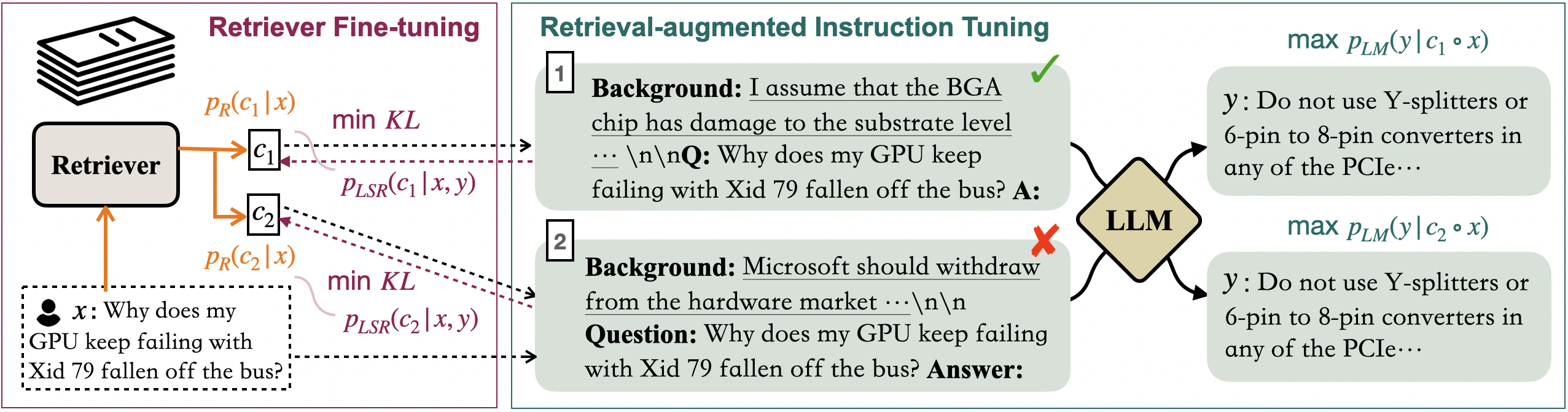
- Retrieve top-k text chunks for each prompt and prepend them as a Background field to the instruction, enabling parallel ensembling across chunks.
- LM fine-tuning (LM-ft): train the LLM to maximize p(y|c i ∘ x) with augmented background c i and instruction x, guiding the model to utilize retrieved background and ignore misleading content.
- Retriever fine-tuning (R-ft): train the query encoder to minimize KL-divergence between retriever scores pR(c|x) and a learned LM-Supervised Retrieval distribution pLSR(c|x,y) based on LM likelihood pLM(y|c∘x).
- Combine LM-ft and R-ft to achieve joint gains, with evaluation on knowledge-intensive tasks not seen during fine-tuning.
Experimental results
Research questions
- RQ1Can lightweight, dual-stage fine-tuning retrofit an existing LLM with retrieval capabilities without full pre-training?
- RQ2Do separate LM-ft and R-ft stages yield additive gains, and how do they interact when combined?
- RQ3How does RA-DIT perform on zero- and few-shot knowledge-intensive benchmarks compared to off-the-shelf LLM+retriever approaches and continuously pre-trained RALMs?
Key findings
- RA-DIT 65B achieves state-of-the-art results on zero- and few-shot knowledge-intensive benchmarks, significantly outperforming in-context RALMs in 0-shot (+ up to 8.9 percentage points) and 5-shot (+ up to 1.4 points) settings on average across MMLU, NQ, TQA, and ELI5.
- RA-DIT outperforms Atlas (64-shot fine-tuned encoder-decoder RALM) on 6 of 8 tasks by an average of 4.1 points in a unified 64-shot setting.
- Both LM-ft and R-ft contribute to gains; the best results come from combining both (RA-DIT outperforms RePlug by about 0.8 points on average in 5-shot).
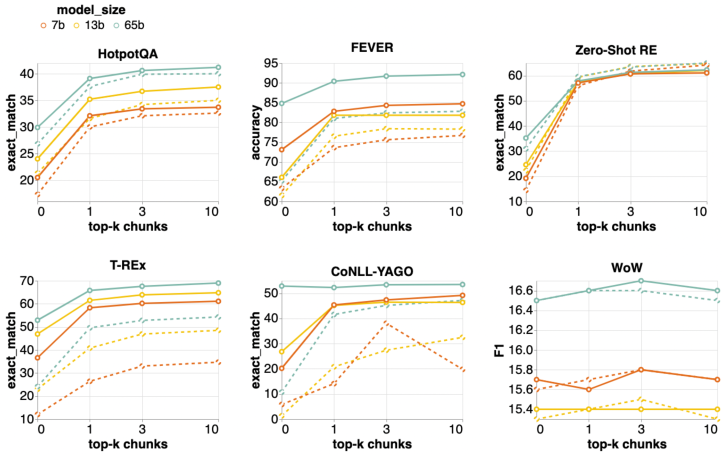
- Retrieval augmentation improves LLaMA with 65B parameters even when retrieval is limited to a single top-1 chunk, with further gains as more chunks are used.
- Fine-tuning the retriever using corpus data generally generalizes better than MTI data alone, and freezing the document encoder while fine-tuning the query encoder yields strong results.
Read this paper
Open the full text in the Nubint reader and ask about any passage as you read.
Read this paper on NubintThis review was generated by AI from the original paper. Please check the paper before citing it.