
[Paper Review] RadAdapt: Radiology Report Summarization via Lightweight Domain Adaptation of Large Language Models
RadAdapt proposes a lightweight domain adaptation framework for radiology report summarization using clinical-text-pretrained LLMs fine-tuned via LoRA, achieving state-of-the-art performance while tuning only 0.32% of parameters. The method outperforms full fine-tuning and prompting baselines, demonstrating that clinical pretraining combined with parameter-efficient fine-tuning is optimal for RRS.
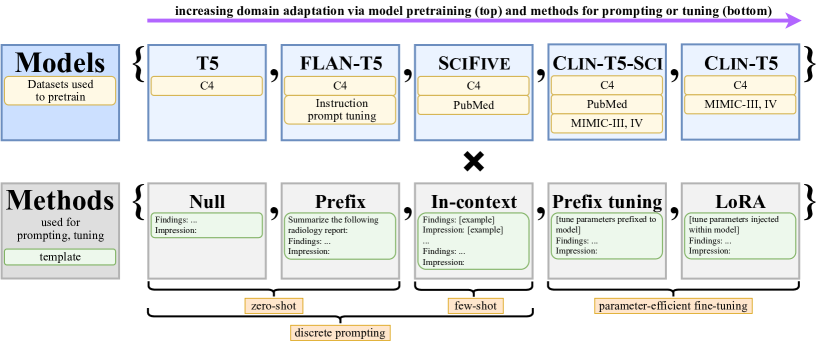
We systematically investigate lightweight strategies to adapt large language models (LLMs) for the task of radiology report summarization (RRS). Specifically, we focus on domain adaptation via pretraining (on natural language, biomedical text, or clinical text) and via discrete prompting or parameter-efficient fine-tuning. Our results consistently achieve best performance by maximally adapting to the task via pretraining on clinical text and fine-tuning on RRS examples. Importantly, this method fine-tunes a mere 0.32% of parameters throughout the model, in contrast to end-to-end fine-tuning (100% of parameters). Additionally, we study the effect of in-context examples and out-of-distribution (OOD) training before concluding with a radiologist reader study and qualitative analysis. Our findings highlight the importance of domain adaptation in RRS and provide valuable insights toward developing effective natural language processing solutions for clinical tasks.
Motivation & Objective
- To investigate lightweight domain adaptation strategies for radiology report summarization (RRS) using large language models (LLMs).
- To evaluate the impact of pretraining on natural language, biomedical, or clinical text on RRS performance.
- To compare discrete prompting, parameter-efficient fine-tuning (LoRA), and end-to-end fine-tuning in terms of effectiveness and efficiency.
- To assess generalization to out-of-distribution (OOD) modalities and anatomies in RRS.
- To validate model performance through a radiologist reader study and qualitative analysis.
Proposed method
- Pretrain LLMs on clinical text (e.g., MIMIC-III) to improve domain alignment for radiology reports.
- Apply LoRA (Low-Rank Adaptation) for parameter-efficient fine-tuning on RRS data, updating only 0.32% of model parameters.
- Use in-context few-shot prompting with varying numbers of exemplars to evaluate prompt engineering impact.
- Evaluate model generalization on out-of-distribution (OOD) data, specifically across different imaging modalities and anatomical regions.
- Conduct a radiologist reader study to assess generated impression quality in terms of correctness, coherence, and clinical relevance.
- Perform ablation studies across model architectures, prompting strategies, and adaptation techniques to isolate performance drivers.
Experimental results
Research questions
- RQ1Does pretraining on clinical text significantly improve RRS performance compared to general or biomedical pretraining?
- RQ2How does LoRA-based parameter-efficient fine-tuning compare to full fine-tuning in terms of performance and parameter efficiency for RRS?
- RQ3What is the impact of in-context few-shot prompting on RRS output quality across different LLMs?
- RQ4How well do adapted models generalize to out-of-distribution (OOD) imaging modalities and anatomical regions?
- RQ5How do radiologists assess the clinical relevance, correctness, and coherence of LLM-generated radiology impressions?
Key findings
- The best-performing method combines clinical-text pretraining (Clin-T5) with LoRA fine-tuning, achieving state-of-the-art performance on RRS benchmarks.
- Fine-tuning only 0.32% of model parameters via LoRA outperforms full fine-tuning (100% parameters) while drastically reducing computational cost.
- Increasing the number of in-context examples consistently improves RRS performance across all evaluated models, highlighting the value of prompt engineering.
- Anatomical diversity is more critical than modality for generalization; models trained on diverse anatomies generalize better to OOD cases.
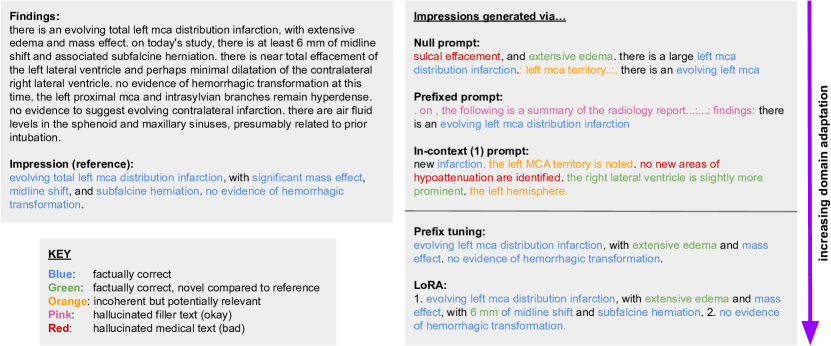
- Radiologist reader study shows high scores for correctness, coherence, and clinical relevance, though occasional hallucinations and mismatches with reference reports were observed.
Read this paper
Open the full text in the Nubint reader and ask about any passage as you read.
Read this paper on NubintThis review was generated by AI from the original paper. Please check the paper before citing it.