
[Paper Review] Reassessment of the dipole in the distribution of quasars on the sky
The paper reassesses the quasar-density dipole, showing large systematic uncertainties from large-scale anisotropies and masking, which prevent a robust exclusion of consistency with the CMB dipole.
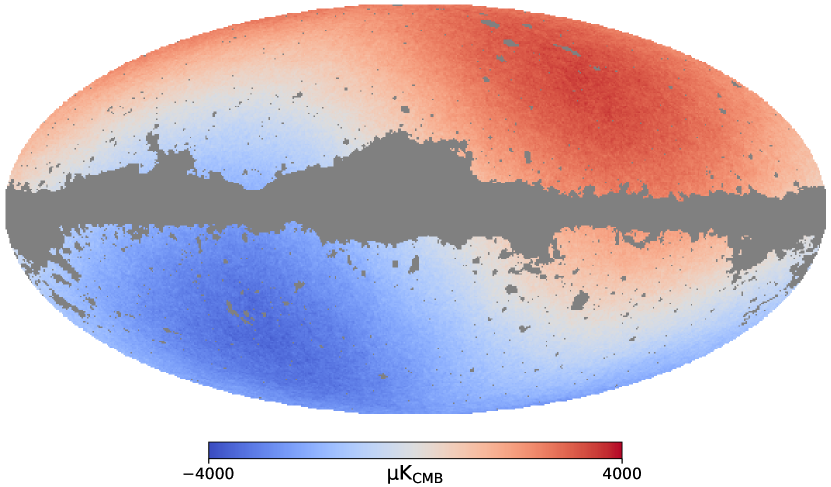
We investigate recent claims by Secrest et al. of an anomalously large amplitude of the dipole in the distribution of CatWISE-selected quasars on the sky. Two main issues indicate that the systematic uncertainties in the derived quasar-density dipole are underestimated. Firstly, the spatial distribution of the quasars is not a pure dipole, possessing low-order multipoles of comparable size to the dipole. These multipoles are unexpected and presumably caused by unknown systematic effects; we cannot be confident that the dipole amplitude is not also affected by the same systematics until the origin of these fluctuations is understood. Secondly, the 50 percent sky cut associated with the quasar catalogue strongly couples the multipoles, meaning that the power estimate at ell=1 contains significant contributions from ell>1. In particular, the dominant quadrupole mode in the Galactic mask strongly couples the dipole with the octupole, leading to a large uncertainty in the dipole amplitude. Together these issues mean that the dipole in the quasar catalogue has an uncertainty large enough that consistency with the cosmic microwave background (CMB) dipole cannot be ruled out. More generally, current data sets are insufficiently clean to robustly measure the quasar dipole and future studies will require samples that are larger (preferably covering more of the sky) and free of systematic effects to make strong claims regarding their consistency with the CMB dipole.
Motivation & Objective
- Assess whether the quasar density dipole matches the CMB dipole given potential systematics.
- Identify and quantify large-scale systematics in the quasar catalog that could bias dipole estimates.
- Evaluate how masking couples higher-order multipoles to the dipole and inflates uncertainties.
- Test robustness of dipole estimators using sub-samples and alternative methods.
- Provide guidance for future quasar dipole studies with larger, cleaner datasets.
Proposed method
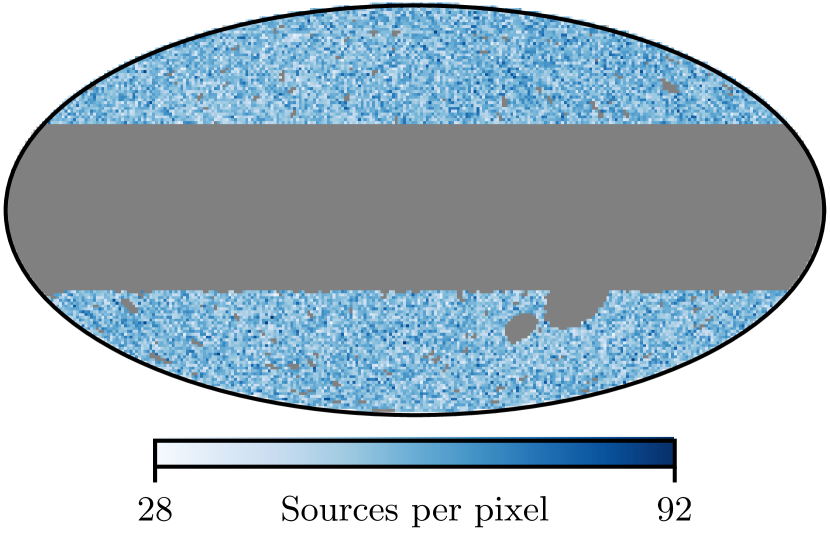
- Construct a CatWISE-based quasar sample with W1–W2 color cut and Galactic masking following Secrest et al. to form a density map.
- Analyze the impact of a large sky mask on dipole estimation using spherical-harmonic regression and examine multipole coupling via the coupling matrix M.
- Simulate quasar maps with added higher multipoles (quadrupole, octupole) to study bias in the dipole under masking.
- Use a real-space correlation-function method (PolSpice) to estimate the dipole and higher multipoles from the masked map.
- Investigate the effect of an ecliptic-gradient correction on quasar counts and its influence on dipole interpretation.
Experimental results
Research questions
- RQ1Does the quasar-density dipole align with the CMB dipole when accounting for systematics and masking?
- RQ2How do large-scale systematics and stellar contamination affect the inferred dipole amplitude and direction?
- RQ3How does sky masking couple higher-order multipoles to the dipole, and what is the resulting impact on uncertainties?
- RQ4What is the robustness of different dipole/dipole-related estimators (regression-based, correlation-function) under realistic systematics?
Key findings
- The quasar density map shows large-scale structure and multipoles beyond a pure dipole, undermining confidence in a clean dipole measurement.
- Masking induces strong coupling between dipole and higher-order multipoles (notably quadrupole and octupole), biasing the dipole amplitude.
- A bright–faint split suggests stellar contamination biases the dipole and its agreement with the CMB dipole depends on sample selection.
- Simulations including higher multipoles show the dipole estimator can be biased; p-values weaken from near 5σ (under simplistic assumptions) to ~2σ when accounting for higher multipoles and masking.
- PolSpice real-space analysis yields D ≈ 0.010 with large statistical and systematic uncertainties.
- Overall, current data are not clean enough to robustly confirm or rule out consistency with the CMB dipole; larger, cleaner samples are required.
Read this paper
Open the full text in the Nubint reader and ask about any passage as you read.
Read this paper on NubintThis review was generated by AI from the original paper. Please check the paper before citing it.