
[논문 리뷰] Reassessment of the dipole in the distribution of quasars on the sky
논문은 퀘이사 밀도 dipole를 재평가하여 대규모 스케일 비등방성과 마스킹으로 인한 큰 시스템적 불확실성이 존재하며, 이는 CMB dipole과의 일관성 배제를 견고하게 할 수 없음을 시사한다.
We investigate recent claims by Secrest et al. of an anomalously large amplitude of the dipole in the distribution of CatWISE-selected quasars on the sky. Two main issues indicate that the systematic uncertainties in the derived quasar-density dipole are underestimated. Firstly, the spatial distribution of the quasars is not a pure dipole, possessing low-order multipoles of comparable size to the dipole. These multipoles are unexpected and presumably caused by unknown systematic effects; we cannot be confident that the dipole amplitude is not also affected by the same systematics until the origin of these fluctuations is understood. Secondly, the 50 percent sky cut associated with the quasar catalogue strongly couples the multipoles, meaning that the power estimate at ell=1 contains significant contributions from ell>1. In particular, the dominant quadrupole mode in the Galactic mask strongly couples the dipole with the octupole, leading to a large uncertainty in the dipole amplitude. Together these issues mean that the dipole in the quasar catalogue has an uncertainty large enough that consistency with the cosmic microwave background (CMB) dipole cannot be ruled out. More generally, current data sets are insufficiently clean to robustly measure the quasar dipole and future studies will require samples that are larger (preferably covering more of the sky) and free of systematic effects to make strong claims regarding their consistency with the CMB dipole.
연구 동기 및 목표
- 잠재적 시스템오틱스를 고려할 때 퀘이사 밀도 dipole가 CMB dipole와 일치하는지 평가한다.
- dipole 추정에 편향을 줄 수 있는 퀘이사 카탈로그의 대규모 시스템오틱스를 식별하고 정량화한다.
- 마스킹이 고차 멀폴을 dipole에 결합시키고 불확실성을 증가시키는 방식을 평가한다.
- 부분 샘플과 대체 방법을 사용하여 dipole 추정기의 로버스트성을 테스트한다.
- 더 크고 더 깨끗한 데이터셋을 활용한 향후 퀘이사 dipole 연구를 위한 지침을 제공한다.
제안 방법
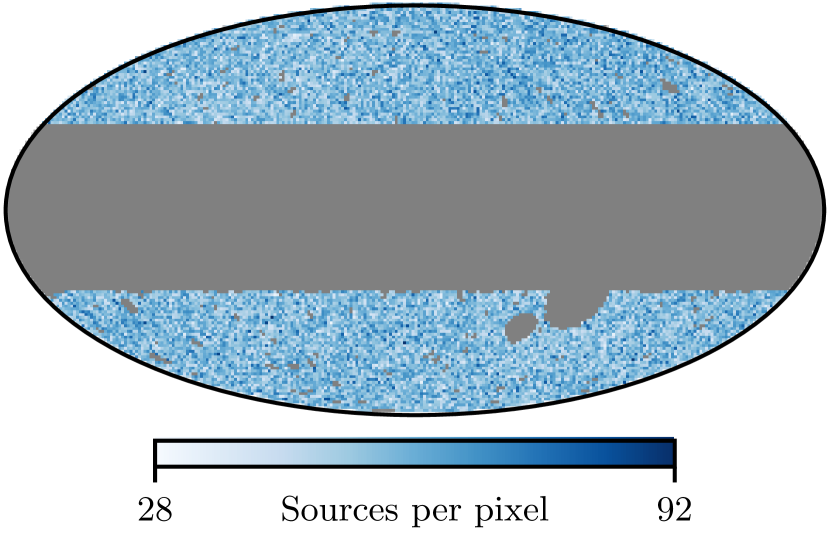
- Secrest 등(Secrest et al.)의 방법에 따라 W1–W2 색 cut과 은하 마스킹을 적용하여 CatWISE 기반의 퀘이사 샘플을 구성하고 밀도 맵을 만든다.
- 구면조화 회귀를 사용하여 대형 하늘 마스크가 dipole 추정에 미치는 영향을 분석하고 coupling 행렬 M을 통해 멀폴 간 결합을 검토한다.
- 마스킹하에서 dipole의 편향을 연구하기 위해 추가된 고차 멀폴(Quadrupole, Octupole)과 함께 퀘이사 맵을 시뮬레이션한다.
- 마스킹된 맵으로부터 dipole와 고차 멀폴을 추정하기 위해 실공간 상관 함수 기법(PolSpice)을 사용한다.
- 황도 기울기 보정이 퀘이사 수에 미치는 영향과 dipole 해석에 미치는 영향을 조사한다.
![Figure 1 : All-sky CMB map from Planck with the monopole subtracted. We specifically show the Public Release 4 data [ 41 ] , employing the Commander component-separation method. A mask covering $22\text{\,}\mathrm{\char 37\relax}$ of the sky has been applied ( $f_{\mathrm{sky}}=$78\text{\,}\mathrm{\](https://ar5iv.labs.arxiv.org/html/2405.09762/assets/x1.png)
실험 결과
연구 질문
- RQ1잠재적 시스템오틱스와 마스킹을 고려할 때 퀘이사 밀도 dipole가 CMB dipole와 일치하는가?
- RQ2대규모 시스템오틱스와 항성 오염이 추정된 dipole 진폭과 방향에 어떤 영향을 미치는가?
- RQ3하늘 마스킹이 고차 멀폴을 dipole에 어떻게 결합시키며, 그 불확실성에 어떤 영향을 주는가?
- RQ4현실적인 시스템오틱스 하에서 서로 다른 dipole/dipole 관련 추정기(regression-based, correlation-function)의 로버스트성은 어느 정도인가?
주요 결과
- 퀘이사 밀도 맵은 순수한 dipole을 넘어서는 대규모 구조와 다수의 멀폴로 구성되어 있어, 클린한 dipole 측정에 대한 신뢰를 약화시킨다.
- 마스킹은 dipole과 고차 멀폴(특히 이차 및 팔극) 사이의 강한 결합을 일으켜 dipole 진폭에 편향을 준다.
- 밝은-약한 분할은 항성 오염이 dipole에 편향을 주며 CMB dipole과의 일치 여부가 샘플 선택에 의존함을 시사한다.
- 고차 멀폴을 포함한 시뮬레이션은 dipole 추정기가 편향될 수 있음을 보여주며, 단순한 가정 하에서의 p-값은 고차 멀폴과 마스킹을 고려한 경우 약 5σ에서 ~2σ로 약화된다.
- PolSpice 실공간 분석은 D ≈ 0.010의 값을 보이나 큰 통계적/시스템적 불확실성이 존재한다.
- 종합적으로 현재 데이터는 CMB dipole과의 일관성을 견고하게 확인하거나 기각하기에 충분히 깨끗하지 않다; 더 크고 깨끗한 샘플이 필요하다.
더 나은 연구,지금 바로 시작하세요
연구 설계부터 논문 작성까지, 연구 시간을 획기적으로 줄여보세요.
카드 등록 없음 · 무료 플랜 제공
이 리뷰는 AI가 만들고, 인간 에디터가 검토했습니다.