
[Paper Review] Recurrent Vision Transformers for Object Detection with Event Cameras
This paper introduces Recurrent Vision Transformers (RVTs), a novel backbone for event-based object detection that achieves state-of-the-art mAP of 47.2% on the Gen1 dataset while reducing inference time to under 12 ms on a T4 GPU and cutting parameters by 5× compared to prior methods, through a multi-stage design combining convolutional priors, local and dilated global self-attention, and efficient recurrent feature aggregation using plain LSTMs instead of Conv-LSTMs.
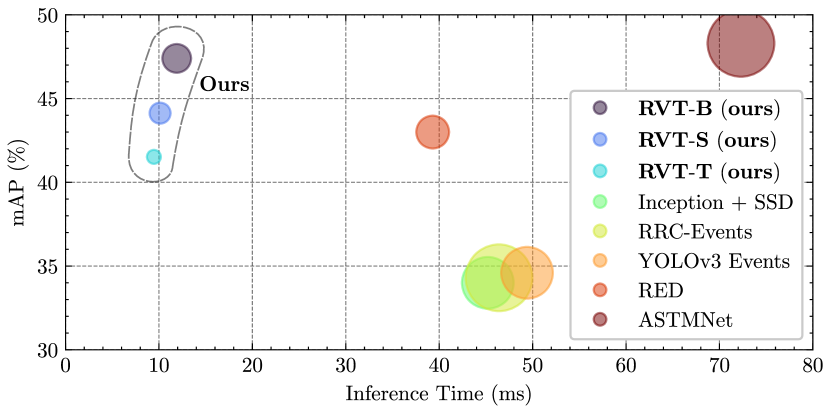
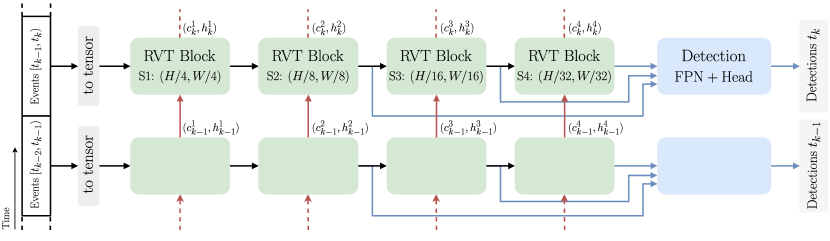
We present Recurrent Vision Transformers (RVTs), a novel backbone for object detection with event cameras. Event cameras provide visual information with sub-millisecond latency at a high-dynamic range and with strong robustness against motion blur. These unique properties offer great potential for low-latency object detection and tracking in time-critical scenarios. Prior work in event-based vision has achieved outstanding detection performance but at the cost of substantial inference time, typically beyond 40 milliseconds. By revisiting the high-level design of recurrent vision backbones, we reduce inference time by a factor of 6 while retaining similar performance. To achieve this, we explore a multi-stage design that utilizes three key concepts in each stage: First, a convolutional prior that can be regarded as a conditional positional embedding. Second, local and dilated global self-attention for spatial feature interaction. Third, recurrent temporal feature aggregation to minimize latency while retaining temporal information. RVTs can be trained from scratch to reach state-of-the-art performance on event-based object detection - achieving an mAP of 47.2% on the Gen1 automotive dataset. At the same time, RVTs offer fast inference (<12 ms on a T4 GPU) and favorable parameter efficiency (5 times fewer than prior art). Our study brings new insights into effective design choices that can be fruitful for research beyond event-based vision.
Motivation & Objective
- Address the gap between the ultra-low latency potential of event cameras and the high inference times (>40ms) of existing detection models.
- Design a vision transformer backbone that maintains high detection accuracy while drastically reducing computational latency and parameter count.
- Explore macro-level architectural choices—especially recurrence and attention mechanisms—that enable efficient, real-time inference on conventional GPUs without specialized hardware.
- Achieve a favorable trade-off between model performance, inference speed, and parameter efficiency for time-critical applications like autonomous driving.
Proposed method
- Propose a multi-stage hierarchical backbone where each stage applies a convolutional prior to provide spatial inductive bias and act as a conditional positional embedding.
- Integrate local and dilated global self-attention mechanisms to efficiently capture both local and long-range spatial dependencies with linear complexity in input resolution.
- Replace computationally heavy Conv-LSTM cells with lightweight, channel-wise plain LSTM cells to enable efficient temporal feature aggregation with reduced parameters and latency.
- Train the entire RVT architecture from scratch using standard detection frameworks, enabling compatibility with existing object detection pipelines.
- Leverage PyTorch's JIT compilation to further accelerate inference, especially for smaller models, achieving sub-3ms inference on high-end GPUs.
- Use a single, reusable stage design that is stacked across four stages to build the full backbone, simplifying deployment and hyperparameter tuning.
Experimental results
Research questions
- RQ1Can a vision transformer-based backbone achieve both high accuracy and low inference latency in event-based object detection on standard GPUs?
- RQ2How does replacing Conv-LSTM with plain LSTM cells affect performance and efficiency in event-based detection?
- RQ3To what extent can local and dilated global self-attention replace traditional convolutional or graph-based operations in modeling spatio-temporal features from event streams?
- RQ4Can a strong convolutional prior serve as an effective conditional positional embedding in a transformer-based architecture for event data?
- RQ5What is the impact of architectural macro-design choices—such as recurrence placement and attention type—on the performance-latency trade-off in event-based vision?
Key findings
- RVT achieves a new state-of-the-art mAP of 47.2% on the Gen1 automotive dataset, outperforming prior methods including ASTMNet and RED.
- The base RVT model achieves inference times of 10.2 ms on the Gen1 dataset and 11.9 ms on the 1 Mpx dataset using a T4 GPU, representing a 6× reduction in latency compared to prior SOTA methods.
- With PyTorch's JIT compilation, inference time is further reduced to 2.8 ms on an RTX 3090 GPU for the base model on the 1 Mpx dataset.
- The tiny RVT model achieves 4.1% higher mAP than the RED model on the Gen1 dataset while using 5× fewer parameters (18.5M vs. 92M).
- The RVT backbone reduces parameter count from 100M (prior art) to 18.5M, achieving a 5× improvement in parameter efficiency without sacrificing performance.
- The model maintains robust detection performance even during event-free intervals, though performance degrades when no events are present, indicating a need for multi-modal fusion with frames in future work.
Read this paper
Open the full text in the Nubint reader and ask about any passage as you read.
Read this paper on NubintThis review was generated by AI from the original paper. Please check the paper before citing it.