
[Paper Review] RePLan: Robotic Replanning with Perception and Language Models
RePLan uses a hierarchical LLM-based planner, a Vision-Language Model perceiver, and a verifier to enable real-time replanning and reward generation for long-horizon robotic tasks, demonstrating strong performance across multiple environments.
Advancements in large language models (LLMs) have demonstrated their potential in facilitating high-level reasoning, logical reasoning and robotics planning. Recently, LLMs have also been able to generate reward functions for low-level robot actions, effectively bridging the interface between high-level planning and low-level robot control. However, the challenge remains that even with syntactically correct plans, robots can still fail to achieve their intended goals due to imperfect plans or unexpected environmental issues. To overcome this, Vision Language Models (VLMs) have shown remarkable success in tasks such as visual question answering. Leveraging the capabilities of VLMs, we present a novel framework called Robotic Replanning with Perception and Language Models (RePLan) that enables online replanning capabilities for long-horizon tasks. This framework utilizes the physical grounding provided by a VLM's understanding of the world's state to adapt robot actions when the initial plan fails to achieve the desired goal. We developed a Reasoning and Control (RC) benchmark with eight long-horizon tasks to test our approach. We find that RePLan enables a robot to successfully adapt to unforeseen obstacles while accomplishing open-ended, long-horizon goals, where baseline models cannot, and can be readily applied to real robots. Find more information at https://replan-lm.github.io/replan.github.io/
Motivation & Objective
- Motivate and enable autonomous, long-horizon robotic task execution with minimal human intervention.
- Bridge high-level planning and low-level control via language models and visual grounding.
- Incorporate perception feedback and verification to reduce plan failures and hallucinations.
- Demonstrate open-ended, multi-step task solving with a reinforcement-learning-free reward generation flow.
Proposed method
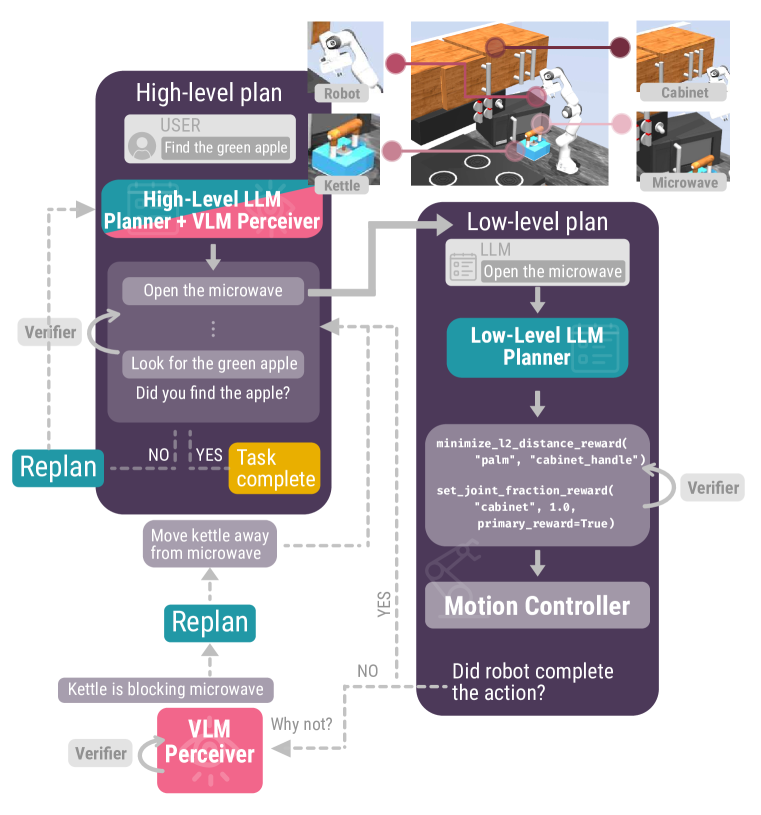
- High-Level LLM Planner generates abstract subtasks from a user goal.
- VLM Perceiver provides grounded state observations and object-state feedback.
- Low-Level LLM Planner converts high-level subtasks into low-level reward functions.
- Motion Controller (MuJoCo MPC) executes actions using generated rewards.
- LLM Verifier checks and corrects planner outputs and ensures actions align with goals.
Experimental results
Research questions
- RQ1Can a multi-level planning system using LLMs and VLMs perform long-horizon, open-ended robotic tasks with real-time replanning?
- RQ2Does incorporating perception grounding and verification improve task success and robustness compared to baseline LLM-based or non-grounded approaches?
- RQ3How effective is a reward-generation pipeline from LLMs for control in MPC-based robot manipulation?
- RQ4What is the impact of removing modules (Verifier, Perceiver, Replan) on long-horizon task performance?
Key findings
- RePLan achieves an average success rate of 88.6% across seven tasks, substantially higher than baselines.
- Compared to Language to Rewards, RePLan shows a 3.6× improvement in overall task completion.
- Ablations show notable performance drops when removing Verifier, Perceiver, or Replan modules, with the largest drop when removing Perceiver or Replan.
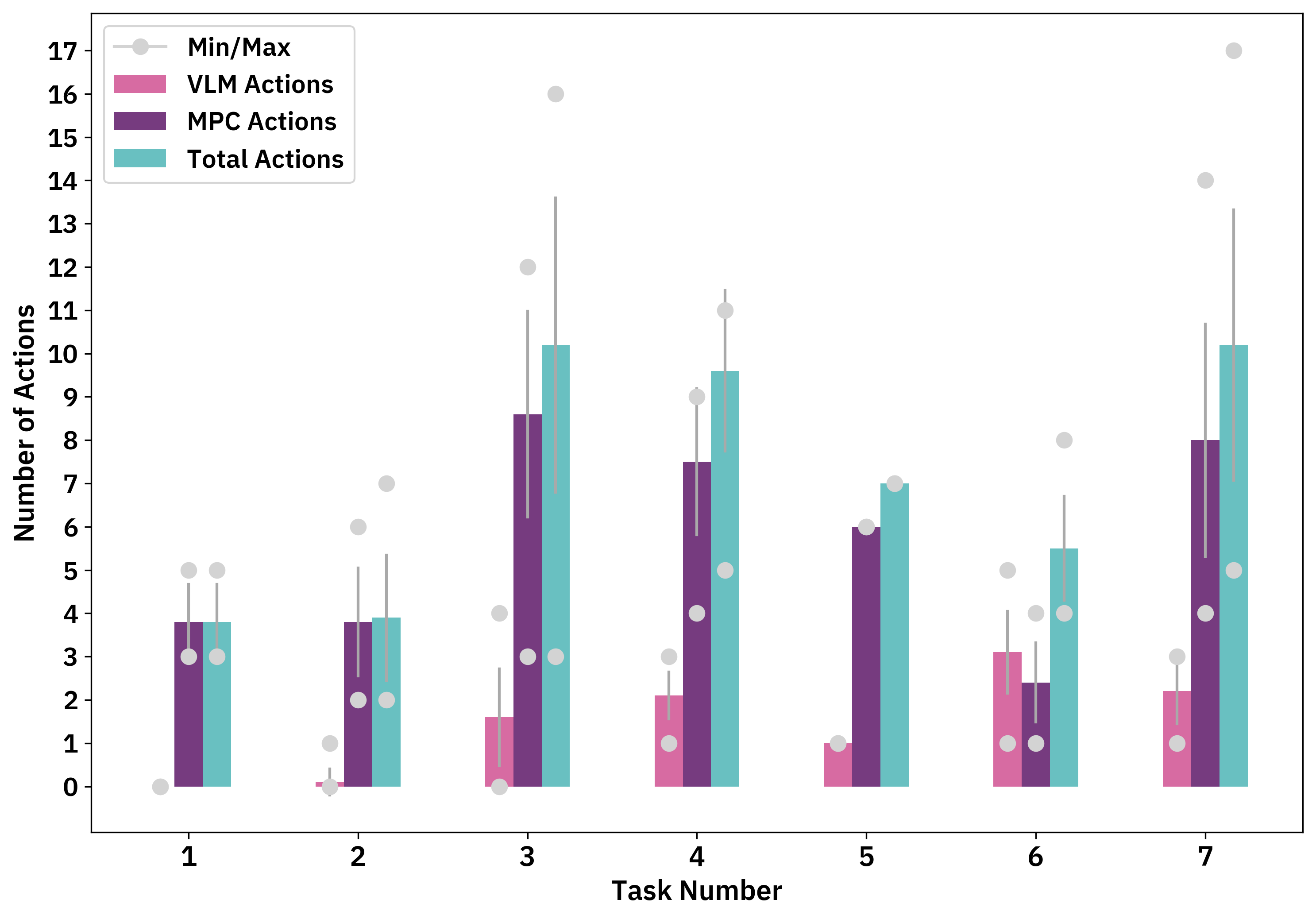
- Task-level performance varies (e.g., Task 3 is the hardest), reflecting challenges like obstacles and correct reward prioritization.
- The system demonstrates open-ended problem solving, including replanning after failures and handling unseen obstacles.
Read this paper
Open the full text in the Nubint reader and ask about any passage as you read.
Read this paper on NubintThis review was generated by AI from the original paper. Please check the paper before citing it.