
[Paper Review] Respecting Domain Relations: Hypothesis Invariance for Domain Generalization
This paper proposes hypothesis invariant representations (HIRs) for domain generalization, which relax the strict invariance of domain invariant representations (DIRs) by aligning classifier predictions across domains instead of aligning raw representations. Experiments show HIRs outperform DIRs and even match methods using prior domain knowledge, especially under severe data corruptions.
In domain generalization, multiple labeled non-independent and non-identically distributed source domains are available during training while neither the data nor the labels of target domains are. Currently, learning so-called domain invariant representations (DIRs) is the prevalent approach to domain generalization. In this work, we define DIRs employed by existing works in probabilistic terms and show that by learning DIRs, overly strict requirements are imposed concerning the invariance. Particularly, DIRs aim to perfectly align representations of different domains, i.e. their input distributions. This is, however, not necessary for good generalization to a target domain and may even dispose of valuable classification information. We propose to learn so-called hypothesis invariant representations (HIRs), which relax the invariance assumptions by merely aligning posteriors, instead of aligning representations. We report experimental results on public domain generalization datasets to show that learning HIRs is more effective than learning DIRs. In fact, our approach can even compete with approaches using prior knowledge about domains.
Motivation & Objective
- To address the over-constraint of domain invariant representations (DIRs), which enforce perfect alignment of source domain representations, potentially discarding useful classification information.
- To relax invariance requirements in domain generalization by focusing on alignment of classifier predictions (posteriors) rather than raw representations.
- To preserve useful structural relations between domains—such as rotation or corruption patterns—without relying on prior knowledge of domain relationships.
- To demonstrate that HIRs can generalize effectively to unseen target domains, even under severe data corruptions, by learning robust, prediction-based invariance.
- To show that HIRs outperform standard DIRs and can rival methods using strong prior knowledge, such as in rotated MNIST.
Proposed method
- Define sufficiency and invariance of representations in domain generalization using a probabilistic framework, extending concepts from information theory.
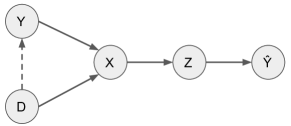
- Propose hypothesis invariant representations (HIRs) that align posteriors (i.e., model predictions) across different source domains, rather than aligning input representations.
- Use a loss function that minimizes the divergence between predicted class distributions from different domains, approximating posterior alignment without explicit density estimation.
- Introduce a hyperparameter α to balance the HIR loss with the standard cross-entropy classification loss, enabling controlled posterior alignment.
- Apply HIR loss during training on both paired and unpaired data, showing improved performance in unpaired settings where domain relations are more complex.
- Evaluate on diverse benchmarks: rotated MNIST (with paired/unpaired settings), VLCS (four independent domains), and Tiny ImageNet-C (seven severe corruptions), using ResNet50 and CCSA architectures.
Experimental results
Research questions
- RQ1Is the strict representation alignment enforced by domain invariant representations (DIRs) necessary for effective domain generalization?
- RQ2Can aligning classifier predictions (posteriors) across domains lead to better generalization than aligning raw representations?
- RQ3Does preserving the relative spatial structure of domains in representation space improve generalization when no prior knowledge is available?
- RQ4How does the HIR loss perform under severe, diverse data corruptions such as blur and noise?
- RQ5Can HIRs achieve performance comparable to methods that use strong prior knowledge about domain shifts?
Key findings
- HIRs outperform DIRs on all evaluated datasets, including rotated MNIST, VLCS, and Tiny ImageNet-C, demonstrating superior domain generalization capability.
- On Tiny ImageNet-C, HIRs achieve state-of-the-art performance by effectively aligning divergent posteriors across seven severe corruption types, even without including the clean images as a domain.
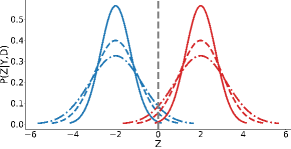
- The HIR loss is more effective in unpaired training settings, where posterior divergences are larger, indicating that HIRs benefit from structural domain differences.
- For noise corruptions (e.g., Gaussian noise, impulse noise), higher α values improve performance, while lower α values are better for blur corruptions, showing adaptive sensitivity to corruption type.
- HIRs can match or exceed performance of methods using strong prior knowledge (e.g., rotated MNIST), despite not relying on such information.
- In the paired setting of rotated MNIST, HIR loss leads to overfitting due to high posterior similarity, confirming that HIRs are most effective when domain relations are non-trivial and diverse.
Read this paper
Open the full text in the Nubint reader and ask about any passage as you read.
Read this paper on NubintThis review was generated by AI from the original paper. Please check the paper before citing it.