
[Paper Review] Revealing the Dynamic Magneto-ionic Environments of Repeating Fast Radio Burst Sources through Multi-year Polarimetric Monitoring with CHIME/FRB
This study presents multi-year polarimetric monitoring of 13 repeating fast radio burst (FRB) sources using CHIME/FRB, revealing significant and dynamic magneto-ionic environments through burst-to-burst variations in Faraday rotation measure (RM) and depolarization. Key findings include extreme RM variations (up to several hundred rad m⁻² over months), minimal DM changes, and magnetic field estimates suggesting FRB environments are far more dynamic and extreme than those of pulsar-SNR systems.
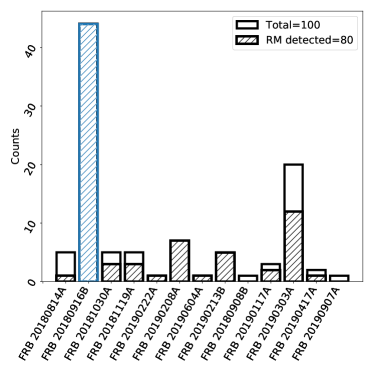
Fast radio bursts (FRBs) display a confounding variety of burst properties and host galaxy associations. Repeating FRBs offer insight into the FRB population by enabling spectral, temporal and polarimetric properties to be tracked over time. Here, we report on the polarized observations of 12 repeating sources using multi-year monitoring with the Canadian Hydrogen Intensity Mapping Experiment (CHIME) over 400-800 MHz. We observe significant RM variations from many sources in our sample, including RM changes of several hundred $ m{rad\, m^{-2}}$ over month timescales from FRBs 20181119A, 20190303A and 20190417A, and more modest RM variability ($ m{ΔRM \lesssim}$ few tens rad m$^{-2}$) from FRBs 20181030A, 20190208A, 20190213B and 20190117A over equivalent timescales. Several repeaters display a frequency dependent degree of linear polarization that is consistent with depolarization via scattering. Combining our measurements of RM variations with equivalent constraints on DM variability, we estimate the average line-of-sight magnetic field strength in the local environment of each repeater. In general, repeating FRBs display RM variations that are more prevalent/extreme than those seen from radio pulsars in the Milky Way and the Magellanic Clouds, suggesting repeating FRBs and pulsars occupy distinct magneto-ionic environments.
Motivation & Objective
- To characterize the time-variable magneto-ionic environments of repeating FRB sources through long-term polarimetric monitoring.
- To investigate the origin of Faraday rotation measure (RM) variability in repeating FRBs and its implications for local magnetic fields.
- To compare the derived local magnetic field strengths (B∥) in FRB environments with those in pulsar-SNR systems.
- To assess the role of multi-path propagation and scattering in burst depolarization and RM evolution.
- To determine whether the observed RM and DM variations constrain the physical properties of the FRB emission region and surrounding plasma
Proposed method
- Conducted multi-year polarimetric monitoring of 13 repeating FRB sources using the CHIME/FRB instrument, analyzing 100 bursts with high time resolution.
- Measured burst-specific linear polarization degree (L/I) and circular polarization fraction, identifying instrumental effects and intrinsic variability.
- Applied RM analysis to track Faraday rotation evolution over timescales of weeks to months, using RM-spectral fitting and depolarization modeling.
- Estimated the line-of-sight magnetic field component (B∥) in the FRB environment using ΔRM and ΔDM constraints, assuming a plasma density and path length model.
- Compared B∥ estimates with those from pulsar-SNR systems to assess environmental differences.
- Utilized the RMtools package (Purcell et al., 2020) for robust RM decomposition and uncertainty quantification in complex, time-variable signals.
Experimental results
Research questions
- RQ1What is the timescale and amplitude of Faraday rotation measure (RM) variability in repeating FRB sources over multi-year observations?
- RQ2How do depolarization and linear polarization degree (L/I) vary from burst to burst, and what do they reveal about multi-path propagation?
- RQ3To what extent do changes in dispersion measure (DM) correlate with RM variations, and what does this imply about the local plasma environment?
- RQ4How do the derived local magnetic field strengths (B∥) in FRB environments compare to those in known pulsar-SNR systems?
- RQ5Can the observed RM and depolarization behavior be explained by a single, stable magneto-ionic environment, or do they require dynamic, inhomogeneous plasma structures?
Key findings
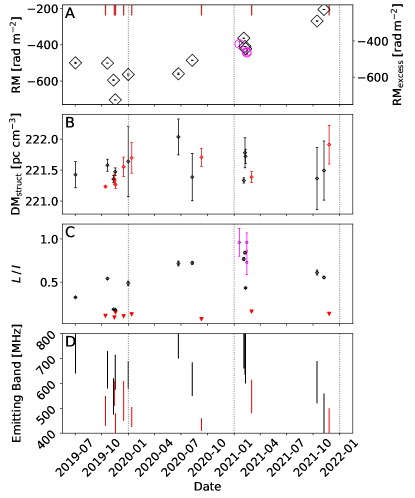
- Repeating FRB sources exhibit significant RM variability on timescales of weeks to months, with some sources showing extreme changes of several hundred rad m⁻².
- Despite these large RM variations, dispersion measure (DM) changes are minimal (ΔDM ~ few pc cm⁻³), indicating that RM variations are not driven by bulk plasma motion or large-scale DM evolution.
- The derived line-of-sight magnetic field component (B∥) in FRB environments is comparable to that in pulsar-SNR systems, but a significant subsample of FRBs shows RM variations far exceeding those seen in pulsars.
- Burst-to-burst variability in linear polarization degree (L/I) is observed in many sources, with deviations from depolarization models suggesting additional, unmodeled plasma inhomogeneities.
- Circular polarization is generally low (≤20%), consistent with instrumental effects rather than intrinsic emission physics.
- The combination of extreme RM variability and minimal DM evolution implies that the local magneto-ionic environment of repeating FRBs is highly dynamic and inhomogeneous, unlike the more stable environments of typical pulsar-SNR systems.
Read this paper
Open the full text in the Nubint reader and ask about any passage as you read.
Read this paper on NubintThis review was generated by AI from the original paper. Please check the paper before citing it.