
[Paper Review] Review on Fault Diagnosis and Fault-Tolerant Control Scheme for Robotic Manipulators: Recent Advances in AI, Machine Learning, and Digital Twin
This review synthesizes recent advances in fault diagnosis and fault-tolerant control (FTC) for robotic manipulators through the integration of artificial intelligence (AI), machine learning (ML), and digital twin technologies (DTT). It presents a comprehensive analysis of AI/ML-driven fault detection, isolation, and identification methods, demonstrating how digital twins enable real-time monitoring, predictive maintenance, and autonomous recovery, significantly enhancing system reliability and reducing downtime in industrial and safety-critical applications.
This comprehensive review article delves into the intricate realm of fault-tolerant control (FTC) schemes tailored for robotic manipulators. Our exploration spans the historical evolution of FTC, tracing its development over time, and meticulously examines the recent breakthroughs fueled by the synergistic integration of cutting-edge technologies such as artificial intelligence (AI), machine learning (ML), and digital twin technologies (DTT). The article places a particular emphasis on the transformative influence these contemporary trends exert on the landscape of robotic manipulator control and fault tolerance. By delving into the historical context, our aim is to provide a comprehensive understanding of the evolution of FTC schemes. This journey encompasses the transition from model-based and signal-based schemes to the role of sensors, setting the stage for an exploration of the present-day paradigm shift enabled by AI, ML, and DTT. The narrative unfolds as we dissect the intricate interplay between these advanced technologies and their applications in enhancing fault tolerance within the domain of robotic manipulators. Our review critically evaluates the impact of these advancements, shedding light on the novel methodologies, techniques, and applications that have emerged in recent times. The overarching goal of this article is to present a comprehensive perspective on the current state of fault diagnosis and fault-tolerant control within the context of robotic manipulators, positioning our exploration within the broader framework of AI, ML, and DTT advancements. Through a meticulous examination of both historical foundations and contemporary innovations, this review significantly contributes to the existing body of knowledge, offering valuable insights for researchers, practitioners, and enthusiasts navigating the dynamic landscape of robotic manipulator control.
Motivation & Objective
- To analyze the evolution of fault-tolerant control (FTC) schemes in robotic manipulators from model-based to AI/ML-driven approaches.
- To investigate the role of digital twin technologies (DTT) in enabling real-time fault diagnosis and adaptive control.
- To identify key AI and ML techniques—such as deep neural networks, reinforcement learning, and support vector machines—used in fault detection and isolation.
- To evaluate the integration of IoT, signal processing, and hybrid control strategies (e.g., MPC, backstepping) in enhancing fault tolerance.
- To highlight emerging trends such as Explainable AI (XAI), edge computing, and sustainability in FTC for next-generation robotic systems.
Proposed method
- The study employs a systematic literature review of recent works (2015–2024) on FTC in robotic manipulators, focusing on AI, ML, and DTT applications.
- It classifies fault diagnosis techniques into signal-based (e.g., FFT, DWT, Hilbert Transform), model-based (e.g., LMI, observer design), and data-driven (e.g., ANN, SVM, RNN, CNN) methods.
- Digital twin integration is analyzed through the use of real-time data streams, simulation models, and feedback loops to mirror physical manipulator states.
- Advanced control strategies such as adaptive fuzzy type-2 backstepping (AFT2BC), Lyapunov-based MPC (LMPC), and deep reinforcement learning (DRL) are evaluated for fault recovery.
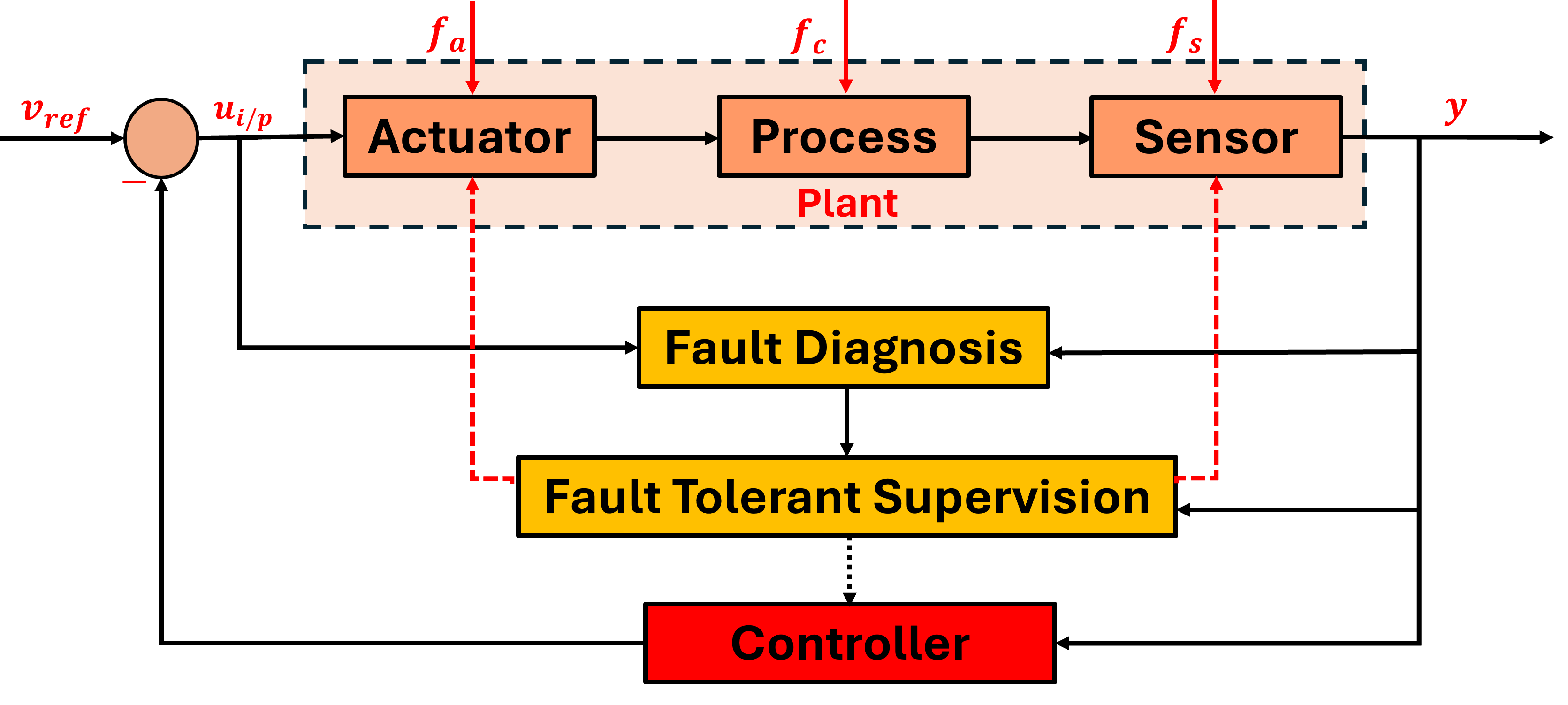
- The framework combines fault detection, isolation, and identification (FDI) with reconfiguration strategies to ensure graceful degradation or autonomous recovery.
- Key components include autoencoders (AEs) for anomaly detection, restricted/Deep Boltzmann machines (RBM/DBM) for representation learning, and hybrid models (e.g., TS-Kalman filters) for uncertainty handling.
Experimental results
Research questions
- RQ1How have AI and machine learning techniques transformed fault diagnosis and fault-tolerant control in robotic manipulators compared to traditional model-based methods?
- RQ2What is the role of digital twin technologies in enabling real-time monitoring, predictive maintenance, and autonomous fault recovery in robotic systems?
- RQ3Which AI/ML models (e.g., CNN, RNN, DRL) demonstrate superior performance in fault detection and isolation for robotic manipulators under varying operational conditions?
- RQ4How do hybrid control strategies combining model predictive control (MPC) and learning-based methods improve fault tolerance and system stability?
- RQ5What are the emerging challenges and future directions in FTC, including explainability, edge deployment, and energy efficiency in robotic systems?
Key findings
- AI and ML techniques such as deep neural networks (DNN), convolutional neural networks (CNN), and support vector machines (SVM) significantly improve fault detection accuracy and reduce false positives compared to classical signal processing.
- Digital twin technologies enable real-time simulation of manipulator dynamics, allowing for predictive fault diagnosis and pre-emptive system reconfiguration.
- Reinforcement learning (RL) and deep reinforcement learning (DRL) demonstrate strong potential in adaptive control reconfiguration, enabling autonomous recovery from actuator or sensor faults.
- Hybrid approaches such as AFT2BC and LMPC-based controllers ensure stability and robustness under uncertainty, with guaranteed convergence via Lyapunov analysis.
- The integration of digital twins with IoT and edge computing allows for low-latency, scalable fault diagnosis in industrial automation settings.
- Emerging trends like Explainable AI (XAI) and cross-domain knowledge transfer are expected to enhance transparency and generalization of FTC systems across different robotic platforms.
Read this paper
Open the full text in the Nubint reader and ask about any passage as you read.
Read this paper on NubintThis review was generated by AI from the original paper. Please check the paper before citing it.