
[Paper Review] Revisiting oldest stars as cosmological probes: new constraints on the Hubble constant
This study re-evaluates the oldest stars—globular clusters, white dwarfs, and ultra-faint galaxies—as independent cosmological probes to constrain the Hubble constant $H_0$. Using Bayesian inference with conservative priors on formation redshift ($11 \leq z_f \leq 30$) and $\Omega_{\rm M} = 0.30 \pm 0.02$, it derives $H_0 < 70.6$ km/s/Mpc from the most accurate individual age estimates and $H_0 < 73.0$ km/s/Mpc at 90.3% confidence when averaging subsamples, favoring the Planck2020 value over SH0ES.
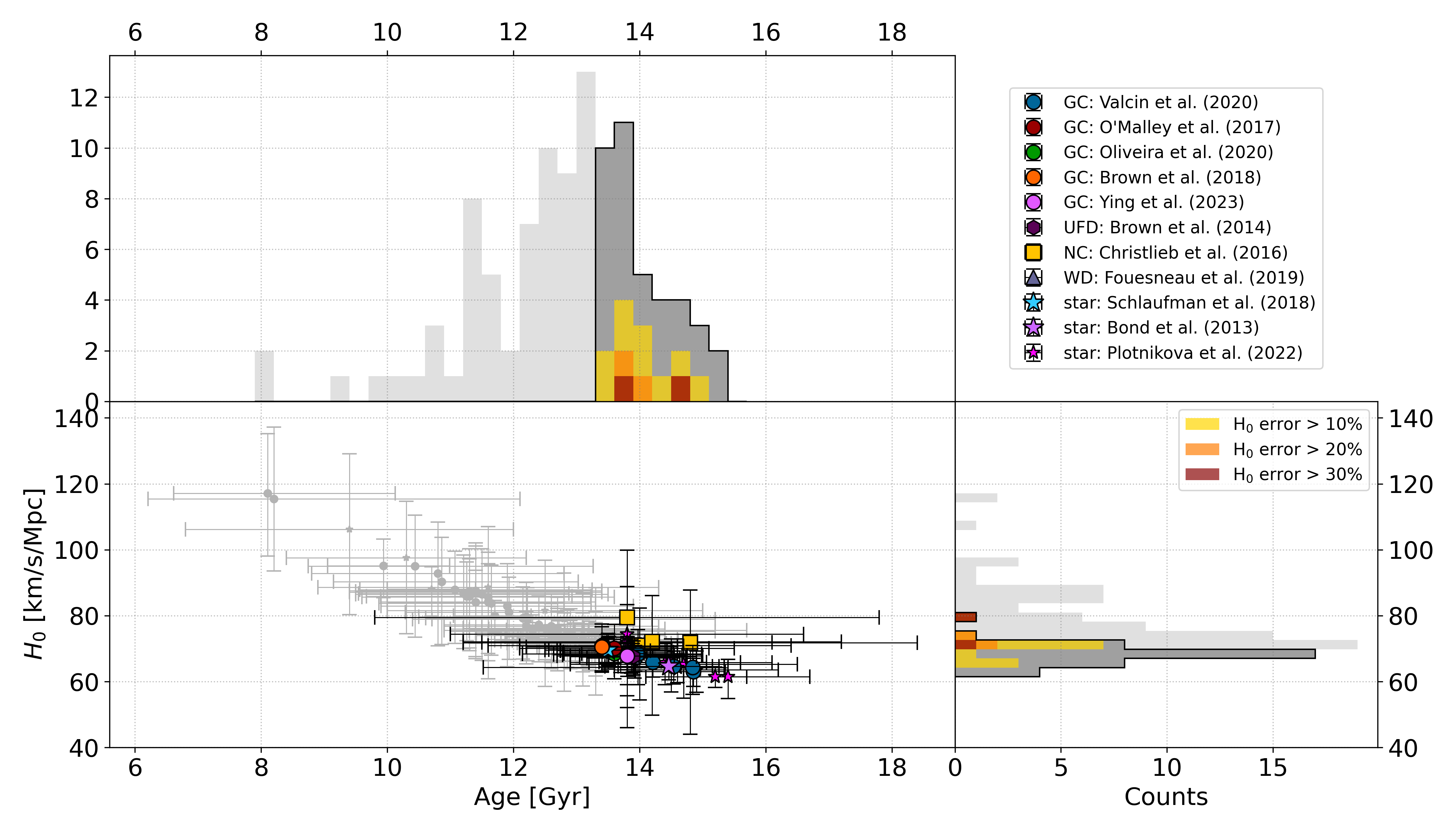
Despite the tremendous advance of observational cosmology, the value of the Hubble constant ($H_0$) is still controversial (the so called ``Hubble tension'') because of the inconsistency between local/late-time measurements and those derived from the cosmic microwave background. As the age of the Universe is very sensitive to $H_0$, we explored whether the present-day oldest stars could place independent constraints on the Hubble constant. To this purpose, we selected from the literature the oldest objects (globular clusters, stars, white dwarfs, ultra-faint and dwarf spheroidal galaxies) with accurate age estimates. Adopting a conservative prior on their formation redshifts ($11 \leq z_{ m f} \leq 30$) and assuming $Ω_{ m M} = 0.3 \pm 0.02$, we developed a method based on Bayesian statistics to estimate the Hubble constant. We selected the oldest objects ($>13.3$ Gyr) and estimated $H_0$ both for each of them individually and for the average ages of homogeneous subsamples. Statistical and systematic uncertainties were properly taken into account. The constraints based on individual ages indicate that $H_0<70.6$ km/s/Mpc when selecting the most accurate estimates. If the ages are averaged and analyzed independently for each subsample, the most stringent constraints imply $H_0<73.0$ with a probability of 90.3% and errors around 2.5 km/s/Mpc. We also constructed an ``accuracy matrix'' to assess how the constraints on $H_0$ become more stringent with further improvements in the accuracy of stellar ages and $Ω_{ m M}$. The results show the high potential of the oldest stars as independent and competitive cosmological probes not only limited to the Hubble constant.
Motivation & Objective
- To assess the potential of the oldest stars as independent cosmological probes for constraining the Hubble constant $H_0$.
- To address the Hubble tension by leveraging the age of the oldest observable objects, which must be younger than the age of the Universe.
- To develop a Bayesian framework that accounts for statistical and systematic uncertainties in stellar age estimates and cosmological parameters.
- To quantify how improvements in age and $\Omega_{\rm M}$ accuracy can tighten constraints on $H_0$.
- To evaluate the compatibility of observed stellar ages with late-time ($H_0$) and early-universe ($H_0$) measurements, particularly Planck2020 vs. SH0ES.
Proposed method
- Applies Bayesian inference to estimate $H_0$ using the age of the oldest stars under a flat $\Lambda$CDM model.
- Imposes a conservative uniform prior on formation redshift $z_f \in [11, 30]$ to minimize model dependence.
- Uses a Gaussian prior on $\Omega_{\rm M} = 0.30 \pm 0.02$, informed by late-Universe probes independent of CMB data.
- Employs the integral relation $H_0 = A / t \int_0^{z_f} [\Omega_{\rm M}(1+z)^3 + (1 - \Omega_{\rm M})]^{-1/2} dz$ to link age $t$ to $H_0$.
- Analyzes 39 objects with ages $>13.3$ Gyr, computing $H_0$ individually and in homogeneous subsamples (e.g., globular clusters, white dwarfs).
- Constructs an 'accuracy matrix' to project how future improvements in stellar age and $\Omega_{\rm M}$ uncertainties will tighten $H_0$ constraints.

Experimental results
Research questions
- RQ1Can the ages of the oldest stars in the present-day Universe provide independent constraints on the Hubble constant $H_0$?
- RQ2How do systematic uncertainties in stellar age estimates affect the derived $H_0$ values, and can they be mitigated?
- RQ3What is the compatibility of the oldest observed stellar ages with the $H_0$ values from the Planck CMB and SH0ES local measurements?
- RQ4To what extent can future improvements in stellar age precision reduce the uncertainty on $H_0$?
- RQ5Can the oldest stars help discriminate between standard $\Lambda$CDM and early dark energy models that attempt to resolve the Hubble tension?
Key findings
- The most accurate individual age estimates yield $H_0 < 70.6$ km/s/Mpc with high confidence, favoring lower values of $H_0$.
- When averaging ages within homogeneous subsamples, the 90.3% credible upper limit on $H_0$ is $73.0$ km/s/Mpc, which is below the SH0ES value of $73.04 \pm 1.04$ km/s/Mpc.
- The results show a strong preference for the Planck2020 $H_0$ value ($67.4 \pm 0.5$ km/s/Mpc) over the SH0ES value, based on the age of the oldest stars.
- The systematic uncertainty from the $\Omega_{\rm M}$ prior contributes at most $\sigma_{\rm syst} = 2.37$ km/s/Mpc, indicating that the method is robust to prior assumptions.
- An accuracy matrix shows that reducing stellar age uncertainties to $\lesssim 0.3-0.4$ Gyr would tighten $H_0$ constraints to $\sim 1-2$ km/s/Mpc, making them competitive with other cosmological probes.
- The study demonstrates that the oldest stars are not only viable but highly promising cosmological probes, with potential to constrain $H_0$ and test models like early dark energy.
Read this paper
Open the full text in the Nubint reader and ask about any passage as you read.
Read this paper on NubintThis review was generated by AI from the original paper. Please check the paper before citing it.