
[Paper Review] RoboPianist: Dexterous Piano Playing with Deep Reinforcement Learning
RoboPianist introduces a deep reinforcement learning framework that enables simulated two-handed robotic systems to learn to play 150 diverse piano pieces with high spatial and temporal precision. By integrating human-provided fingering annotations and multi-task imitation learning, the system achieves over 83% performance gain over model-based baselines, demonstrating advanced bi-manual dexterity in high-dimensional control.
Replicating human-like dexterity in robot hands represents one of the largest open problems in robotics. Reinforcement learning is a promising approach that has achieved impressive progress in the last few years; however, the class of problems it has typically addressed corresponds to a rather narrow definition of dexterity as compared to human capabilities. To address this gap, we investigate piano-playing, a skill that challenges even the human limits of dexterity, as a means to test high-dimensional control, and which requires high spatial and temporal precision, and complex finger coordination and planning. We introduce RoboPianist, a system that enables simulated anthropomorphic hands to learn an extensive repertoire of 150 piano pieces where traditional model-based optimization struggles. We additionally introduce an open-sourced environment, benchmark of tasks, interpretable evaluation metrics, and open challenges for future study. Our website featuring videos, code, and datasets is available at https://kzakka.com/robopianist/
Motivation & Objective
- Address the challenge of high-dimensional, bi-manual dexterous control in robotics, going beyond simple manipulation tasks.
- Develop a benchmark for evaluating dexterous manipulation that captures complex coordination, timing, and planning.
- Enable end-to-end learning of piano-playing policies using deep reinforcement learning with human priors.
- Demonstrate multi-task generalization by training a single policy to play multiple diverse musical pieces.
- Provide an open-source environment and dataset to advance research in high-dimensional control and robotic dexterity.
Proposed method
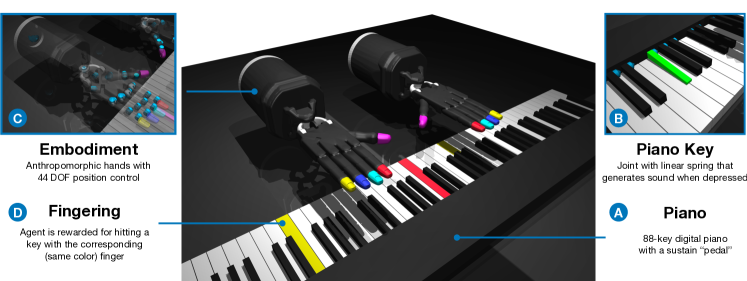
- Design a simulated environment with two anthropomorphic robot hands (44 degrees of freedom) and a digital piano keyboard with 88 key-spring models.
- Use deep reinforcement learning with curriculum learning to train policies that map MIDI sequences to precise finger movements.
- Incorporate human-provided fingering annotations as a form of behavioral prior to guide exploration and improve sample efficiency.
- Implement multi-task imitation learning using behavior cloning to train a single policy capable of playing multiple songs.
- Optimize hyperparameters such as control timestep (0.05s), lookahead horizon, and discount factor (0.84–0.92) for optimal performance.
- Use F1 score and note timing accuracy as interpretable evaluation metrics to assess policy performance across songs of varying complexity.
Experimental results
Research questions
- RQ1Can deep reinforcement learning successfully train bi-manual robotic hands to play complex, multi-note piano pieces with high temporal and spatial precision?
- RQ2How effective are human-provided fingering annotations in accelerating learning and improving policy performance in high-dimensional control?
- RQ3To what extent can a single multi-task policy generalize across diverse musical pieces without task-specific fine-tuning?
- RQ4What hyperparameter configurations (e.g., control frequency, discount factor) yield optimal performance on complex, fast-paced pieces like 'Für Elise'?
- RQ5How does the proposed RL-based approach compare to strong model-based optimization methods in terms of generalization and performance on unseen pieces?
Key findings
- RoboPianist surpasses a strong model-based baseline by over 83% in overall performance across the 150-piece benchmark.
- The use of human-provided fingering annotations significantly improves sample efficiency and final policy performance in deep reinforcement learning.
- Multi-task imitation learning enables a single policy to generalize across 150 diverse piano pieces with high F1 scores.
- A control timestep of 0.05 seconds (20Hz) provides optimal balance between control granularity and computational tractability.
- The discount factor has a critical impact on performance, with values in the range 0.84–0.92 yielding the best results, especially on complex pieces.
- Agents trained with lower discount factors (e.g., 0.84) showed higher F1 scores and more aggressive learning, while higher discounts led to conservative behavior and suboptimal performance.

Read this paper
Open the full text in the Nubint reader and ask about any passage as you read.
Read this paper on NubintThis review was generated by AI from the original paper. Please check the paper before citing it.