
[Paper Review] RoMa: Robust Dense Feature Matching
RoMa proposes a robust dense feature matching method that combines frozen DINOv2 features for coarse-level matching with specialized ConvNet features for fine-level refinement, using a transformer decoder that predicts anchor probabilities to model multimodal distributions. It achieves a 36% improvement on the challenging WxBS benchmark, setting a new state-of-the-art in dense matching robustness under extreme real-world variations.
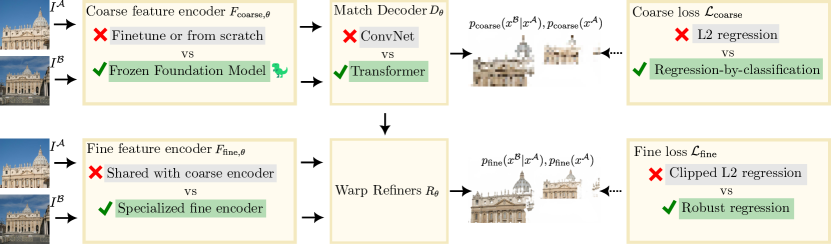
Feature matching is an important computer vision task that involves estimating correspondences between two images of a 3D scene, and dense methods estimate all such correspondences. The aim is to learn a robust model, i.e., a model able to match under challenging real-world changes. In this work, we propose such a model, leveraging frozen pretrained features from the foundation model DINOv2. Although these features are significantly more robust than local features trained from scratch, they are inherently coarse. We therefore combine them with specialized ConvNet fine features, creating a precisely localizable feature pyramid. To further improve robustness, we propose a tailored transformer match decoder that predicts anchor probabilities, which enables it to express multimodality. Finally, we propose an improved loss formulation through regression-by-classification with subsequent robust regression. We conduct a comprehensive set of experiments that show that our method, RoMa, achieves significant gains, setting a new state-of-the-art. In particular, we achieve a 36% improvement on the extremely challenging WxBS benchmark. Code is provided at https://github.com/Parskatt/RoMa
Motivation & Objective
- Address the lack of robustness in dense feature matching under extreme real-world changes such as illumination, viewpoint, scale, and texture variations.
- Overcome the limitations of fine-tuning or training from scratch by leveraging frozen, self-supervised pretrained features from DINOv2 for improved generalization.
- Improve matching accuracy by combining coarse DINOv2 features with specialized ConvNet features tailored for fine-grained localization.
- Enhance robustness in multimodal matching scenarios by redesigning the match decoder to predict anchor probabilities instead of direct coordinate regression.
- Optimize training via a dual-loss strategy—regression-by-classification for coarse matching and robust regression for refinement—better aligning with the underlying data distribution.
Proposed method
- Utilize frozen DINOv2 features as a robust, general-purpose backbone for coarse feature extraction, avoiding overfitting from limited 3D-supervised data.
- Introduce a specialized ConvNet to extract fine-grained features that enable precise localization, trained independently from the DINOv2 features.
- Construct a feature pyramid by fusing DINOv2's coarse features with the ConvNet's fine features, enabling multi-scale, accurate matching.
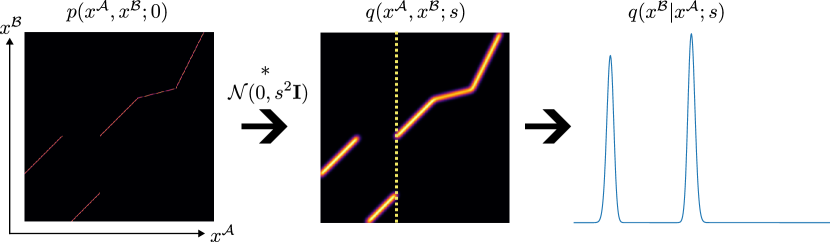
- Design a coordinate-agnostic transformer decoder that predicts anchor probabilities, allowing the model to express multimodal matching distributions.
- Implement a two-stage loss strategy: regression-by-classification for coarse matching to handle multimodal distributions, followed by robust regression for refinement to handle unimodal local distributions.
- Train the model using a combination of supervised correspondence data and the proposed loss functions, enabling end-to-end optimization of the full pipeline.
Experimental results
Research questions
- RQ1Can frozen, self-supervised features from DINOv2 significantly improve robustness in dense feature matching compared to fine-tuned or randomly initialized features?
- RQ2Does combining coarse features from a foundation model with fine features from a specialized ConvNet lead to better localization accuracy than joint training of features?
- RQ3Can modeling matching as anchor probability prediction instead of direct coordinate regression improve performance in multimodal matching scenarios?
- RQ4Is a dual-loss strategy—regression-by-classification for coarse matching and robust regression for refinement—more effective than standard L2 losses?
- RQ5To what extent does the proposed method improve performance on extreme benchmarks like WxBS, where prior methods fail?
Key findings
- RoMa achieves a 36% relative improvement in mean average precision (mAP) on the extremely challenging WxBS benchmark, setting a new state-of-the-art.
- On the IMC2022 benchmark, RoMa reduces relative error by 26% compared to the previous SOTA method, demonstrating strong generalization on wide-baseline matching.
- RoMa achieves the first AUC@20° score above 70 on the ScanNet-1500 benchmark, indicating superior performance in low-texture, high-variation indoor scenes.
- On the MegaDepth-8-Scenes benchmark, RoMa achieves an AUC@20° of 85.3, outperforming previous SOTA methods such as DKM (84.2) and ASpanFormer (82.9).
- In visual localization on the InLoc benchmark, RoMa achieves 89.9% localization accuracy within 0.25m and 2°, surpassing all prior methods.
- Despite introducing a more complex architecture, RoMa incurs only a 7% increase in inference time (198.8ms vs. 186.3ms at 560×560 resolution), indicating efficient deployment.
Read this paper
Open the full text in the Nubint reader and ask about any passage as you read.
Read this paper on NubintThis review was generated by AI from the original paper. Please check the paper before citing it.