
[Paper Review] SAFE: Secure Aggregation with Failover and Encryption
This paper proposes SAFE, a secure aggregation protocol for federated learning that chains learners in a cycle, uses a single initiator to apply a random mask, and limits the controller to message brokering. It achieves 70x faster aggregation than state-of-the-art methods with 36 nodes by reducing communication overhead and enabling efficient failover recovery, while remaining efficient on constrained devices like IoT gateways.
We propose and experimentally evaluate a novel secure aggregation algorithm targeted at cross-organizational federated learning applications with a fixed set of participating learners. Our solution organizes learners in a chain and encrypts all traffic to reduce the controller of the aggregation to a mere message broker. We show that our algorithm scales better and is less resource demanding than existing solutions, while being easy to implement on constrained platforms. With 36 nodes our method outperforms state-of-the-art secure aggregation by 70x, and 56x with and without failover, respectively.
Motivation & Objective
- To address privacy and scalability challenges in cross-organizational federated learning with constrained, stable learners.
- To reduce controller involvement to message routing only, minimizing trust and resource use.
- To enable efficient failure recovery without requiring full secret re-computation across all nodes.
- To optimize performance on low-compute devices such as IoT gateways and embedded systems.
- To improve scalability through subgrouping and efficient encryption-based compression.
Proposed method
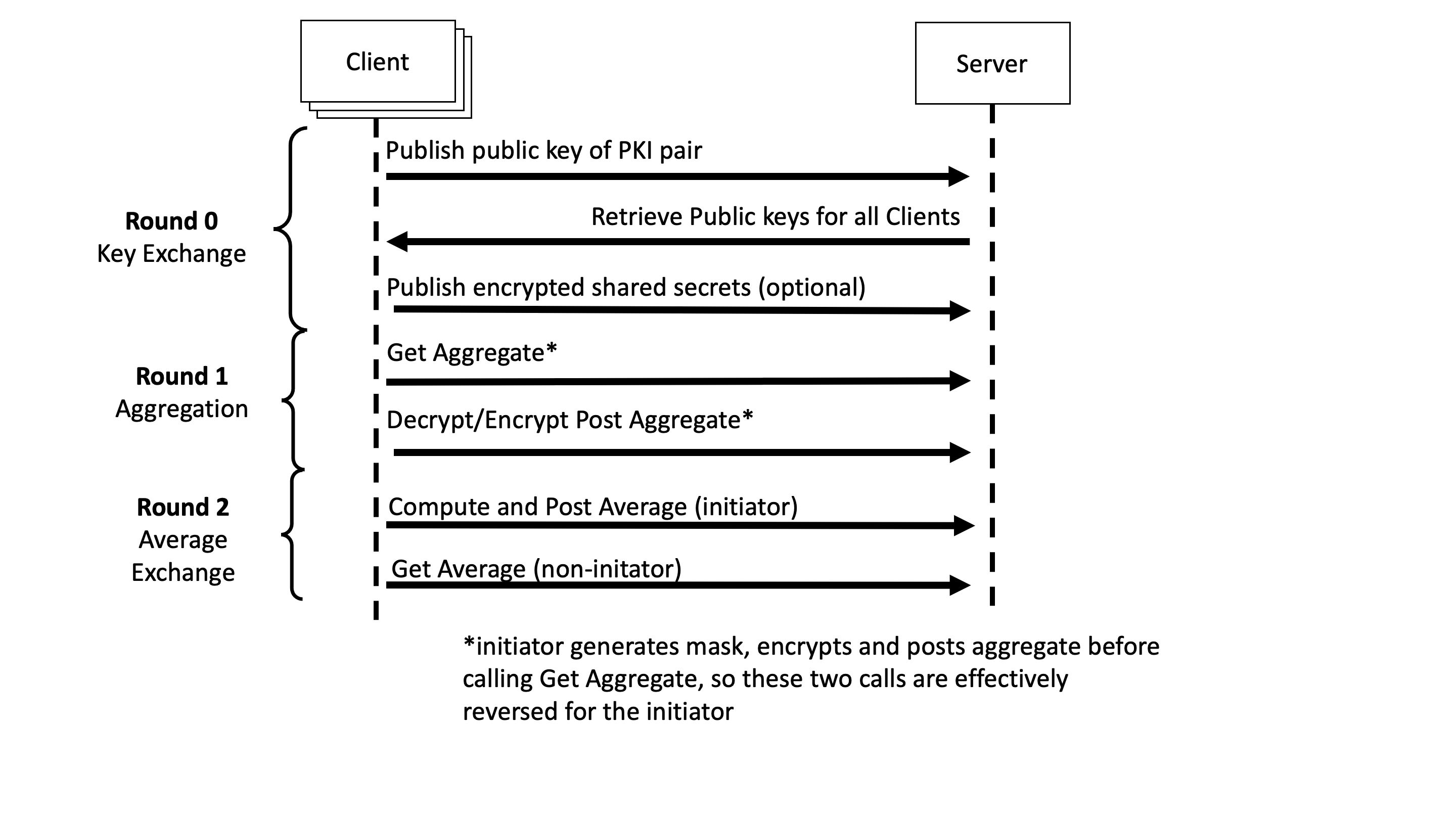
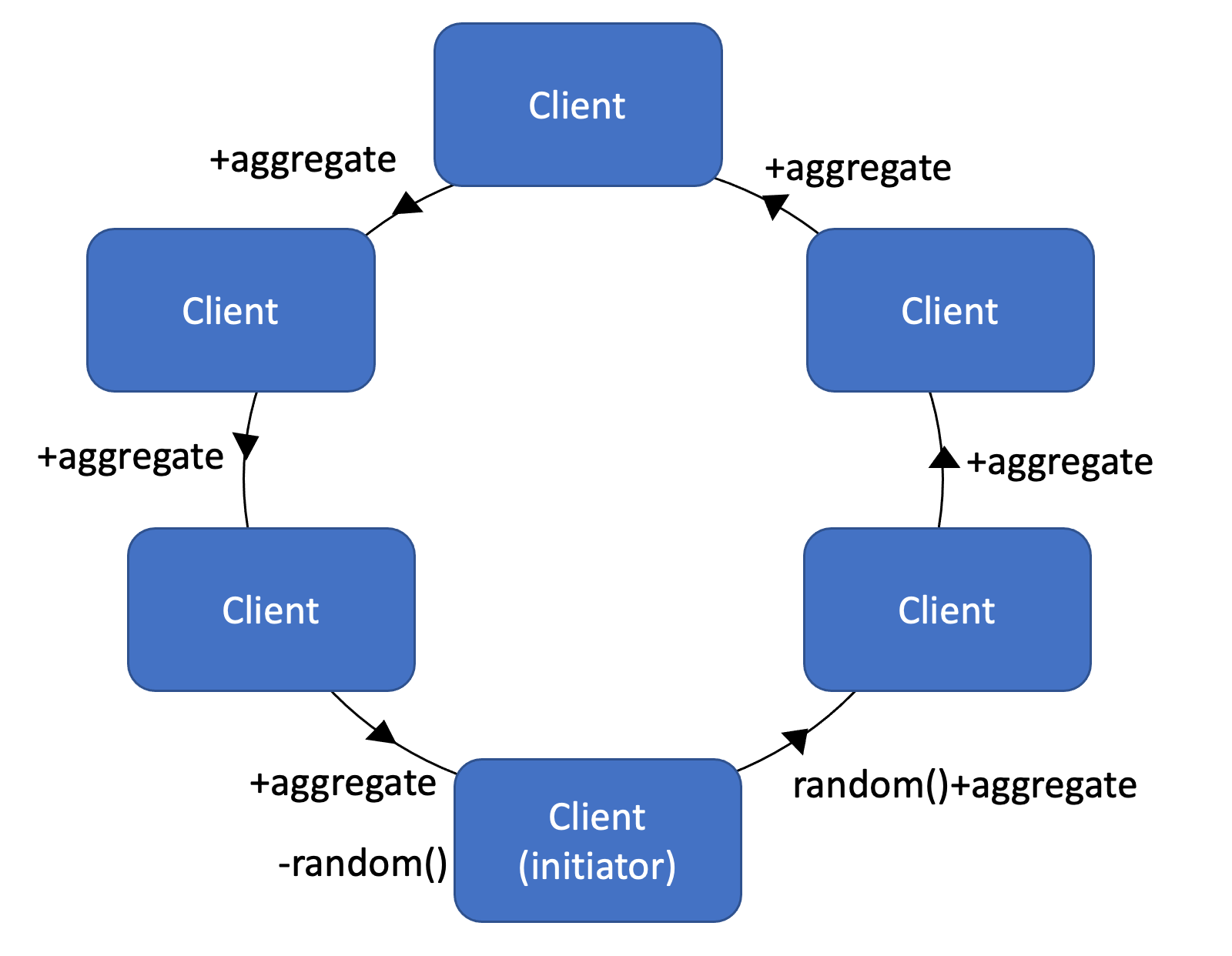
- Learners are organized in a logical chain where each forwards encrypted updates to the next, with the initiator applying a single random mask to all model updates.
- All communication is end-to-end encrypted using public-key cryptography, ensuring the controller cannot access individual model parameters.
- The controller acts only as a message broker and progress monitor, not as an active participant in aggregation computation.
- Failures are handled by re-encrypting and re-routing updates from the point of failure, minimizing the number of nodes involved in recovery.
- Subgrouping is introduced to parallelize aggregation across multiple chains, improving throughput for large numbers of nodes.
- The protocol is implemented using lightweight primitives (coreutils, OpenSSL) to ensure compatibility with constrained platforms like OpenWrt.
Experimental results
Research questions
- RQ1Can a secure aggregation protocol be designed that minimizes controller trust and resource usage while enabling efficient failure recovery?
- RQ2How does a single-mask, chain-based approach compare to pairwise masking in terms of performance and resilience on constrained devices?
- RQ3To what extent can subgrouping improve scalability and reduce aggregation latency in large federated learning setups?
- RQ4What is the performance overhead of end-to-end encryption on low-power edge devices in a secure aggregation pipeline?
- RQ5How does the protocol handle node failures without requiring full secret re-sharing or global recomputation?
Key findings
- With 36 nodes, SAFE achieves a 70x performance improvement over state-of-the-art secure aggregation protocols, both with and without failover.
- The protocol reduces resource consumption by eliminating the need for pairwise secret sharing and global recovery mechanisms.
- On constrained devices like OpenWrt-based access points, SAFE can be efficiently implemented using only coreutils and OpenSSL, enabling deployment on low-compute platforms.
- Subgrouping with four parallel groups reduces aggregation time from ~4.5 seconds to ~2 seconds for 12 nodes with 1 feature, demonstrating significant throughput gains.
- The performance crossover between SAFE and prior methods occurs between 5 and 10 features, indicating strong efficiency for moderate-dimensional model updates.
- The protocol remains practical for subgroups of 3 to 100 nodes, though hierarchical federation is recommended for scaling beyond this range.
Read this paper
Open the full text in the Nubint reader and ask about any passage as you read.
Read this paper on NubintThis review was generated by AI from the original paper. Please check the paper before citing it.