
[Paper Review] Salute the Classic: Revisiting Challenges of Machine Translation in the Age of Large Language Models
This paper revisits six classical challenges in machine translation within the context of large language models (LLMs), demonstrating that while LLMs significantly reduce reliance on parallel data and excel at translating long sentences (up to 512 words), persistent issues remain in domain mismatch, rare word prediction, inference efficiency, low-resource language performance, and human-aligned evaluation. The study highlights that LLMs introduce new challenges beyond traditional NMT, necessitating improved evaluation methods and model interpretability.
The evolution of Neural Machine Translation (NMT) has been significantly influenced by six core challenges (Koehn and Knowles, 2017), which have acted as benchmarks for progress in this field. This study revisits these challenges, offering insights into their ongoing relevance in the context of advanced Large Language Models (LLMs): domain mismatch, amount of parallel data, rare word prediction, translation of long sentences, attention model as word alignment, and sub-optimal beam search. Our empirical findings indicate that LLMs effectively lessen the reliance on parallel data for major languages in the pretraining phase. Additionally, the LLM-based translation system significantly enhances the translation of long sentences that contain approximately 80 words and shows the capability to translate documents of up to 512 words. However, despite these significant improvements, the challenges of domain mismatch and prediction of rare words persist. While the challenges of word alignment and beam search, specifically associated with NMT, may not apply to LLMs, we identify three new challenges for LLMs in translation tasks: inference efficiency, translation of low-resource languages in the pretraining phase, and human-aligned evaluation. The datasets and models are released at https://github.com/pangjh3/LLM4MT.
Motivation & Objective
- To reassess the relevance of six classical machine translation challenges in the era of large language models (LLMs).
- To evaluate how LLMs perform on traditional MT challenges such as domain mismatch, rare word prediction, and long-sequence translation.
- To identify new challenges emerging in LLM-based translation, including inference efficiency, low-resource language performance, and evaluation discrepancies.
- To compare automatic (BLEU) and human (MQM) evaluation metrics, revealing a moderate negative correlation (-0.53) between them.
- To advocate for human-centered evaluation and interpretability improvements in LLM-based translation systems.
Proposed method
- The study uses Llama2-7b as the foundational LLM for German-to-English translation, leveraging its pretraining on large-scale monolingual data.
- Experiments evaluate performance across multiple domains (law, medical, IT, Koran, subtitles) using both in-domain and out-of-domain test sets.
- Document-level translation is assessed using a 200K general-domain training set and sacreBLEU (d-BLEU) for automatic evaluation.
- Human evaluation is conducted using a customized multidimensional quality metric (MQM) adapted for literary translation, with case-sensitive scoring.
- The correlation between human (MQM) and automatic (d-BLEU) evaluation is computed using Pearson’s coefficient.
- The study compares LLM-based translation (Llama2-MT) with GPT-4 and Google Translate to assess relative performance and evaluation divergence.
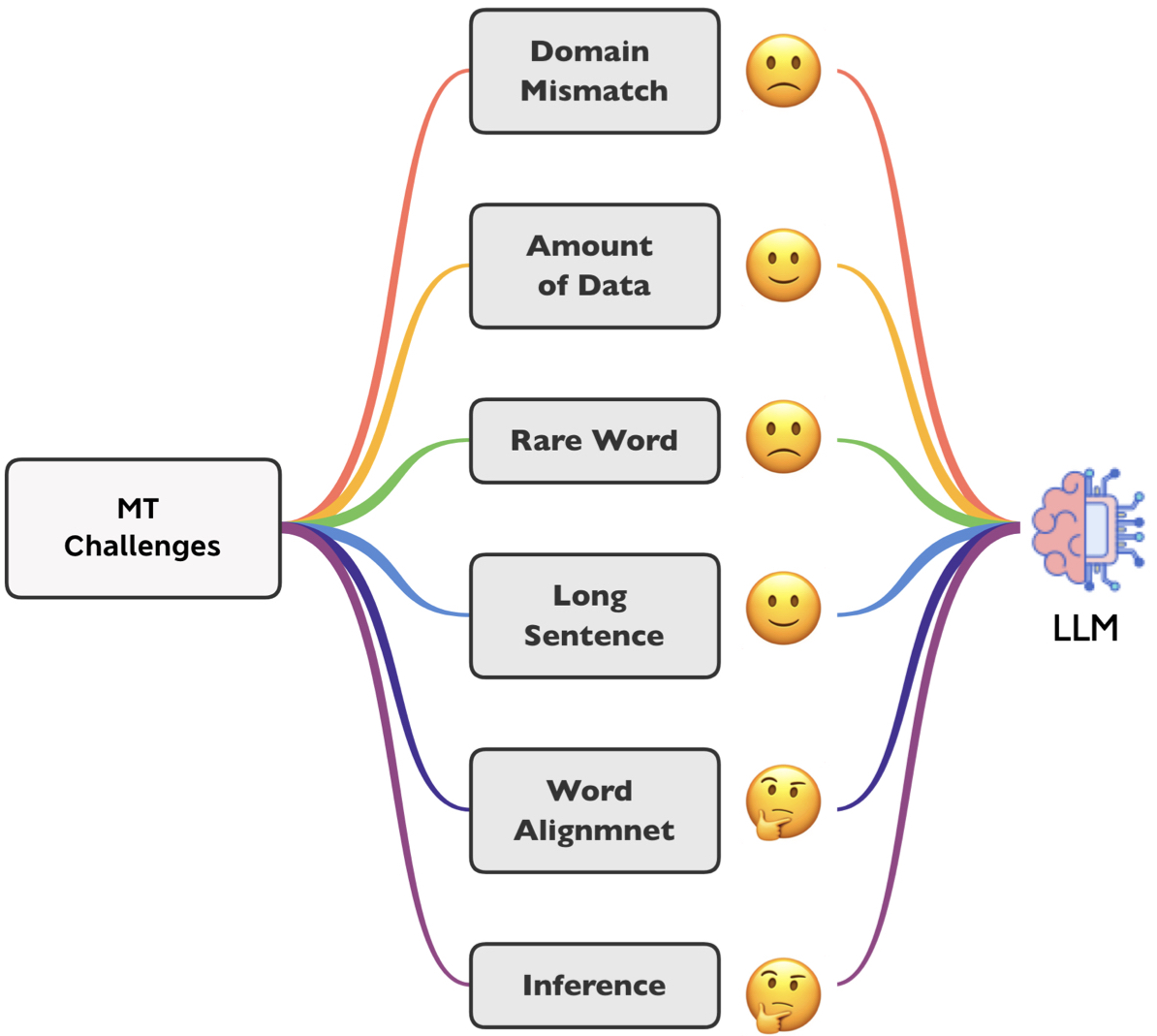
Experimental results
Research questions
- RQ1To what extent do LLMs resolve the six classical challenges in machine translation as defined by Koehn and Knowles (2017)?
- RQ2How does the performance of LLMs vary across out-of-domain translation tasks, particularly in terms of terminology, style, and hallucination?
- RQ3What are the new challenges introduced by LLMs in translation, beyond the classical NMT challenges?
- RQ4How do automatic evaluation metrics (e.g., d-BLEU) compare to human evaluation (MQM) in assessing LLM-based translation quality?
- RQ5What are the implications of the observed correlation (-0.53) between human and automatic evaluation for future model development?
Key findings
- LLM-based translation systems significantly reduce dependency on parallel training data for high-resource languages like English and German.
- LLMs achieve consistent performance in translating long sentences (up to 80 words) and documents of approximately 500 words, outperforming traditional NMT in this regard.
- Despite improvements, domain mismatch remains a challenge, with notable performance drops when translating out-of-domain texts such as legal or religious documents.
- Rare word prediction remains a persistent issue, with LLMs frequently omitting or mistranslating rare terms, especially in low-resource domains.
- Inference efficiency is a major bottleneck, with LLMs exhibiting a 100-fold latency increase compared to standard NMT models.
- A moderate negative correlation (r = -0.53) exists between human evaluation (MQM) and automatic evaluation (d-BLEU), indicating a significant divergence in perceived translation quality.

Read this paper
Open the full text in the Nubint reader and ask about any passage as you read.
Read this paper on NubintThis review was generated by AI from the original paper. Please check the paper before citing it.