
[Paper Review] Scale-Free Networks beyond Power-Law Degree Distribution
This paper demonstrates that the degree–degree distance distribution (DDDD) is a more universal indicator of scale-free networks than the traditional degree distribution (DD), proving that all networks with a power-law DD also exhibit a power-law DDDD, but not vice versa. The authors introduce two network models—based on preferential attachment and fitness mechanisms—that generate power-law DDDD without power-law DD, showing DDDD better captures underlying mechanisms of scale-freeness in real-world networks.
Complex networks across various fields are often considered to be scale free -- a statistical property usually solely characterized by a power-law distribution of the nodes' degree $k$. However, this characterization is incomplete. In real-world networks, the distribution of the degree-degree distance $η$, a simple link-based metric of network connectivity similar to $k$, appears to exhibit a stronger power-law distribution than $k$. While offering an alternative characterization of scale-freeness, the discovery of $η$ raises a fundamental question: do the power laws of $k$ and $η$ represent the same scale-freeness? To address this question, here we investigate the exact asymptotic {relationship} between the distributions of $k$ and $η$, proving that every network with a power-law distribution of $k$ also has a power-law distribution of $η$, but \emph{not} vice versa. This prompts us to introduce two network models as counterexamples that have a power-law distribution of $η$ but not $k$, constructed using the preferential attachment and fitness mechanisms, respectively. Both models show promising accuracy by fitting only one model parameter each when modeling real-world networks. Our findings suggest that $η$ is a more suitable indicator of scale-freeness and can provide a deeper understanding of the universality and underlying mechanisms of scale-free networks.
Motivation & Objective
- To investigate whether power-law degree–degree distance distribution (DDDD) and power-law degree distribution (DD) represent the same scale-freeness in complex networks.
- To determine the asymptotic relationship between the distributions of degree $k$ and degree–degree distance $\eta$.
- To construct counterexamples showing networks with power-law DDDD but not power-law DD, challenging the primacy of DD as the sole indicator of scale-freeness.
- To propose DDDD as a more robust and universal indicator of scale-free network mechanisms, especially when DD fails to exhibit power-law behavior.
- To extend scale-free network theories—such as percolation and dynamical systems—beyond networks with power-law DD by incorporating DDDD.
Proposed method
- Theoretical analysis of the asymptotic relationship between the degree distribution $f(k) \propto k^{-\alpha}$ and the degree–degree distance distribution $g(\eta)$, using analytical derivation and limit analysis.
- Derivation of the DDDD for the Erdős–Rényi random graph model, showing it is not power-law due to an upper bound on $\eta$ and an exponential decay term, even when $p_0$ is fixed.
- Construction of two network models: one using preferential attachment with a time-dependent fitness threshold, and another using a fitness-based attachment mechanism, both designed to produce power-law DDDD without power-law DD.
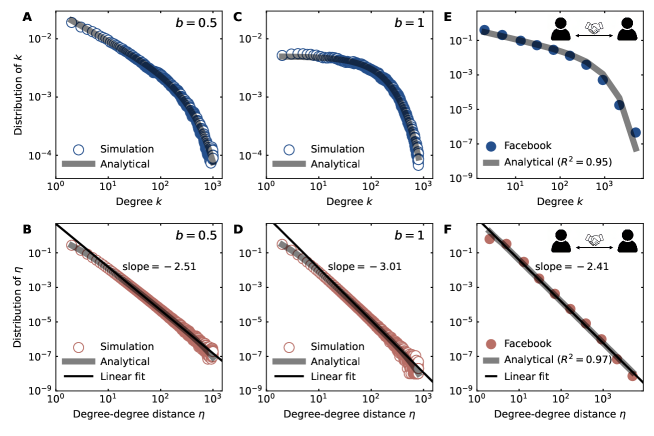
- Analytical derivation of the DDDD for both models, showing $g(\eta) \propto \eta^{-\beta}$ for $\beta \approx 2.5$ in the asymptotic regime, while $f(k)$ is not power-law.
- Use of the degree–degree distance $\eta = \exp\left|\ln k_i - \ln k_j\right|$ as a link-based metric to quantify connectivity imbalance, replacing or complementing node-based degree $k$.
- Validation of the models on real-world networks (e.g., Facebook, WorldCity), showing accurate fitting with only one adjustable parameter per model, supporting empirical relevance.
Experimental results
Research questions
- RQ1Is the power-law distribution of the degree–degree distance $\eta$ a necessary or sufficient condition for a network to be considered scale-free?
- RQ2Does every network with a power-law degree distribution $f(k)$ also exhibit a power-law degree–degree distance distribution $g(\eta)$?
- RQ3Can networks exist with a power-law $g(\eta)$ but not a power-law $f(k)$, and if so, what mechanisms generate them?
- RQ4How does the DDDD compare to the DD in capturing the underlying mechanisms of real-world complex networks?
- RQ5Can the DDDD serve as a more universal and robust indicator of scale-freeness than the traditional DD, especially in finite-size or non-ideal networks?
Key findings
- All networks with a power-law degree distribution $f(k) \propto k^{-\alpha}$ also exhibit a power-law degree–degree distance distribution $g(\eta) \propto \eta^{-\beta}$, proving that power-law DDDD is a necessary consequence of power-law DD.
- The converse is not true: networks can have a power-law DDDD without a power-law DD, as demonstrated by two constructed models based on preferential attachment and fitness mechanisms.
- The DDDD in the Erdős–Rényi random graph model is not power-law due to the finite upper bound on $\eta$ and the presence of an exponential decay term, even in the large-$N$ limit.
- The constructed preferential attachment and fitness-based models each produce a power-law DDDD with exponent $\beta \approx 2.5$ while avoiding power-law DD, confirming that DDDD can be power-law independently of DD.
- The DDDD is more universal than the DD as an indicator of scale-freeness, as it captures scale-invariant connectivity imbalances even when the degree distribution fails to show a power law.
- Empirical fitting of the DDDD-based models to real-world networks (e.g., Facebook, WorldCity) achieves high accuracy with only one adjustable parameter, suggesting practical utility in modeling complex systems.

Read this paper
Open the full text in the Nubint reader and ask about any passage as you read.
Read this paper on NubintThis review was generated by AI from the original paper. Please check the paper before citing it.