
[Paper Review] Scaling Riemannian Diffusion Models
This paper proposes a scalable Riemannian diffusion model that leverages Riemannian symmetric spaces to enable high-precision computation of heat kernel quantities, overcoming prior intractable approximations in score matching. By accurately computing the heat kernel and enabling exact sampling via probability flow ODEs, the method achieves state-of-the-art performance on high-dimensional manifolds, including $SU(3)$ lattices (128D) and hyperspherical contrastive embeddings (127D), enabling the first successful application of differential equation-based generative models to real-world tasks in hundreds of dimensions.
Riemannian diffusion models draw inspiration from standard Euclidean space diffusion models to learn distributions on general manifolds. Unfortunately, the additional geometric complexity renders the diffusion transition term inexpressible in closed form, so prior methods resort to imprecise approximations of the score matching training objective that degrade performance and preclude applications in high dimensions. In this work, we reexamine these approximations and propose several practical improvements. Our key observation is that most relevant manifolds are symmetric spaces, which are much more amenable to computation. By leveraging and combining various ansätze, we can quickly compute relevant quantities to high precision. On low dimensional datasets, our correction produces a noticeable improvement, allowing diffusion to compete with other methods. Additionally, we show that our method enables us to scale to high dimensional tasks on nontrivial manifolds. In particular, we model QCD densities on $SU(n)$ lattices and contrastively learned embeddings on high dimensional hyperspheres.
Motivation & Objective
- To address the intractability of denoising score matching in Riemannian diffusion models due to complex geometric structure.
- To enable scalable and accurate training of Riemannian diffusion models on high-dimensional manifolds, particularly those relevant to physics and representation learning.
- To overcome prior approximations in score matching that degrade performance and limit scalability to high dimensions.
- To demonstrate the feasibility of differential equation-based generative modeling on real-world, high-dimensional manifolds such as $SU(n)$ lattices and hyperspherical embeddings.
- To improve model interpretability and performance in contrastive learning by modeling the true hyperspherical distribution instead of relying on penultimate layer features.
Proposed method
- Leverages Riemannian symmetric spaces to enable efficient and precise computation of the heat kernel, which is essential for denoising score matching.
- Adapts known heat kernel techniques to the specific context of Riemannian score matching, allowing fast and stable training.
- Develops an exact sampling method from the heat kernel using the probability flow ODE, solvable via standard ODE solvers on the maximal torus of the manifold.
- Uses the maximal torus to reduce computational complexity and enable efficient simulation-free sampling on symmetric spaces.
- Integrates the precise heat kernel estimator into the denoising score matching objective to improve training stability and performance.
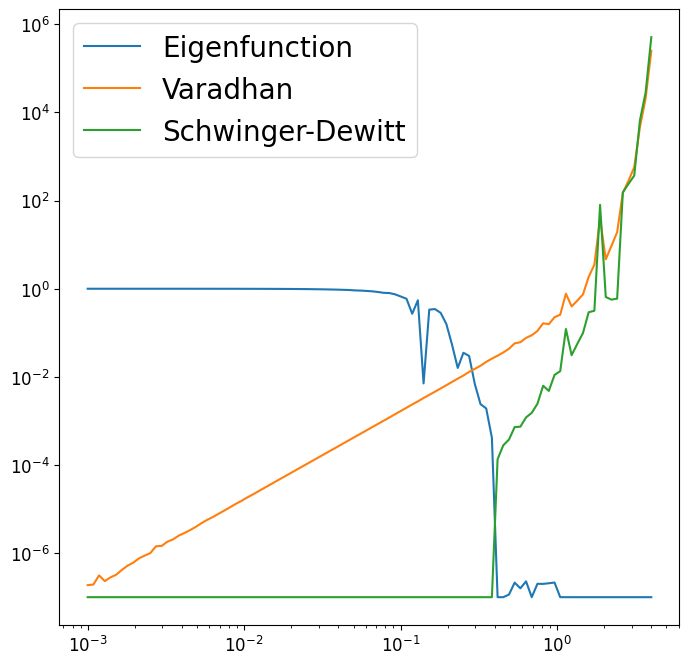
- Applies the method to high-dimensional tasks such as learning the Wilson action on $4\times4$ $SU(3)$ lattices and modeling contrastive learning embeddings on $S^{127}$.
Experimental results
Research questions
- RQ1Can Riemannian diffusion models be scaled to high-dimensional manifolds such as $SU(n)$ lattices and high-dimensional hyperspheres?
- RQ2Can precise heat kernel computation on symmetric spaces eliminate the need for inaccurate approximations in score matching?
- RQ3Does exact sampling via probability flow ODEs improve model performance and training stability on manifolds?
- RQ4Can Riemannian diffusion models recover faithful distributions from contrastively learned hyperspherical embeddings, improving interpretability and OOD detection?
- RQ5Is it possible to achieve state-of-the-art performance in high-dimensional generative modeling on nontrivial manifolds using differential equation-based approaches?
Key findings
- The proposed method achieves an effective sample size of 0.62 when learning the Wilson action on $4\times4$ $SU(3)$ lattices, a high-dimensional $128$-dimensional manifold.
- On contrastive learning embeddings in $127$-dimensional hyperspheres, the Riemannian diffusion model achieves OOD detection performance comparable to or better than state-of-the-art methods using penultimate layer features.
- The model successfully learns complex checkerboard distributions on the flat torus, outperforming RFM and flow matching, which degrade with increasing complexity.
- Without the accurate heat kernel estimator, denoising score matching produces substandard results, demonstrating the necessity of precise geometric computation.
- The method enables the first successful application of differential equation-based generative models to real-world, high-dimensional tasks with hundreds of dimensions.
- The model recovers collapsed projection head representations in contrastive learning, enhancing interpretability by modeling the true hyperspherical distribution.

Read this paper
Open the full text in the Nubint reader and ask about any passage as you read.
Read this paper on NubintThis review was generated by AI from the original paper. Please check the paper before citing it.