
[논문 리뷰] Sciences with the 2.5-meter Wide Field Survey Telescope (WFST)
WFST는 2.5미터 지름의 광시야 광학 망원경에 0.73기가픽셀 카메라를 장착하여, u, g, r, i 대역에서 북반구 하늘을 깊이 있고 고주기로 광학적 측광 조사하는 데 설계되었다. 이는 매년 수천 개의 변량 천체를 탐지할 것이며, 중력파 사건의 전자기적 복사체, 빠른 광학 변량 천체, 간섭파 파괴 사건을 포함한다. 6년간의 유산 데이터셋은 g ≈ 25.8 등급까지 도달하여, 북반구의 시간 영역 및 우주론 과학을 크게 발전시킬 것이다.
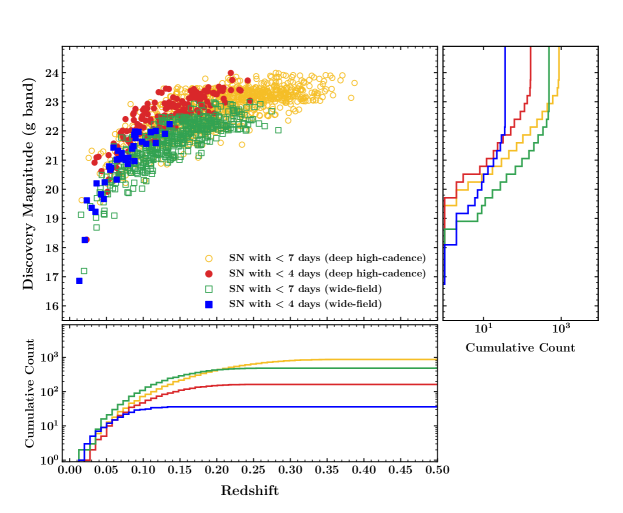
The Wide Field Survey Telescope (WFST) is a dedicated photometric surveying facility being built jointly by the University of Science and Technology of China and the Purple Mountain Observatory. It is equipped with a 2.5-meter diameter primary mirror, an active optics system, and a mosaic CCD camera with 0.73 gigapixels on the primary focal plane for high-quality image capture over an FOV of 6.5-square-degree. It is anticipated that WFST will be set up at the Lenghu site in the summer of 2023 and begin to observe the northern sky in four optical bands (u, g, r, and i) with a range of cadences, from hourly/daily in the Deep High-Cadence Survey (DHS) program to semiweekly in the Wide-Field Survey (WFS) program, three months later. During a photometric night, a nominal 30 s exposure in the WFS program will reach a depth of 22.27, 23.32, 22.84, and 22.31 (AB magnitudes) in these four bands, respectively, allowing for the detection of a tremendous amount of transients in the low-z universe and a systematic investigation of the variability of Galactic and extragalactic objects. In the DHS program, intranight 90 s exposures as deep as 23 (u) and 24 mag (g), in combination with target of opportunity follow-ups, will provide a unique opportunity to explore energetic transients in demand for high sensitivities, including the electromagnetic counterparts of gravitational wave events, supernovae within a few hours of their explosions, tidal disruption events and fast, luminous optical transients even beyond a redshift of unity. In addition, the final 6-year co-added images, anticipated to reach g=25.8 mag in WFS or 1.5 mags deeper in DHS, will be of fundamental importance to general Galactic and extragalactic science. The highly uniform legacy surveys of WFST will serve as an indispensable complement to those of LSST that monitor the southern sky.
연구 동기 및 목표
- 시간 영역 및 다중 메신저 천문학의 핵심적 격차를 보완하기 위해 북반구에 전용 고주기 측광 조사 시설을 구축하는 것.
- 초신성, 간섭파 파괴 사건(TDE), 중력파 및 고에너지 중성자 천체의 전자기적 복사체와 같은 에너지가 큰 변량 천체를 탐지하고 특성화하는 것.
- 이전 조사보다 깊이와 균일성이 향상된 조건에서 은하수의 3차원 먼지 분포, 항성 집단, 위성 소형은하를 맵핑하는 것.
- 루빈 관측소의 LSST와 보완적인 유산 데이터셋을 제공하여, 다른 조사와의 공동 분석을 통해 우주론적 제약 조건을 강화하는 것.
- 지름 10의 행성 가설을 검증하기 위해, 지구 근처 천체, 쌍성, 해왕성 외부 천체를 포함한 소형 태양계 천체의 탐지 및 특성화를 향상시키는 것.
제안 방법
- 2.5미터 망원경에 활성 광학 시스템과 0.73기가픽셀 모자이크 CCD 카메라를 장착하여 6.5제곱도의 시야를 확보하는 것.
- 두 가지 주요 조사 모드를 시행: 반주기 1회 이상의 광시야 조사(WFS)와 야간 내 90초 노출을 반복하는 깊이 있는 고주기 조사(DHS).
- 측광 조건 하에서 u, g, r, i 대역에서 각각 30초 노출 깊이가 22.27, 23.32, 22.84, 22.31 AB 등급에 도달하는 것.
- WFS에서 g ≈ 25.8 등급까지 도달하는 6년간의 통합 이미지와 DHS에서 1.5등급 더 깊은 이미지를 생산하여, 깊은 은하 및 희미한 천체 조사가 가능하도록 하는 것.
- 미래의 스펙트럼 조사(예: LAMOST II, MUST)와 통합하여 변량 및 변동 천체의 적색편이 및 물리적 특성 분석을 가능하게 하는 것.
- 통합된 이미지 데이터를 활용하여 3차원 먼지 투과도 맵핑, 항성 집단 식별, 은하-은하핵 연결성 및 우주론적 구조 형성 탐색
실험 결과
연구 질문
- RQ1저적색편이 우주에서 빠르고 밝은 광학 변량 천체(FLTs)와 중력파 사건의 전자기적 복사체의 발생률과 인구 분포는 어떻게 되는가?
- RQ2대규모 TDE 샘플은 침체한 초거대 블랙홀의 민감도와 중간질량 블랙홀(IMBH) 존재 여부를 어떻게 드러내는가?
- RQ3강한 렌즈 효과와 물질 붕괴 물리학의 맥락에서 활성 은하핵(AGNs)의 극단적인 광학 변동의 물리적 기원은 무엇인가?
- RQ4WFST의 깊고 균일한 측광 데이터는 은하수의 빠진 위성 문제와 3차원 먼지 분포에 대한 제약 조건을 어떻게 향상시키는가?
- RQ5BAO, SNe Ia, CMB, 약한 렌즈 조사와의 공동 분석을 통해 WFST의 유산 이미지 데이터는 우주론적 제약 조건을 얼마나 향상시키는가?
주요 결과
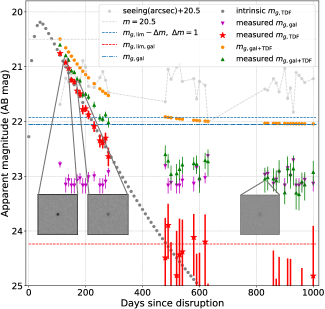
- WFST는 연간 약 100~200개의 TDE를 탐지할 것으로 예상되며, 탐지 가능한 사건의 적색편이 범위를 z ≈ 1.0까지 확장하여 블랙홀 민감도 및 물질 붕괴 물리학 연구가 가능해진다.
- 깊이 있는 고주기 조사(DHS)에서 WFST는 u-대역에서 23 등급, g-대역에서 24 등급까지 도달하여 초신성 폭발 직후 몇 시간 내에 탐지하고, z > 1의 적색편이를 초월하는 빠른 광학 변량 천체를 탐지할 수 있다.
- 최종 6년간의 통합 이미지에서 광시야 조사(WFS)는 g ≈ 25.8 등급까지 도달하고, 깊은 조사(DHS)는 1.5등급 더 깊어져, DES 및 HSC-SSP를 뛰어넘는 깊이와 균일성을 확보한다.
- WFST의 u-대역 커버리지 덕분에 젊은 항성 물체와 AGNs의 물질 붕괴율을 정확하게 측정할 수 있으며, 먼지 투과도 모델링이 향상된다.
- 6년간 약 3페타바이트의 이미지 데이터를 생산하며, WFS는 8,000 제곱도, DHS는 1,000 제곱도를 커버하여, 다파장 및 다중 메신저 연구의 기초가 되는 유산을 형성한다.
- WFST의 데이터는 은하수의 허브에서 낮은 표면 밝기 소형은하의 탐지 능력을 향상시켜 빠진 위성 문제를 직접 검증할 수 있으며, Pan-STARRS1보다 r-대역에서 2~3등급 더 깊은 측광을 제공한다.
더 나은 연구,지금 바로 시작하세요
논문 읽기부터 검토까지, 연구 시간을 획기적으로 줄여보세요.
카드 등록 없음 · 무료 플랜 제공
이 리뷰는 AI가 만들고, 인간 에디터가 검토했습니다.