
[Paper Review] SCOOP: Self-Supervised Correspondence and Optimization-Based Scene Flow
SCOOP proposes a self-supervised 3D scene flow estimation method that decouples correspondence learning from flow refinement: a lightweight network learns point features for soft correspondence to initialize flow, followed by run-time optimization of residual flow updates. Trained on minimal data without ground-truth supervision, SCOOP achieves state-of-the-art accuracy on KITTI while being 8× faster than optimization-only baselines and outperforming supervised methods with far less training data.
Scene flow estimation is a long-standing problem in computer vision, where the goal is to find the 3D motion of a scene from its consecutive observations. Recently, there have been efforts to compute the scene flow from 3D point clouds. A common approach is to train a regression model that consumes source and target point clouds and outputs the per-point translation vector. An alternative is to learn point matches between the point clouds concurrently with regressing a refinement of the initial correspondence flow. In both cases, the learning task is very challenging since the flow regression is done in the free 3D space, and a typical solution is to resort to a large annotated synthetic dataset. We introduce SCOOP, a new method for scene flow estimation that can be learned on a small amount of data without employing ground-truth flow supervision. In contrast to previous work, we train a pure correspondence model focused on learning point feature representation and initialize the flow as the difference between a source point and its softly corresponding target point. Then, in the run-time phase, we directly optimize a flow refinement component with a self-supervised objective, which leads to a coherent and accurate flow field between the point clouds. Experiments on widespread datasets demonstrate the performance gains achieved by our method compared to existing leading techniques while using a fraction of the training data. Our code is publicly available at https://github.com/itailang/SCOOP.
Motivation & Objective
- To address the challenge of scene flow estimation in 3D point clouds with limited or no ground-truth flow annotations.
- To reduce reliance on large-scale synthetic datasets by enabling effective training on small real-world datasets.
- To improve flow accuracy and efficiency by decoupling correspondence learning from flow refinement.
- To achieve high-accuracy scene flow estimation without end-to-end learning of flow regression.
- To balance inference speed and accuracy by combining lightweight correspondence learning with efficient run-time optimization.
Proposed method
- A self-supervised neural network is trained solely to learn point features for soft correspondence between source and target point clouds, using a confidence-aware distance loss.
- Flow initialization is computed as the difference between each source point and its softly corresponding target point, where correspondence is defined via weighted sums of target points based on learned feature similarity.
- At inference time, a residual flow refinement is directly optimized using a self-supervised objective that enforces flow coherence and proximity to the target point cloud.
- The optimization objective includes a smoothness prior to regularize neighboring points to have similar flow vectors, improving field consistency.
- The method avoids end-to-end training of flow regression by separating feature learning (trainable) from flow refinement (optimized at test time).
- Confidence scores from the correspondence network are used to weight the distance loss during training, emphasizing reliable matches.
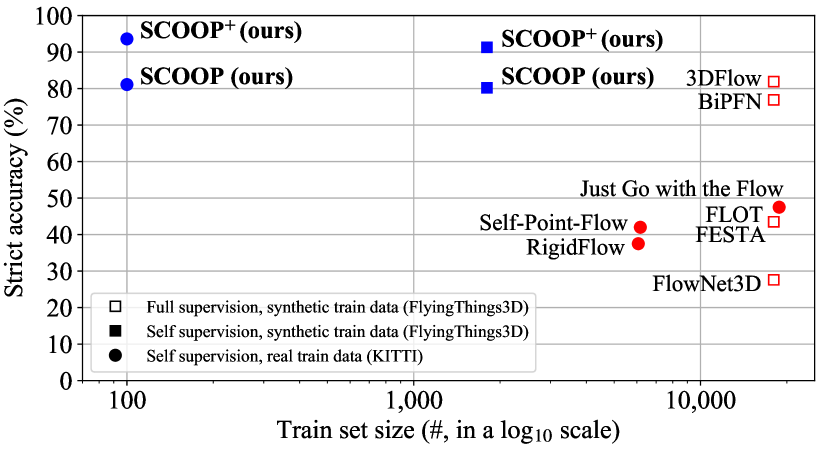
Experimental results
Research questions
- RQ1Can scene flow estimation be accurately performed using only a small amount of real-world data without ground-truth flow supervision?
- RQ2Does decoupling correspondence learning from flow refinement improve performance and reduce data dependency?
- RQ3Can run-time optimization of residual flow updates outperform end-to-end learning-based methods in accuracy and efficiency?
- RQ4How does confidence-aware correspondence learning affect the robustness and accuracy of flow initialization?
- RQ5What is the trade-off between inference time and accuracy when varying the number of optimization steps in the refinement phase?
Key findings
- SCOOP achieves an EPE of 0.039 on the KITTI test set, outperforming state-of-the-art supervised and self-supervised methods while being trained on only a fraction of the data.
- With just 10% of the FT3D training set, SCOOP realizes its full performance potential, demonstrating strong data efficiency.
- SCOOP + reduces EPE by over 50% compared to feed-forward network-only models while achieving 8× faster inference than the optimization-only Neural Prior method.
- The ablation study shows that removing the flow refinement module increases EPE to 0.115, confirming its critical role in improving flow consistency and accuracy.
- Excluding the smoothness loss increases EPE to 0.056, indicating that this regularization is essential for learning robust point representations.
- Using only the highest-transported target points as candidates (rather than all points) improves performance, showing that focused correspondence leads to better initialization.

Read this paper
Open the full text in the Nubint reader and ask about any passage as you read.
Read this paper on NubintThis review was generated by AI from the original paper. Please check the paper before citing it.