
[Paper Review] Search for relativistic magnetic monopoles with five years of the ANTARES detector data
This study presents a search for relativistic magnetic monopoles (MMs) using five years of data from the ANTARES neutrino telescope, analyzing Cherenkov light from relativistic particles in deep-sea water. No signal was observed; the analysis sets the most stringent 90% confidence level upper limits on the MM flux above the Cherenkov threshold ($\beta \geq 0.74$), improving upon previous results and demonstrating the sensitivity of neutrino telescopes to such exotic particles.
A search for magnetic monopoles using five years of data recorded with the ANTARES neutrino telescope from January 2008 to December 2012 with a total live time of 1121 days is presented. The analysis is carried out in the range $β$ $>$ $0.6$ of magnetic monopole velocities using a strategy based on run-by-run Monte Carlo simulations. No signal above the background expectation from atmospheric muons and atmospheric neutrinos is observed, and upper limits are set on the magnetic monopole flux ranging from $5.7 imes 10^{-16}$ to $1.5 imes 10^{-18}$ cm$^{-2} \cdot $ s$^{-1} \cdot $ sr$^{-1}$.
Motivation & Objective
- To search for relativistic magnetic monopoles (MMs) in deep-sea neutrino telescope data using Cherenkov light detection.
- To improve the sensitivity to MMs by analyzing five years of ANTARES data with optimized event reconstruction and background suppression.
- To set new upper limits on the flux of relativistic magnetic monopoles, particularly above the Cherenkov threshold ($\beta \geq 0.74$).
- To assess the performance of neutrino telescopes as detectors for exotic particles like magnetic monopoles.
- To provide a benchmark for future experiments such as KM3NeT, which will have enhanced sensitivity due to larger volume and improved instrumentation.
Proposed method
- Utilized five years of ANTARES data (2008–2012), corresponding to 1,012 active days of live time.
- Applied a multi-variable selection based on hit pattern ($N_{\text{hit}}$), shower opening angle ($\alpha$), and reconstructed velocity ($\beta_{\text{fit}}$) to identify potential MM candidates.
- Divided the analysis into two regions: one with $\beta_{\text{fit}}$ as a free parameter (for $\beta < 0.74$) and one with $\beta_{\text{fit}} = 1$ (for $\beta \geq 0.74$), ensuring exclusive event samples.
- Used atmospheric muon data as a background proxy, extrapolated into the signal region with conservative assumptions.
- Applied final cuts to reduce background, with tighter constraints on $\alpha$ and $N_{\text{hit}}$ in higher-velocity bins.
- Calculated 90% confidence level (C.L.) upper limits on the MM flux using the observed event count and expected background.
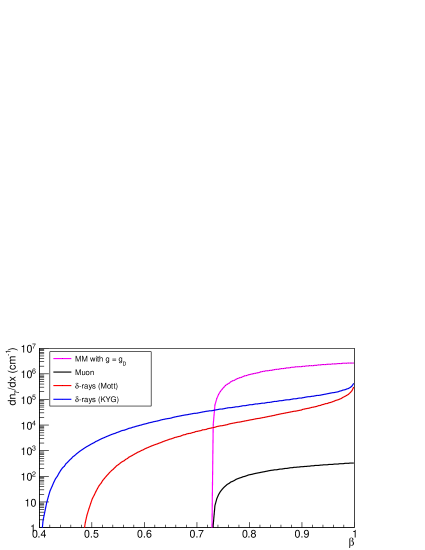
Experimental results
Research questions
- RQ1What is the sensitivity of the ANTARES neutrino telescope to relativistic magnetic monopoles over five years of data?
- RQ2How do the reconstructed kinematic variables ($\beta_{\text{fit}}$, $\alpha$, $N_{\text{hit}}$) help distinguish potential magnetic monopole events from background?
- RQ3What are the upper limits on the flux of relativistic magnetic monopoles, particularly above the Cherenkov threshold?
- RQ4How do the results compare with previous experiments such as IceCube, MACRO, and Baikal, and with theoretical bounds?
- RQ5To what extent can neutrino telescopes like ANTARES and future KM3NeT detect highly relativistic magnetic monopoles?
Key findings
- No significant signal was observed above the atmospheric background expectation, with only one event in the high-velocity region ($\beta \geq 0.74$) consistent with background.
- The total background expectation in the first five velocity bins (where $\beta_{\text{fit}}$ was free) was 5.4 events, compared to one observed event, indicating a conservative background extrapolation.
- For $\beta \geq 0.74$, the ANTARES 90% C.L. upper limit on the magnetic monopole flux is the most stringent to date, surpassing previous results from other experiments.
- The upper limit is valid for magnetic monopoles with mass $M > 10^{10}$ GeV/$c^2$, relevant for Earth-crossing particles.
- The analysis demonstrates that neutrino telescopes are well-suited for detecting relativistic magnetic monopoles due to their ability to resolve high-velocity, highly ionizing showers.
- The future KM3NeT detector is expected to significantly improve sensitivity to magnetic monopoles due to its larger volume and enhanced detection performance.
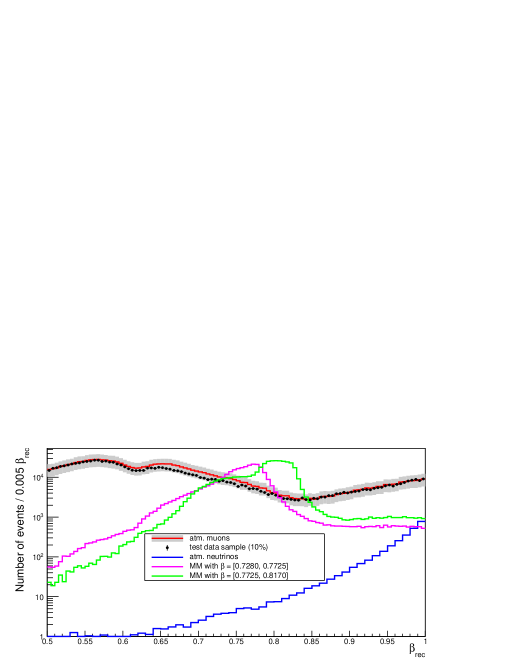
Read this paper
Open the full text in the Nubint reader and ask about any passage as you read.
Read this paper on NubintThis review was generated by AI from the original paper. Please check the paper before citing it.