
[Paper Review] Self-Ensembling with GAN-based Data Augmentation for Domain Adaptation in Semantic Segmentation
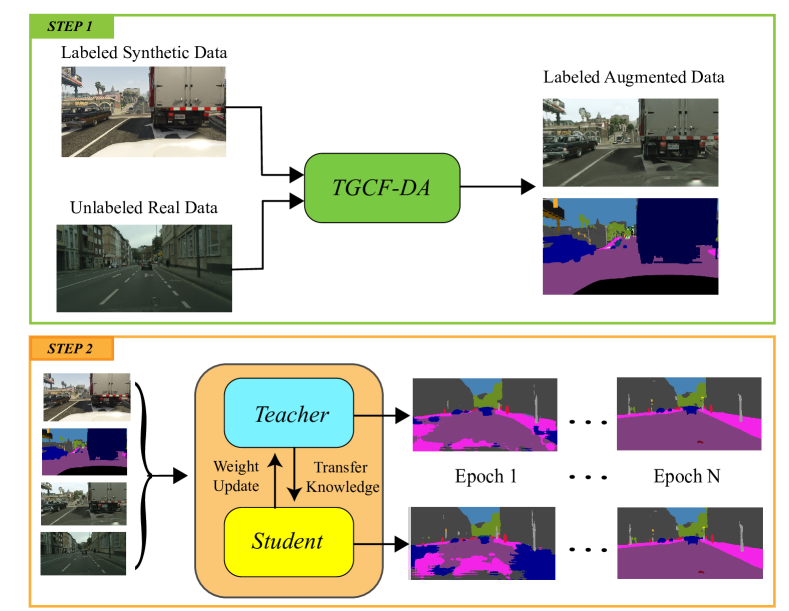
This paper proposes a novel domain adaptation framework for semantic segmentation that combines GAN-based, target-guided, cycle-free data augmentation (TGCF-DA) with self-ensembling to reduce domain shift. By generating semantically consistent, style-transferred images from the target domain and leveraging pseudo-labels from a teacher network, the method achieves state-of-the-art performance on GTA5→Cityscapes and SYNTHIA→Cityscapes benchmarks, outperforming existing approaches.
Deep learning-based semantic segmentation methods have an intrinsic limitation that training a model requires a large amount of data with pixel-level annotations. To address this challenging issue, many researchers give attention to unsupervised domain adaptation for semantic segmentation. Unsupervised domain adaptation seeks to adapt the model trained on the source domain to the target domain. In this paper, we introduce a self-ensembling technique, one of the successful methods for domain adaptation in classification. However, applying self-ensembling to semantic segmentation is very difficult because heavily-tuned manual data augmentation used in self-ensembling is not useful to reduce the large domain gap in the semantic segmentation. To overcome this limitation, we propose a novel framework consisting of two components, which are complementary to each other. First, we present a data augmentation method based on Generative Adversarial Networks (GANs), which is computationally efficient and effective to facilitate domain alignment. Given those augmented images, we apply self-ensembling to enhance the performance of the segmentation network on the target domain. The proposed method outperforms state-of-the-art semantic segmentation methods on unsupervised domain adaptation benchmarks.
Motivation & Objective
- Address the challenge of domain shift in semantic segmentation when transferring from synthetic (source) to real-world (target) domains.
- Overcome the limitations of manual data augmentation in self-ensembling for segmentation, which causes spatial misalignment.
- Develop an efficient, cycle-free GAN-based data augmentation method that preserves semantic consistency while transferring target domain style.
- Integrate self-ensembling with the proposed augmentation to improve model generalization on the target domain.
- Achieve state-of-the-art performance on standard unsupervised domain adaptation benchmarks for semantic segmentation.
Proposed method
- Propose Target-Guided and Cycle-Free Data Augmentation (TGCF-DA), a GAN-based method that generates augmented images by transferring style from target domain images while preserving semantic content.
- Use a semantic consistency loss to constrain the generator, ensuring global and local structural preservation in augmented images.
- Condition the generator on target domain style features to produce realistic, domain-aligned augmentations without requiring cycle-consistency.
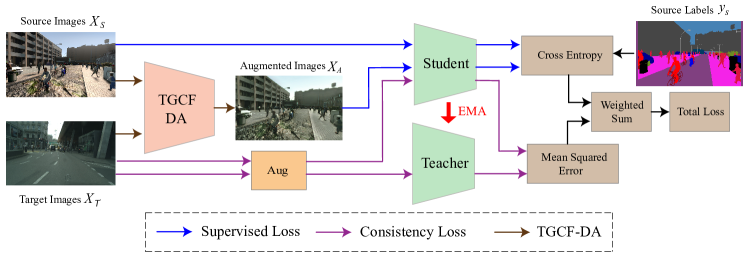
- Implement a self-ensembling framework with a teacher-student architecture, where the teacher's predictions serve as pseudo-labels for the student.
- Apply a ramp-up consistency loss with adaptive weighting to gradually increase the influence of the consistency loss during training.
- Use exponential moving average (EMA) with decay annealing to stabilize the teacher network's predictions over time.
Experimental results
Research questions
- RQ1Can GAN-based, target-guided data augmentation reduce domain shift in semantic segmentation without relying on cycle-consistency?
- RQ2How does self-ensembling with GAN-augmented data improve domain adaptation performance compared to standard data augmentation?
- RQ3Does the proposed cycle-free, semantic-consistent augmentation mitigate spatial misalignment issues in self-ensembling for segmentation?
- RQ4How do hyperparameters like EMA decay and consistency loss ramp-up affect model convergence and performance?
- RQ5To what extent does the method improve per-class IoU, especially for minority classes, compared to baseline self-ensembling?
Key findings
- The proposed method achieves state-of-the-art performance on the GTA5→Cityscapes and SYNTHIA→Cityscapes benchmarks, outperforming existing SOTA methods.
- On GTA5→Cityscapes, the method achieves a mean IoU of 42.5, significantly improving over the baseline TGCF-DA (41.3) when self-ensembling is applied.
- On SYNTHIA→Cityscapes, the method reaches a mean IoU of 38.5, demonstrating consistent gains across both benchmarks.
- Per-class IoU analysis shows larger improvements on majority classes (e.g., 'road') than on minority classes (e.g., 'bus'), indicating the impact of class imbalance on pseudo-label quality.
- Hyperparameter ablation shows that EMA decay of 0.999 in later training and a ramp-up coefficient δ₀ = 30 yield optimal performance.
- Visual results confirm that proper semantic constraint (λ_sem = 10) preserves image structure, while insufficient constraint (λ_sem = 1) leads to object mixing and semantic degradation.
Read this paper
Open the full text in the Nubint reader and ask about any passage as you read.
Read this paper on NubintThis review was generated by AI from the original paper. Please check the paper before citing it.