
[Paper Review] Self-similarity-based super-resolution of photoacoustic angiography from hand-drawn doodles
This paper proposes a self-similarity-based super-resolution method for photoacoustic angiography (PAA) that generates high-quality PAA images from hand-drawn doodles using a diffusion-based generative model, enabling effective training with minimal real PAA data. The approach achieves superior reconstruction quality—outperforming models trained on authentic PAA images—demonstrating the viability of synthetic data for zero-shot generalization in medical imaging super-resolution.
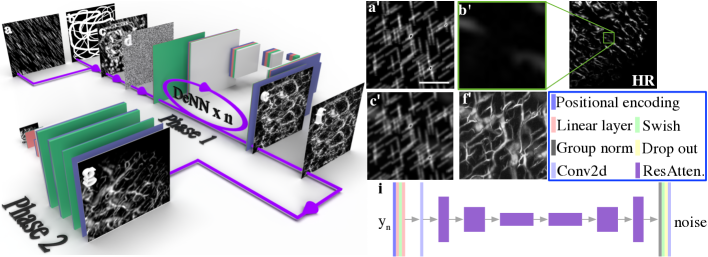
Deep-learning-based super-resolution photoacoustic angiography (PAA) is a powerful tool that restores blood vessel images from under-sampled images to facilitate disease diagnosis. Nonetheless, due to the scarcity of training samples, PAA super-resolution models often exhibit inadequate generalization capabilities, particularly in the context of continuous monitoring tasks. To address this challenge, we propose a novel approach that employs a super-resolution PAA method trained with forged PAA images. We start by generating realistic PAA images of human lips from hand-drawn curves using a diffusion-based image generation model. Subsequently, we train a self-similarity-based super-resolution model with these forged PAA images. Experimental results show that our method outperforms the super-resolution model trained with authentic PAA images in both original-domain and cross-domain tests. Specially, our approach boosts the quality of super-resolution reconstruction using the images forged by the deep learning model, indicating that the collaboration between deep learning models can facilitate generalization, despite limited initial dataset. This approach shows promising potential for exploring zero-shot learning neural networks for vision tasks.
Motivation & Objective
- To address the challenge of limited real PAA training data, which hinders model generalization and increases scanning time and potential tissue damage.
- To develop a data-efficient super-resolution framework that reduces reliance on extensive, time-consuming acquisition of authentic PAA images.
- To explore the feasibility of using synthetic, diffusion-generated PAA images as a viable alternative to real data for training high-performance super-resolution models.
- To enable real-time, high-resolution PAA imaging by accelerating sampling through super-resolution reconstruction from under-sampled data.
Proposed method
- A diffusion probabilistic model is trained on a small set of authentic PAA images to generate realistic, high-resolution PAA images from hand-drawn doodles.
- The generated PAA images are used to train a self-similarity-based super-resolution model (SwinIR) that exploits structural redundancy in blood vessel patterns.
- The method leverages iterative denoising steps in the diffusion process to refine low-resolution inputs into high-resolution PAA outputs with enhanced structural fidelity.
- The self-similarity mechanism in SwinIR enhances feature learning by identifying and reconstructing repeated patterns in vascular networks.
- The approach enables training with over 10,000 forged PAA images, significantly expanding the dataset beyond the original 202 authentic images.
- The framework is validated on dynamic PAA video sequences, demonstrating temporal consistency in reconstructed frames.
Experimental results
Research questions
- RQ1Can synthetic PAA images generated from hand-drawn doodles effectively replace real PAA images in training super-resolution models?
- RQ2Does a super-resolution model trained on forged PAA data generalize better than one trained on real data, especially in low-data regimes?
- RQ3Can the proposed method achieve high-quality, temporally coherent reconstruction of dynamic PAA video sequences from under-sampled frames?
- RQ4To what extent does the use of diffusion-based data generation improve model robustness and image realism in super-resolution for PAA?
Key findings
- The super-resolution model trained on forged PAA images achieved higher PSNR and SSIM values than the model trained on authentic PAA images in cross-domain testing.
- The method enabled a 16-fold acceleration in imaging speed by reducing sampling to 1/4 of the original resolution in two dimensions, while maintaining high reconstruction quality.
- The reconstructed dynamic PAA video sequence showed strong temporal consistency, with cleaner backgrounds and reduced noise compared to the ground truth.
- The model trained on forged images outperformed the real-data-trained model in both original-domain and cross-domain evaluations, indicating enhanced generalization.
- The use of diffusion-based generation significantly increased training data diversity and volume, overcoming the limitations of small authentic datasets.
- The approach minimizes laser exposure to tissues by reducing the number of required scans, supporting safer clinical applications of PAA.
Read this paper
Open the full text in the Nubint reader and ask about any passage as you read.
Read this paper on NubintThis review was generated by AI from the original paper. Please check the paper before citing it.