
[Paper Review] Self-supervised 6D Object Pose Estimation for Robot Manipulation
This paper proposes a self-supervised 6D object pose estimation system for robot manipulation that uses active vision and robot interactions to generate accurate, real-world pose-labeled data for fine-tuning neural networks. By leveraging RGB-D camera feedback and robot-induced scene changes, the system improves segmentation and pose estimation accuracy, resulting in an 86.7% grasp success rate—up from 46.7%—and a 55.3% reduction in initialization time compared to synthetic-only training.
To teach robots skills, it is crucial to obtain data with supervision. Since annotating real world data is time-consuming and expensive, enabling robots to learn in a self-supervised way is important. In this work, we introduce a robot system for self-supervised 6D object pose estimation. Starting from modules trained in simulation, our system is able to label real world images with accurate 6D object poses for self-supervised learning. In addition, the robot interacts with objects in the environment to change the object configuration by grasping or pushing objects. In this way, our system is able to continuously collect data and improve its pose estimation modules. We show that the self-supervised learning improves object segmentation and 6D pose estimation performance, and consequently enables the system to grasp objects more reliably. A video showing the experiments can be found at https://youtu.be/W1Y0Mmh1Gd8.
Motivation & Objective
- To address the domain gap between synthetic and real-world data in 6D object pose estimation for robot manipulation.
- To enable continuous, self-supervised data collection using robot interactions such as grasping and pushing.
- To improve the accuracy of 6D object pose estimation and semantic segmentation through self-annotated real-world data.
- To enhance model-based grasping performance using fine-tuned pose estimation networks.
- To achieve life-long learning in robotic systems by iteratively improving pose estimation through active data collection.
Proposed method
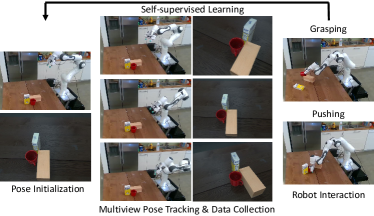
- An RGB-D camera is mounted on a robot manipulator to capture multi-view images of objects in the workspace.
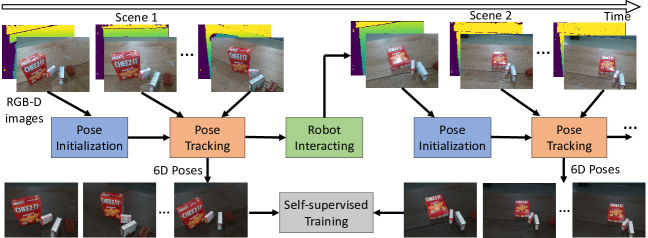
- 6D object poses are initialized using a particle filter with forward kinematics as a motion prior, enabling accurate tracking across views.
- The system uses a self-supervised loop: after pose tracking, the robot manipulates objects (grasping or pushing) to generate new scenes and new data.
- Self-annotated real images are used to fine-tune pre-trained neural networks for semantic segmentation and 6D pose estimation.
- SDF-based pose refinement is applied to improve translation and rotation accuracy after initial estimation.
- The system employs auto-encoders trained on RGB images to reconstruct object shapes and refine pose predictions.
Experimental results
Research questions
- RQ1Can a robot system automatically generate accurate 6D pose annotations for real-world images without human supervision?
- RQ2How does self-supervised fine-tuning using real-world data collected via robot interactions improve 6D pose estimation and segmentation performance?
- RQ3To what extent does active scene reconfiguration through grasping or pushing enhance data diversity and model generalization?
- RQ4Can self-supervised learning significantly improve grasp success rates in cluttered, real-world environments?
- RQ5What is the impact of using RGB-only vs. RGB-D data in the particle filter for pose estimation?
Key findings
- Fine-tuning the semantic segmentation network with self-annotated real images significantly improved segmentation accuracy, especially for objects with complex materials like shininess.
- Self-supervised fine-tuning of auto-encoders led to better reconstruction quality, which in turn improved 6D pose estimation accuracy.
- The system achieved a grasp success rate of 86.7%—an 85.7 percentage point improvement—when using real data for fine-tuning compared to synthetic-only training.
- Average object initialization time was reduced by 55.3% (from 10.04s to 4.48s) after self-supervised fine-tuning.
- The overall time per grasping attempt was reduced by 27.3% (from 21.27s to 15.47s) due to faster and more accurate pose initialization.
- Surprisingly, the RGB-only particle filter with SDF refinement outperformed the RGB-D version, as the auto-encoders were trained exclusively on RGB data, leading to more accurate rotation estimation.
Read this paper
Open the full text in the Nubint reader and ask about any passage as you read.
Read this paper on NubintThis review was generated by AI from the original paper. Please check the paper before citing it.