
[Paper Review] Self-supervised Video Object Segmentation by Motion Grouping
This paper proposes a self-supervised video object segmentation method that segments objects using only optical flow, leveraging a slot attention-based Transformer variant to group pixels with similar motion into foreground and background layers. It achieves state-of-the-art performance on DAVIS2016 and surpasses all prior self-supervised methods on the challenging MoCA camouflage dataset, demonstrating the critical role of motion cues over appearance-based biases.
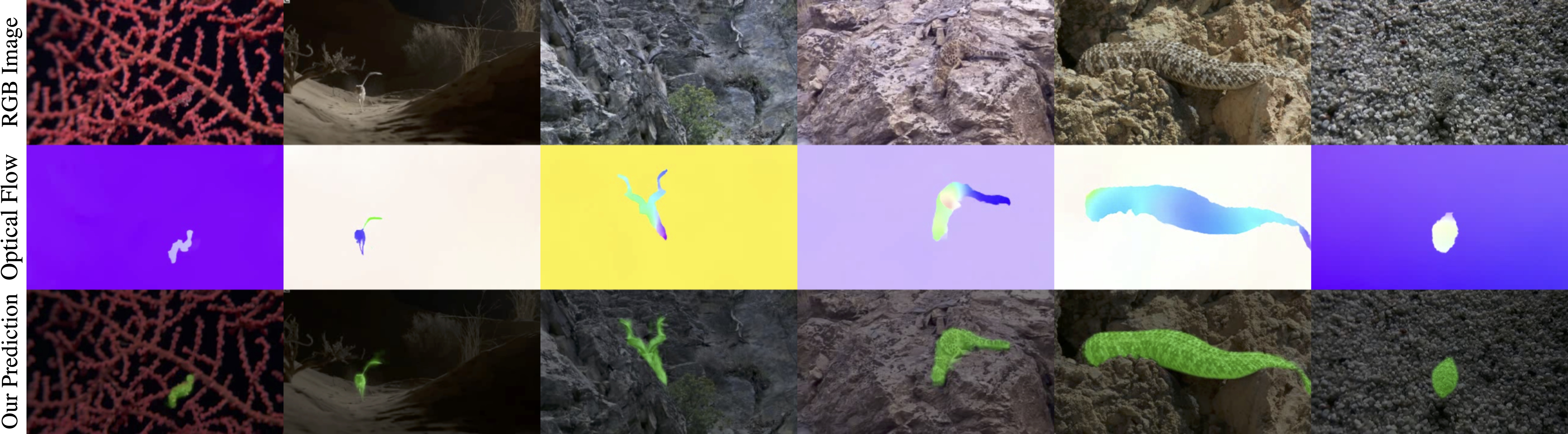
Animals have evolved highly functional visual systems to understand motion, assisting perception even under complex environments. In this paper, we work towards developing a computer vision system able to segment objects by exploiting motion cues, i.e. motion segmentation. We make the following contributions: First, we introduce a simple variant of the Transformer to segment optical flow frames into primary objects and the background. Second, we train the architecture in a self-supervised manner, i.e. without using any manual annotations. Third, we analyze several critical components of our method and conduct thorough ablation studies to validate their necessity. Fourth, we evaluate the proposed architecture on public benchmarks (DAVIS2016, SegTrackv2, and FBMS59). Despite using only optical flow as input, our approach achieves superior or comparable results to previous state-of-the-art self-supervised methods, while being an order of magnitude faster. We additionally evaluate on a challenging camouflage dataset (MoCA), significantly outperforming the other self-supervised approaches, and comparing favourably to the top supervised approach, highlighting the importance of motion cues, and the potential bias towards visual appearance in existing video segmentation models.
Motivation & Objective
- To develop a self-supervised video object segmentation model that relies solely on motion cues from optical flow, without any human-annotated masks.
- To investigate whether motion-based perceptual grouping—specifically the common fate principle—can enable accurate and efficient object segmentation in complex scenes.
- To evaluate the model’s robustness on challenging datasets where appearance cues are misleading, such as camouflage (MoCA), to highlight the limitations of appearance-only models.
- To achieve high inference speed (over 80fps) by using a lightweight architecture and avoiding computationally expensive post-processing steps.
Proposed method
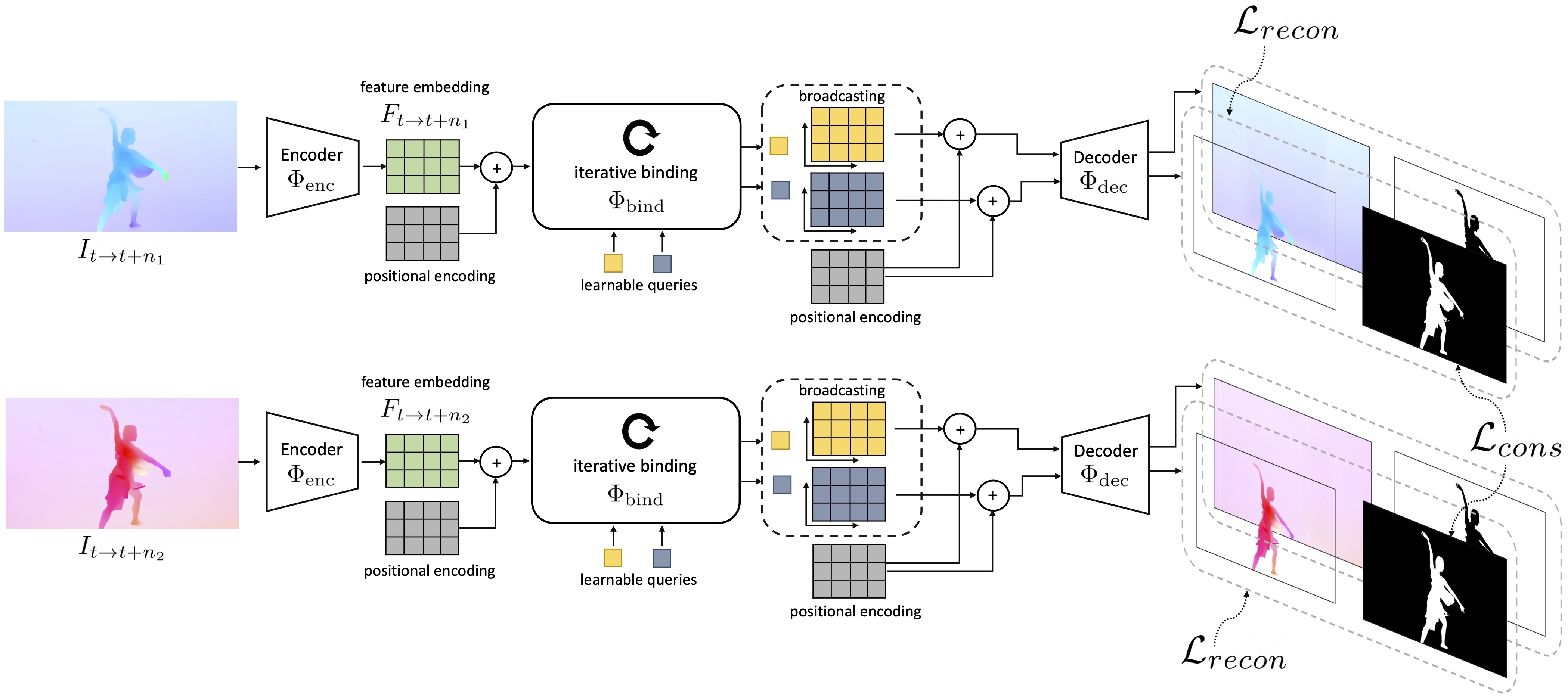
- A modified Transformer architecture replaces self-attention with slot attention to enable iterative grouping and binding of pixels with similar motion into distinct object and background layers.
- The model is trained via a self-supervised proxy task that encourages consistency in motion grouping across different temporal frame gaps, using a consistency loss on optical flow.
- An entropy regularization loss is applied to encourage confident predictions and stabilize training, especially in low-motion or ambiguous regions.
- The network uses a lightweight VGG-style encoder with only 4.77 million parameters, enabling fast inference without post-processing like CRFs or temporal averaging.
- Optical flow is used as the sole input, with no RGB or appearance features, to isolate the contribution of motion cues to segmentation performance.
- The model is trained end-to-end using a reconstruction objective that reconstructs the input flow from predicted segmentation masks and motion fields.
Experimental results
Research questions
- RQ1Can motion cues alone, in the form of optical flow, be sufficient to achieve high-quality video object segmentation in a self-supervised manner?
- RQ2How does a motion-based segmentation model compare to appearance-based models on datasets where visual appearance is misleading, such as in camouflage scenarios?
- RQ3To what extent does enforcing temporal consistency in motion grouping improve segmentation accuracy and robustness?
- RQ4Can a lightweight architecture trained without annotations achieve real-time inference speeds while maintaining state-of-the-art performance?
Key findings
- The model achieves a 9.1% absolute improvement over the previous state-of-the-art self-supervised method (CIS) on DAVIS2016, reaching performance close to supervised models.
- On the MoCA camouflage dataset, the model significantly outperforms all prior self-supervised methods, achieving a 14% improvement over CIS when no post-processing is applied.
- The model operates at over 80fps on small-resolution inputs, making it an order of magnitude faster than previous methods that rely on post-processing like CRFs or multi-crop averaging.
- Ablation studies confirm that both the temporal consistency loss and entropy regularization are critical for performance, with significant degradation when either is removed.
- The model's performance on MoCA highlights the limitations of appearance-based models, as it outperforms even top supervised models like COSNet, which rely heavily on visual appearance.
- The model struggles with multiple independently moving objects, as it is constrained to two slots (foreground and background), indicating a need for dynamic slot discovery in future work.
Read this paper
Open the full text in the Nubint reader and ask about any passage as you read.
Read this paper on NubintThis review was generated by AI from the original paper. Please check the paper before citing it.