
[Paper Review] Semi-Supervised Linear Regression
This paper proposes a semi-supervised linear regression method that improves upon the standard least squares estimator (LSE) by leveraging unlabeled data when the conditional expectation E[Y|X] is not exactly linear. The method uses the marginal distribution of X from unlabeled data to construct an asymptotically superior estimator for the linear coefficient vector β, achieving uniformly smaller variance and mean squared error under model misspecification, with consistent performance gains in finite samples as shown in simulations and real data applications.
We study a regression problem where for some part of the data we observe both the <i>label</i> variable (<i>Y</i>) and the <i>predictors</i> (X), while for other part of the data only the predictors are given. Such a problem arises, for example, when observations of the label variable are costly and may require a skilled human agent. When the conditional expectation E[Y|X] is not exactly linear, one can consider the best linear approximation to the conditional expectation, which can be estimated consistently by the least-square estimates (LSE). The latter depends only on the labeled data. We suggest improved alternative estimates to the LSE that use also the unlabeled data. Our estimation method can be easily implemented and has simply described asymptotic properties. The new estimates asymptotically dominate the usual standard procedures under certain non-linearity condition of E[Y|X]; otherwise, they are asymptotically equivalent. The performance of the new estimator for small sample size is investigated in an extensive simulation study. A real data example of inferring homeless population is used to illustrate the new methodology.
Motivation & Objective
- To develop a method that improves linear regression estimation when the true conditional expectation E[Y|X] is non-linear but a linear approximation is still desired.
- To utilize unlabeled data—where only predictors X are observed—to enhance estimation of the linear coefficient vector β beyond standard least squares.
- To establish asymptotic dominance of the new estimator over LSE when the linear model is misspecified, particularly in terms of variance and prediction error.
- To demonstrate practical utility through simulations and a real-world homeless population estimation case study.
- To explore the conditions under which unlabeled data provides meaningful improvement in high-dimensional and finite-sample settings.
Proposed method
- The method constructs a new estimator β̂_PI that incorporates the empirical distribution of X from unlabeled data to improve estimation of β in the best linear predictor.
- It assumes that the marginal distribution of X in the unlabeled sample is representative of the labeled data, enabling improved inference under model misspecification.
- The estimator is derived under the assumption that E[Y|X] is not exactly linear, allowing the method to exploit non-linearities in the conditional mean to improve estimation.
- The approach asymptotically dominates the LSE in terms of variance and mean squared error when E[Y|X] is non-linear, with equivalence when the model is correctly specified.
- The method is computationally simple and can be implemented using standard regression tools with added weighting or reweighting based on the unlabeled X distribution.
- Theoretical properties are derived under two scenarios: full information (m→∞) and partial information (m proportional to n), with consistent asymptotic improvements.
Experimental results
Research questions
- RQ1Can unlabeled data improve estimation of the linear coefficient vector β when E[Y|X] is not exactly linear?
- RQ2Under what conditions does the inclusion of unlabeled data lead to asymptotic improvement over the standard least squares estimator?
- RQ3How does the performance of the new estimator compare to LSE in finite samples, particularly in terms of estimation and prediction error?
- RQ4What is the impact of model misspecification on the relative performance of the new estimator versus LSE?
- RQ5Can the method be extended to high-dimensional settings or generalized linear models?
Key findings
- The proposed estimator β̂_PI asymptotically dominates the standard least squares estimator (LSE) in terms of variance and mean squared error when E[Y|X] is non-linear.
- The improvement is uniform and consistent across different non-linearity levels, with no loss in performance when the model is correctly specified.
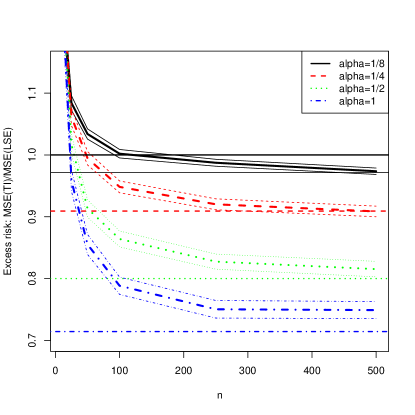
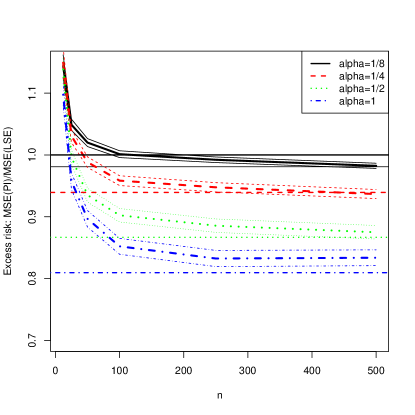
- In finite samples, simulation studies show significant improvement in coefficient estimation, though prediction error gains are smaller due to inherent Y variability.
- The real data example on estimating homeless populations demonstrates practical improvement in coefficient estimation using unlabeled data.
- The method performs best when the true relationship is non-linear but a linear approximation is still used, particularly for sample sizes below a critical threshold dependent on the degree of non-linearity.
- Theoretical results extend to high-dimensional settings under the condition p << n, with potential for future work on variable selection and generalized linear models.
Read this paper
Open the full text in the Nubint reader and ask about any passage as you read.
Read this paper on NubintThis review was generated by AI from the original paper. Please check the paper before citing it.