
[Paper Review] Simple Linguistic Inferences of Large Language Models (LLMs): Blind Spots and Blinds
This paper investigates ChatGPT's limitations in handling simple linguistic inferences—such as grammatically-specified entailments, evidential adverbs of uncertainty, and monotonicity entailment—showing that despite understanding the underlying concepts when queried directly, the model fails to apply this knowledge in zero-shot inference tasks. It identifies 'blinds' in the form of presupposition triggers and non-factive verbs that distort inference predictions, revealing systematic blind spots in LLM reasoning beyond surface-level fluency.
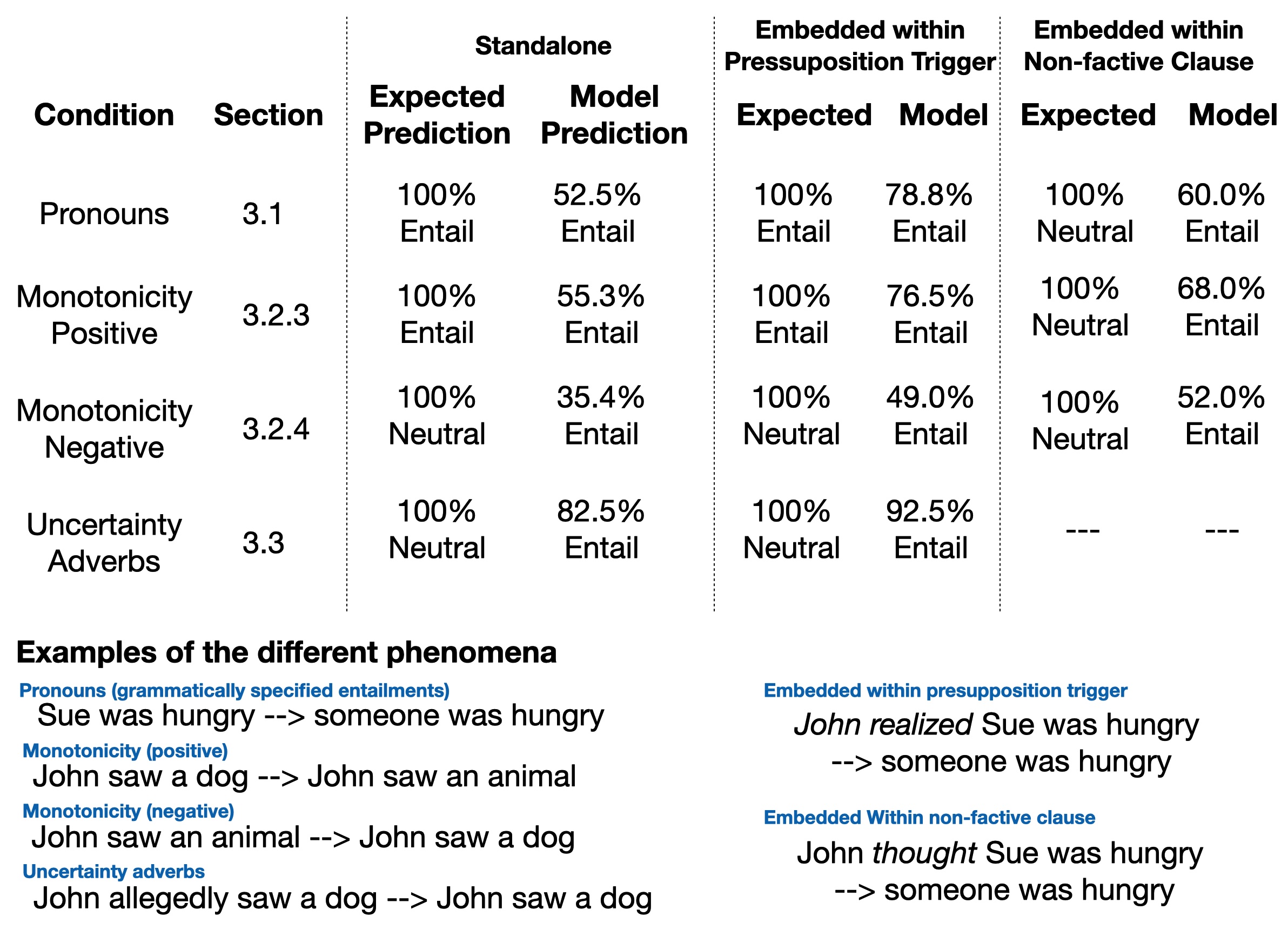
We evaluate LLMs' language understanding capacities on simple inference tasks that most humans find trivial. Specifically, we target (i) grammatically-specified entailments, (ii) premises with evidential adverbs of uncertainty, and (iii) monotonicity entailments. We design evaluation sets for these tasks and conduct experiments in both zero-shot and chain-of-thought setups, and with multiple prompts and LLMs. The models exhibit moderate to low performance on these evaluation sets. Subsequent experiments show that embedding the premise in syntactic constructions that should preserve the entailment relations (presupposition triggers) or change them (non-factives), further confuses the models, causing them to either under-predict or over-predict certain entailment labels regardless of the true relation, and often disregarding the nature of the embedding context. Overall these results suggest that, despite LLMs' celebrated language understanding capacity, even the strongest models have blindspots with respect to certain types of entailments, and certain information-packaging structures act as ``blinds'' overshadowing the semantics of the embedded premise.
Motivation & Objective
- To investigate ChatGPT’s performance on simple linguistic inference tasks that are trivial for humans but challenging for the model.
- To examine whether ChatGPT can consistently apply linguistic knowledge it demonstrates when prompted directly.
- To analyze how embedding premises in presuppositional or non-factive contexts affects inference accuracy.
- To identify structural features in input sentences that distort entailment predictions, acting as 'blinds'.
- To contribute to understanding the reliability and trustworthiness of LLMs in high-stakes applications.
Proposed method
- Manual curation of expert-designed test sets for three inference types: grammatically-specified entailments, evidential adverbs (e.g., supposedly), and monotonicity entailment (upward/downward).
- Zero-shot evaluation of ChatGPT on these test sets without fine-tuning or chain-of-thought prompting.
- Direct probing of ChatGPT’s knowledge about linguistic concepts via explicit definition and usage questions.
- Systematic modification of premises by embedding them under presupposition triggers (e.g., 'He realized that...') and non-factive verbs (e.g., 'They thought that...').
- Quantitative comparison of inference accuracy across different embedding structures and control conditions.
- Analysis of model behavior across multiple inference types to detect systematic biases and inconsistencies.
Experimental results
Research questions
- RQ1Does ChatGPT correctly infer entailment relations in grammatically-specified cases, such as replacing a noun with 'someone'?
- RQ2How does the presence of evidential adverbs like 'supposedly' affect ChatGPT’s ability to assess entailment?
- RQ3Can ChatGPT correctly apply monotonicity principles (upward/downward entailment) in simple class membership inferences?
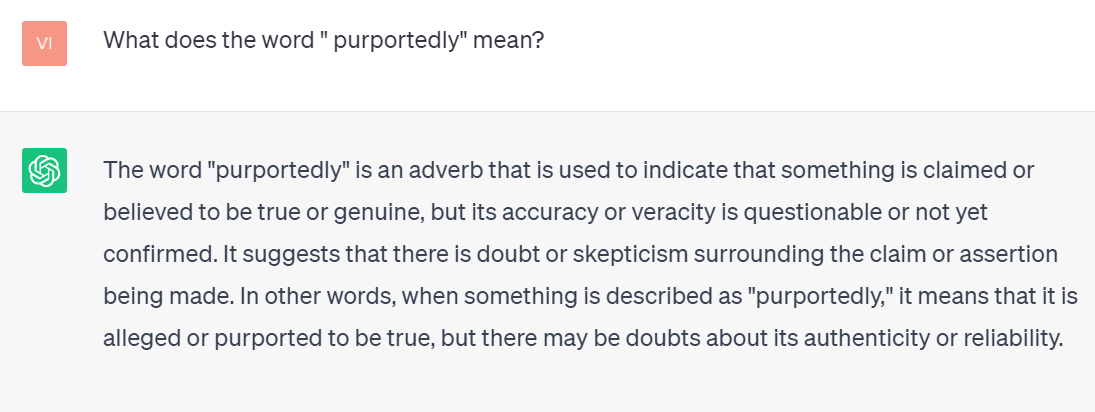
- RQ4To what extent does ChatGPT’s knowledge of linguistic concepts transfer to actual inference tasks?
- RQ5Do presupposition triggers or non-factive verbs systematically bias the model toward predicting entailment, regardless of semantic truth?
Key findings
- ChatGPT exhibits moderate to low accuracy on grammatically-specified entailment tasks, despite correctly explaining the concept when prompted directly.
- The model frequently fails to recognize that evidential adverbs like 'purportedly' block entailment, incorrectly predicting entailment even when the premise is uncertain.
- ChatGPT struggles with monotonicity entailment, incorrectly inferring from subsets to supersets or vice versa in simple class membership cases.
- When premises are embedded under presupposition triggers (e.g., 'He realized that...'), the model predicts entailment significantly more often, even when the semantic content contradicts entailment.
- Similarly, embedding premises under non-factive verbs (e.g., 'They thought that...') leads to a strong bias toward predicting entailment, regardless of the correct semantic label.
- The model shows inconsistent knowledge application: it understands linguistic rules but fails to apply them in inference tasks, indicating a gap between declarative knowledge and reasoning.
Read this paper
Open the full text in the Nubint reader and ask about any passage as you read.
Read this paper on NubintThis review was generated by AI from the original paper. Please check the paper before citing it.