
[Paper Review] Sketch-A-Shape: Zero-Shot Sketch-to-3D Shape Generation
Sketch-A-Shape proposes a zero-shot sketch-to-3D shape generation method that leverages frozen pre-trained vision models (e.g., CLIP, DINOv2) to extract robust semantic features from synthetic 3D renderings during training, enabling generation of diverse 3D shapes from sketches at inference without any paired sketch-3D data. The approach achieves strong generalization across sketch abstraction levels and 3D representations (voxel, implicit, CAD), with state-of-the-art performance on zero-shot benchmarks.
Significant progress has recently been made in creative applications of large pre-trained models for downstream tasks in 3D vision, such as text-to-shape generation. This motivates our investigation of how these pre-trained models can be used effectively to generate 3D shapes from sketches, which has largely remained an open challenge due to the limited sketch-shape paired datasets and the varying level of abstraction in the sketches. We discover that conditioning a 3D generative model on the features (obtained from a frozen large pre-trained vision model) of synthetic renderings during training enables us to effectively generate 3D shapes from sketches at inference time. This suggests that the large pre-trained vision model features carry semantic signals that are resilient to domain shifts, i.e., allowing us to use only RGB renderings, but generalizing to sketches at inference time. We conduct a comprehensive set of experiments investigating different design factors and demonstrate the effectiveness of our straightforward approach for generation of multiple 3D shapes per each input sketch regardless of their level of abstraction without requiring any paired datasets during training.
Motivation & Objective
- To address the lack of large-scale paired sketch-3D datasets, which limits the generalization of existing sketch-to-3D generation methods.
- To enable zero-shot 3D shape generation from sketches without requiring any sketch-3D paired data during training.
- To investigate whether features from pre-trained vision models can generalize across domain shifts from renderings to sketches.
- To develop a method that generalizes across diverse sketch types, from casual doodles to professional designs, and multiple 3D representations.
- To evaluate the impact of architectural choices, such as feature layer selection, conditioning mechanisms, and data augmentation on performance.
Proposed method
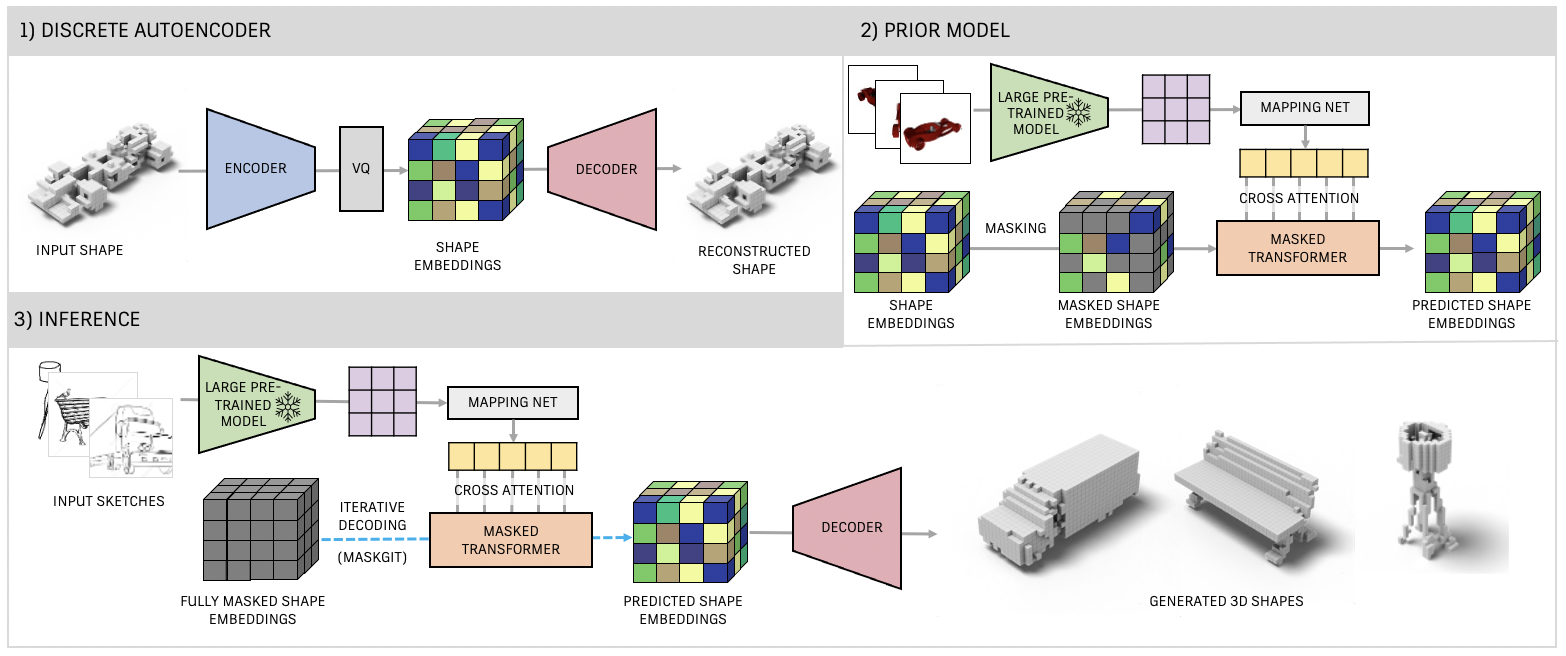
- A VQ-VAE is trained to learn discrete shape embeddings from 3D shapes, enabling compact representation of 3D geometry.
- A masked transformer is conditioned on local semantic features extracted from a frozen pre-trained vision model (e.g., CLIP, DINOv2) applied to synthetic 3D renderings during training.
- During inference, the same masked transformer is conditioned on features extracted from the input sketch using the same frozen vision encoder, enabling zero-shot generation.
- Local features from intermediate layers of the vision transformer (e.g., layer 24 of L-14 model) are used as conditioning signals, capturing rich semantic and spatial information.
- A learnable mapping network with two MLP layers and cross-attention with learnable positional embeddings is used to align image features with the transformer’s latent space.
- Data augmentation strategies such as affine transformations, color jitter, and Canny edge detection are applied during training to improve robustness and generalization.
Experimental results
Research questions
- RQ1Can pre-trained vision model features generalize from synthetic 3D renderings to real sketches in a zero-shot setting?
- RQ2How does the choice of vision model layer affect the quality and accuracy of sketch-to-3D generation?
- RQ3What is the optimal conditioning mechanism (e.g., cross-attention vs. self-attention) and mapping network architecture for feature alignment?
- RQ4How do different data augmentation strategies impact the model’s generalization across diverse sketch datasets?
- RQ5Can the method generate diverse, high-quality 3D shapes across multiple representations (voxel, implicit, CAD) without paired training data?
Key findings
- The model achieves 55.45% QD-Acc, 77.15% TU-Acc, 74.53% SS-Acc, and 69.06% IS-Acc when conditioning on features from the deepest layer (layer 24) of the L-14 vision transformer.
- Performance improves significantly with deeper layers, with layer 24 yielding the highest accuracy, indicating that deeper features contain more robust semantic and spatial information.
- Using a two-layer MLP mapping network with cross-attention and learnable positional embeddings yields the best performance (57.52% QD-Acc, 79.41% TU-Acc, 78.18% SS-Acc, 70.53% IS-Acc).
- The addition of data augmentation, particularly affine and Canny edge transforms, improves overall performance, with the full augmentation set achieving 58.96% QD-Acc, 81.48% TU-Acc, 79.71% SS-Acc, and 74.20% IS-Acc.
- The method generalizes effectively across sketch abstraction levels, generating consistent 3D shapes from casual doodles to detailed professional sketches.
- The model maintains strong performance across different 3D representations (voxel, implicit, CAD), demonstrating broad applicability without requiring retraining.

Read this paper
Open the full text in the Nubint reader and ask about any passage as you read.
Read this paper on NubintThis review was generated by AI from the original paper. Please check the paper before citing it.