
[Paper Review] SleepFM: Multi-modal Representation Learning for Sleep Across Brain Activity, ECG and Respiratory Signals
SleepFM is a multi-modal foundation model that learns joint representations from brain activity (EEG), ECG, and respiratory signals using a novel leave-one-out contrastive learning approach on over 100,000 hours of de-identified polysomnography data from 14,000 participants. It outperforms end-to-end CNNs on sleep stage classification (AUROC 0.88 vs. 0.72) and sleep disordered breathing detection (AUROC 0.85 vs. 0.69), demonstrating strong generalization and cross-modality retrieval performance.
Sleep is a complex physiological process evaluated through various modalities recording electrical brain, cardiac, and respiratory activities. We curate a large polysomnography dataset from over 14,000 participants comprising over 100,000 hours of multi-modal sleep recordings. Leveraging this extensive dataset, we developed SleepFM, the first multi-modal foundation model for sleep analysis. We show that a novel leave-one-out approach for contrastive learning significantly improves downstream task performance compared to representations from standard pairwise contrastive learning. A logistic regression model trained on SleepFM's learned embeddings outperforms an end-to-end trained convolutional neural network (CNN) on sleep stage classification (macro AUROC 0.88 vs 0.72 and macro AUPRC 0.72 vs 0.48) and sleep disordered breathing detection (AUROC 0.85 vs 0.69 and AUPRC 0.77 vs 0.61). Notably, the learned embeddings achieve 48% top-1 average accuracy in retrieving the corresponding recording clips of other modalities from 90,000 candidates. This work demonstrates the value of holistic multi-modal sleep modeling to fully capture the richness of sleep recordings. SleepFM is open source and available at https://github.com/rthapa84/sleepfm-codebase.
Motivation & Objective
- To develop a multi-modal foundation model for sleep analysis that integrates brain activity, ECG, and respiratory signals to capture holistic physiological dynamics.
- To improve representation learning in sleep data by introducing a novel leave-one-out contrastive learning framework that enhances downstream task performance.
- To demonstrate generalization of learned representations across diverse clinical sites and data acquisition protocols.
- To establish a benchmark for self-supervised multi-modal learning in sleep medicine using large-scale, de-identified polysomnography data.
- To enable broader clinical applicability by releasing open-source code and ensuring ethical standards in medical AI.
Proposed method
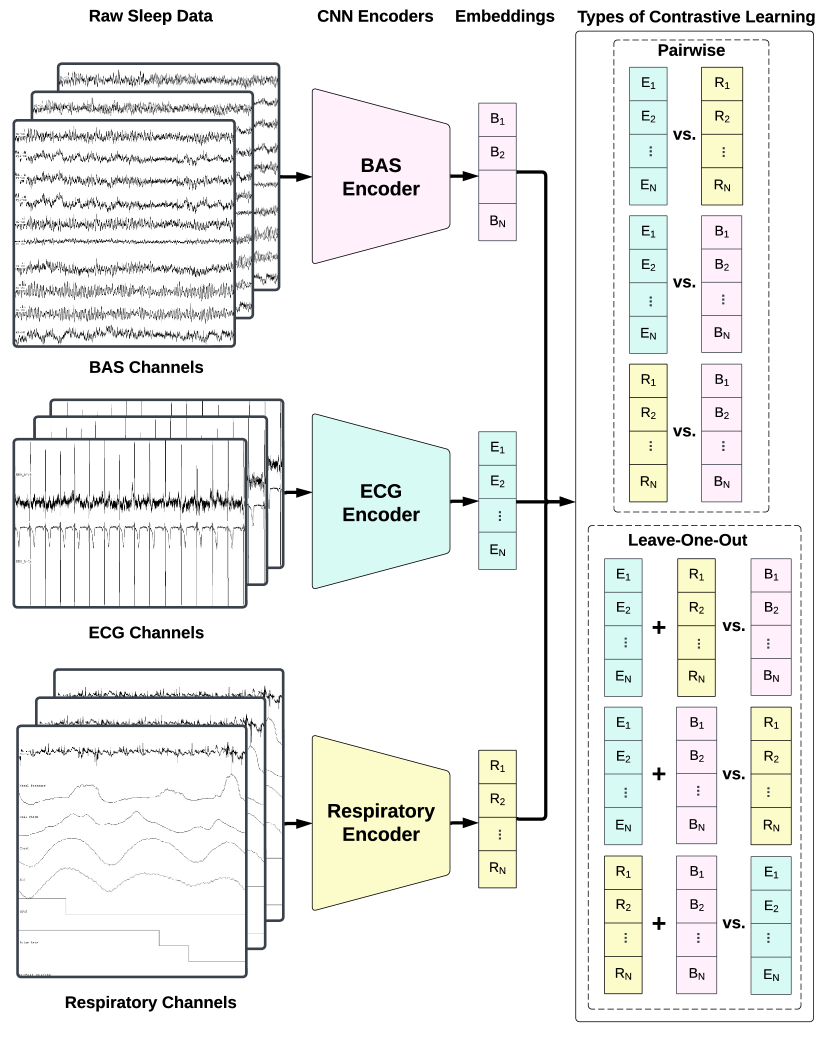
- The model is pre-trained using a novel leave-one-out contrastive learning objective, where one modality is masked at a time to encourage cross-modal alignment and integrated representation learning.
- Standard pairwise contrastive learning is used as a baseline for comparison, where positive pairs are formed from augmentations of the same sample across modalities.
- The model leverages a Siamese encoder architecture to embed multi-modal signals (BAS, ECG, respiratory) into a shared latent space.
- Pre-training is performed on a large-scale dataset of 14,000 participants and over 100,000 hours of multi-modal sleep recordings from Stanford’s sleep clinic.
- Downstream tasks include sleep stage classification, SDB detection, demographic attribute prediction, and cross-modality retrieval using logistic regression on learned embeddings.
- External validation is conducted on a separate dataset from the CinC challenge, assessing generalization across different institutions and data acquisition protocols.
Experimental results
Research questions
- RQ1Can a multi-modal foundation model trained on brain activity, ECG, and respiratory signals improve representation learning for sleep analysis compared to standard contrastive learning?
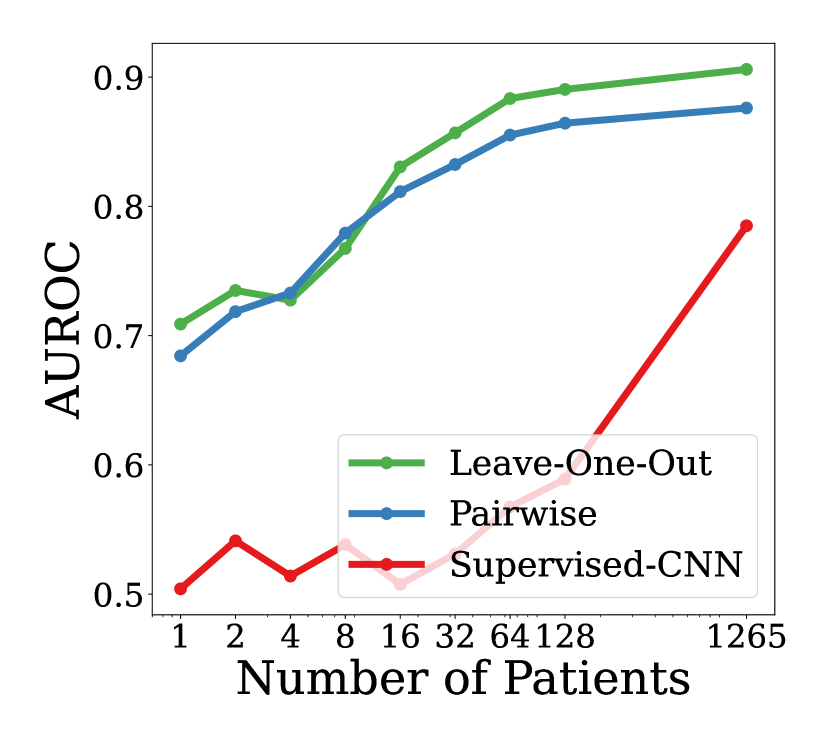
- RQ2Does the proposed leave-one-out contrastive learning approach yield better downstream performance than pairwise contrastive learning in sleep staging and SDB detection?
- RQ3To what extent can the learned embeddings generalize to external datasets with different data collection protocols and modalities?
- RQ4How effective is the model in cross-modality retrieval, such as retrieving corresponding ECG clips from EEG embeddings?
- RQ5Can the foundation model outperform end-to-end trained deep neural networks on clinically relevant sleep tasks?
Key findings
- SleepFM achieved a macro-average AUROC of 0.88 on sleep stage classification, significantly outperforming an end-to-end CNN (0.72 AUROC).
- For sleep disordered breathing detection, SleepFM achieved an AUROC of 0.85, compared to 0.69 for the CNN baseline.
- The model achieved 48% top-1 average accuracy in retrieving corresponding recording clips across modalities from 90,000 candidates, demonstrating strong cross-modal alignment.
- The leave-one-out contrastive learning approach outperformed pairwise contrastive learning across all downstream tasks, indicating better integration of multi-modal signals.
- External validation on the CinC dataset showed robust generalization, with SleepFM achieving an AUROC of 0.924 and AUPRC of 0.759, compared to 0.843 and 0.553 for the CNN.
- The model demonstrated strong performance across diverse demographic groups and generalizes well despite differences in EEG channel configurations between training and test sites.
Read this paper
Open the full text in the Nubint reader and ask about any passage as you read.
Read this paper on NubintThis review was generated by AI from the original paper. Please check the paper before citing it.