
[Paper Review] SLiC-HF: Sequence Likelihood Calibration with Human Feedback
SLiC-HF applies Sequence Likelihood Calibration to learn from human preferences, offering a simpler, more efficient alternative to RLHF-PPO with competitive results on Reddit TL;DRSummarization and off-policy feedback data.
Learning from human feedback has been shown to be effective at aligning language models with human preferences. Past work has often relied on Reinforcement Learning from Human Feedback (RLHF), which optimizes the language model using reward scores assigned from a reward model trained on human preference data. In this work we show how the recently introduced Sequence Likelihood Calibration (SLiC), can also be used to effectively learn from human preferences (SLiC-HF). Furthermore, we demonstrate this can be done with human feedback data collected for a different model, similar to off-policy, offline RL data. Automatic and human evaluation experiments on the TL;DR summarization task show that SLiC-HF significantly improves supervised fine-tuning baselines. Furthermore, SLiC-HF presents a competitive alternative to the PPO RLHF implementation used in past work while being much simpler to implement, easier to tune and more computationally efficient in practice.
Motivation & Objective
- Motivate aligning language models with human preferences beyond reference summaries.
- Introduce SLiC-HF as a sequence-level calibration method using human feedback.
- Demonstrate that SLiC-HF can leverage off-policy feedback data from other models.
- Evaluate SLiC-HF on Reddit TL;DR summarization and compare to RLHF baselines.
Proposed method
- Fine-tune an SFT model on standard data and then apply SLiC calibration using human preference data.
- Use a rank calibration loss: Lcal = max(0, delta - log P_theta(y+|x) + log P_theta(y-|x)).
- Use a cross-entropy regularization term with a target sequence y_ref to keep the model from drifting too far.
- Explore variants: SLiC-HF-sample-rank (sampled candidates ranked by a reward/ranking model) and SLiC-HF-direct (calibrate directly on HF data).
- Train ranking and reward models on HF data to score candidate decodes and guide calibration.
- Compare regularization targets: y_ref from SFT data vs best ranked candidate from decodes.
Experimental results
Research questions
- RQ1Can SLiC-HF learn from human preference data to improve summaries beyond SFT baselines?
- RQ2How does SLiC-HF compare to RLHF-PPO in terms of performance, training simplicity, and compute efficiency?
- RQ3Does off-policy human feedback (data collected for other models) transfer effectively under SLiC-HF?
- RQ4What are the effects of different SLiC-HF variants (sample-rank, direct) and regularization targets on performance?
- RQ5How do ranking-based feedback models compare to reward-based models for guiding SLiC calibration?
Key findings
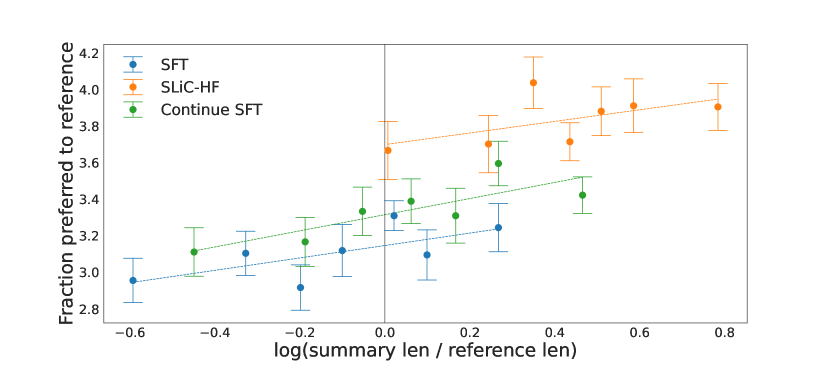
- SLiC-HF significantly improves supervised fine-tuning baselines on Reddit TL;DR when evaluated by humans.
- Ranking-based HF models achieve higher alignment than reward-based HF models (ranking accuracy ~73.2% vs 71.3%).
- SLiC-HF-sample-rank with ranking yields the highest reported win rate among tested variants (up to 86.21% in ranker win rate).
- SLiC-HF achieves competitive performance relative to RLHF-PPO, with some variants outperforming the RLHF-PPO baseline in human evaluations.
- SLiC-HF-direct is simpler but can lead to longer outputs and less stable convergence, while SLiC-HF-sample-rank remains robust.
- Scaling up model size improves SLiC-HF performance (e.g., 11B ranking model with 770M generation model shows gains).
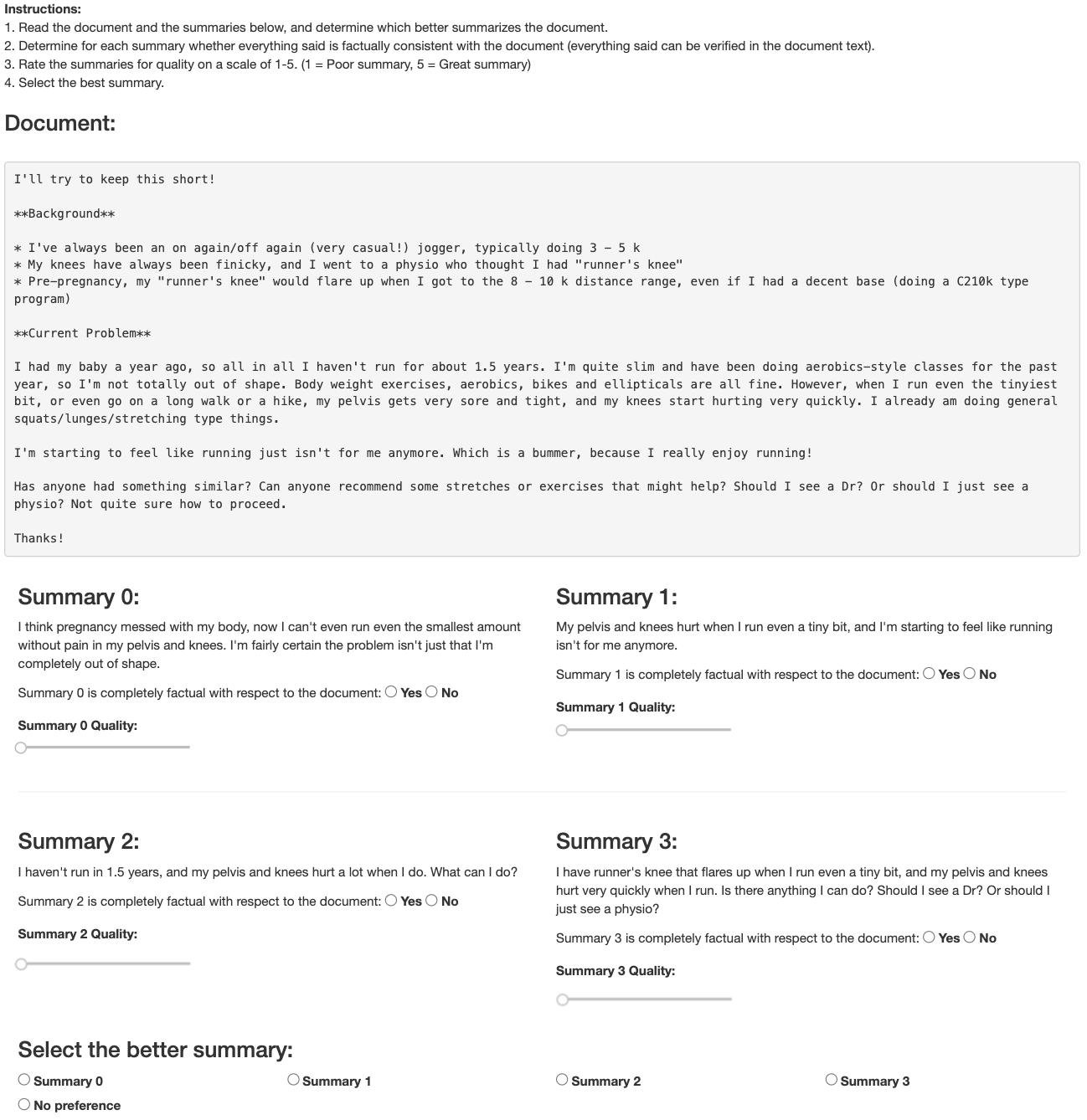
- Human evaluation shows SLiC-HF chosen as best model 73% of the time over several baselines.
Read this paper
Open the full text in the Nubint reader and ask about any passage as you read.
Read this paper on NubintThis review was generated by AI from the original paper. Please check the paper before citing it.