
[논문 리뷰] Small amplitude red giants elucidate the nature of the Tip of the Red Giant Branch as a standard candle
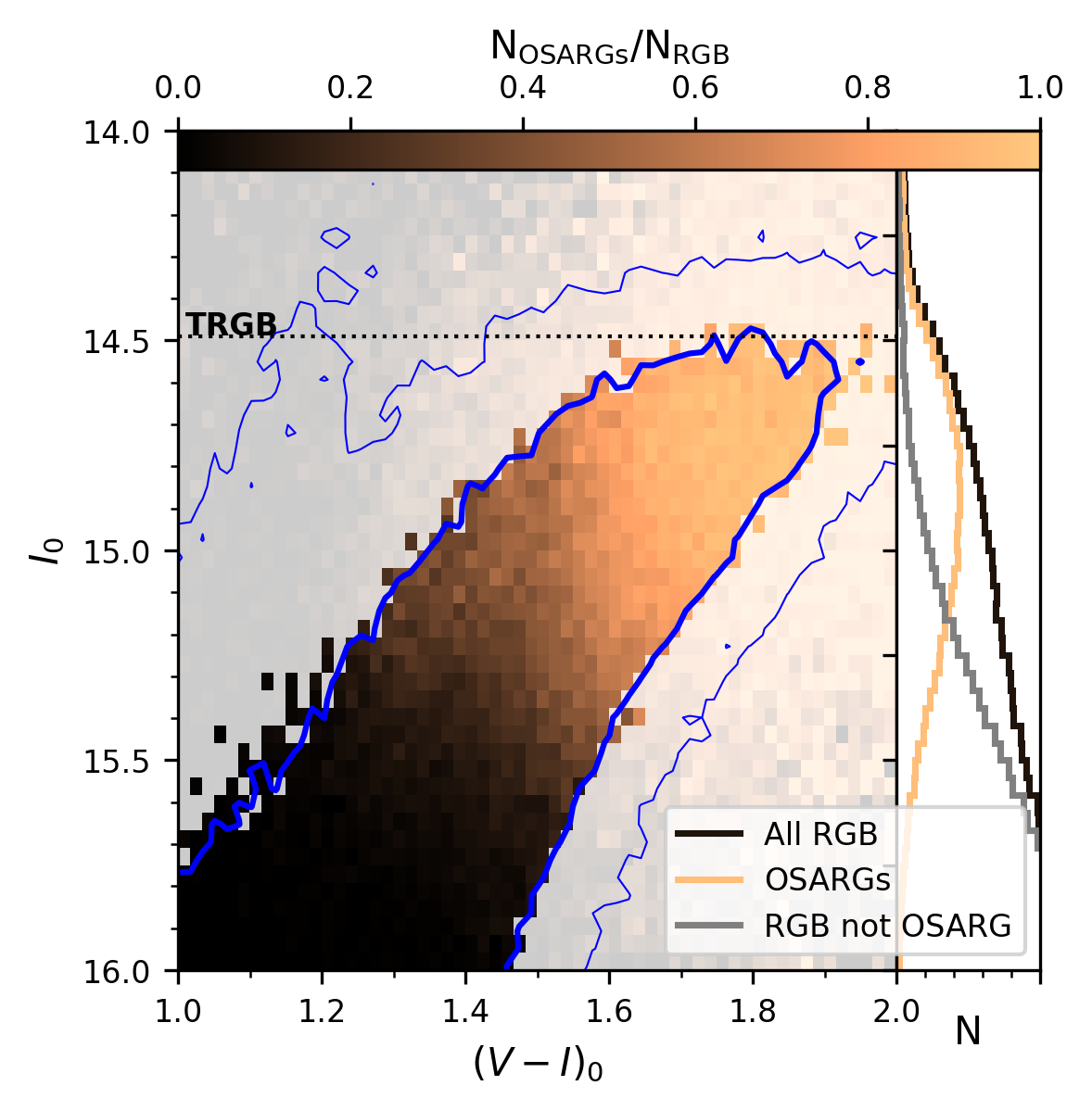
이 논문은 사실상 모든 TRGB 항성이 OSARG 변광변수임을 보여준다; OSARG를 사용하면 정밀한 TRGB 보정치와 허블 상수 H0 = 71.8 ± 1.5 km/s/Mpc를 얻어 TRGB 거리 규模와 Cepheid 거리 규模를 조화시킨다.
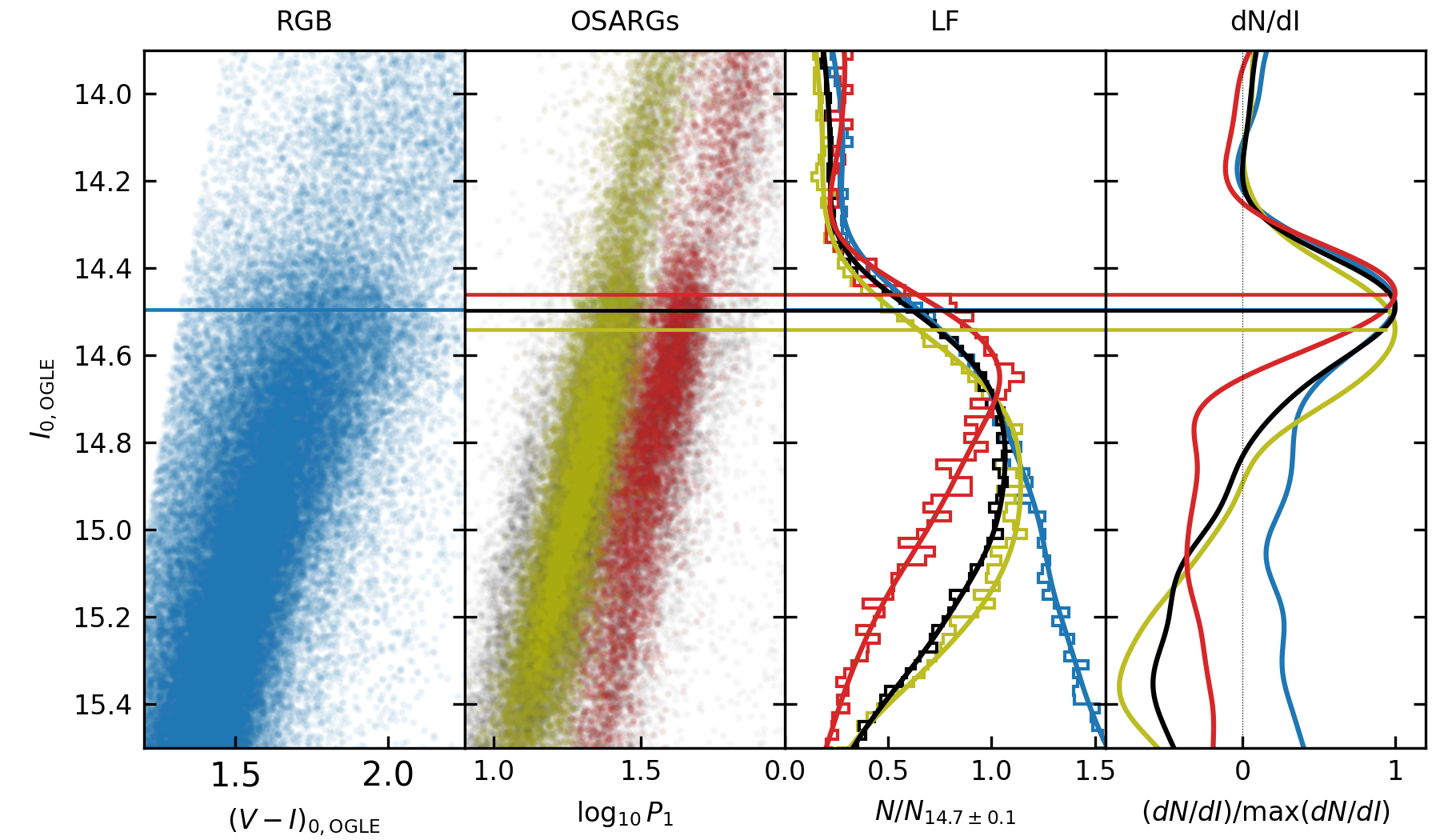
The tip of the red giant branch (TRGB) is an important standard candle for determining luminosity distances. Although several $10^5$ small amplitude red giant stars (SARGs) have been discovered, variability was previously considered irrelevant for the TRGB as a standard candle. Here, we show that all stars near the TRGB are SARGs that follow several period-luminosity sequences, of which sequence A is younger than sequence B as predicted by stellar evolution. We measure apparent TRGB magnitudes, m$_{\mathrm{TRGB}}$, in the Large Magellanic Cloud (LMC), using Sobel filters applied to photometry from the Optical Gravitational Lensing Experiment and the ESA Gaia mission, and we identify several weaknesses in a recent LMC-based TRGB calibration used to measure the Hubble constant. We consider four samples: all Red Giants (RGs), SARGs, and sequences A & B. The B-sequence is best suited for measuring distances to old RG populations, with M$_{\mathrm{F814W,0}}$ = -4.025 $\pm$ 0.014(stat.) $\pm$ 0.033(syst.) mag assuming the LMC's geometric distance. Control of systematics is demonstrated using detailed simulations. Population diversity affects m$_{\mathrm{TRGB}}$ at a level exceeding the stated precision: the SARG and A-sequence samples yield 0.039 mag and 0.085 mag fainter (at 5σ significance) m$_{\mathrm{TRGB}}$ values, respectively. Ensuring equivalent RG populations is crucial to measuring accurate TRGB distances. Additionally, luminosity function smoothing ($\sim$ 0.02 mag) and edge detection response weighting (as much as -0.06 mag) can further bias TRGB measurements, with the latter introducing a tip-contrast relation. We are optimistic that variable red giants will enable further improvements to the TRGB as a standard candle.
연구 동기 및 목표
- LMC의 가변적 빨간 거성(OSARG)들을 사용하여 TRGB 절대광도를 보정한다.
- 변동성 특성이 TRGB 탐지의 정확도를 높이고 스무딩 바이어스를 줄이는지 조사한다.
- 다양한 광측정계에서 TRGB 광도를 정량하고 기존 보정치와 비교한다.
- TRGB 보정을 통해 H0를 도출하고 Cepheid 기반 및 CMB 기반 측정과의 합치를 평가한다.
제안 방법
- OGLE-III OSARG를 LMC의 정제된 RGB 샘플과 대조 매칭한다.
- 지배 주기 기반으로 OSARG를 A-시퀀스와 B-시퀀스 하위군으로 분류한다.
- GLOESS로 스무딩된 광도함수에서 Sobel 에지 검출로 TRGB를 측정한다.
- Gaia DR3 합성 광측정으로 I-band 및 F814W 광도를 얻고 격자교정을 적용한다.
- Detached eclipsing binaries로부터의 LMC 거리로 M_F814W,syn 및 M_I,syn를 보정한다.
- 몬테카를로 재샘플링으로 불확실성을 추정하고 스무딩 바이어스 효과를 정량한다.
실험 결과
연구 질문
- RQ1TRGB에 근접한 OSARG를 선택하는 것이 모든 RGB 항성을 사용할 때보다 TRGB 정확도를 높이는가?
- RQ2LMC 거리로 고정했을 때 다른 광측정계에서의 절대 TRGB 광도는 무엇인가?
- RQ3새로운 TRGB 보정이 Cepheid 기반 및 CMB 기반 값과 비교했을 때 H0에 어떤 영향을 미치는가?
- RQ4A/B OSARG 시퀀스와 같은 천문 물리적 샘플 선택이 TRGB 보정에 체계적 차이를 도입하는가?
주요 결과
| V-I)_0 | I_OGLE (mag) | I_syn (mag) | F814W_syn (mag) | G_Rp (mag) | G_0 (mag) |
|---|---|---|---|---|---|
| 1.82±0.19 | 14.501±0.010 | 14.497±0.011 | 14.491±0.010 | 14.640±0.009 | 15.621±0.015 |
| 1.78±0.21 | 14.495±0.021 | 14.478±0.029 | 14.473±0.027 | 14.635±0.024 | 15.618±0.014 |
| 1.76±0.11 | 14.527±0.027 | 14.506±0.035 | 14.499±0.032 | 14.648±0.039 | 15.626±0.036 |
| 1.79±0.15 | 14.545±0.013 | 14.543±0.012 | 14.537±0.012 | 14.690±0.009 | 15.655±0.016 |
| 1.82±0.19 | 14.459±0.014 | 14.457±0.015 | 14.452±0.013 | 14.607±0.013 | 15.566±0.030 |
- OSARG가 가장 정밀한 TRGB 측정을 제공하며 m_F814W,syn = 14.491 ± 0.010 (stat) ± 0.010 (syst) mag이다.
- LMC 거리로 보정된 TRGB 절대광도는 M_F814W,syn = -3.986 ± 0.011 (stat) ± 0.028 (syst) mag 및 M_I,syn = -3.979 ± 0.011 (stat) mag이다.
- LMC 거리를 사용한 TRGB 보정은 H0 = 71.8 ± 1.5 km s^-1 Mpc^-1을 시사하며 Cepheid 기반 측정과는 거의 일치하고 Planck의 초기 우주 값과는 2.8σ 차이가 있다.
- OSARG A/B 시퀀스 간의 차이가 최대 ~0.041 mag, A와 B 간의 차이가 ~0.087 mag로 변동성 기반 동질성이 TRGB 추정에 미치는 영향을 보여준다.
- 결과는 Gaia 기반 및 EDD(Rizzi) 보정과 일치하는 반면, R_I의 선택 및 샘플 선택의 차이로 인해 Hoyt(CCHP) 보정과는 차이가 있다.
- Calibrated M_I,OGLE 및 M_I,syn 값은 제시된 불확실성 내에서 외부 보정과 일치한다.
더 나은 연구,지금 바로 시작하세요
연구 설계부터 논문 작성까지, 연구 시간을 획기적으로 줄여보세요.
카드 등록 없음 · 무료 플랜 제공
이 리뷰는 AI가 만들고, 인간 에디터가 검토했습니다.