
[Paper Review] Small amplitude red giants elucidate the nature of the Tip of the Red Giant Branch as a standard candle
The paper demonstrates that virtually all TRGB stars are OSARG variables; using OSARGs yields a precise TRGB calibration and a Hubble constant H0 = 71.8 ± 1.5 km/s/Mpc, reconciling TRGB and Cepheid distance scales.
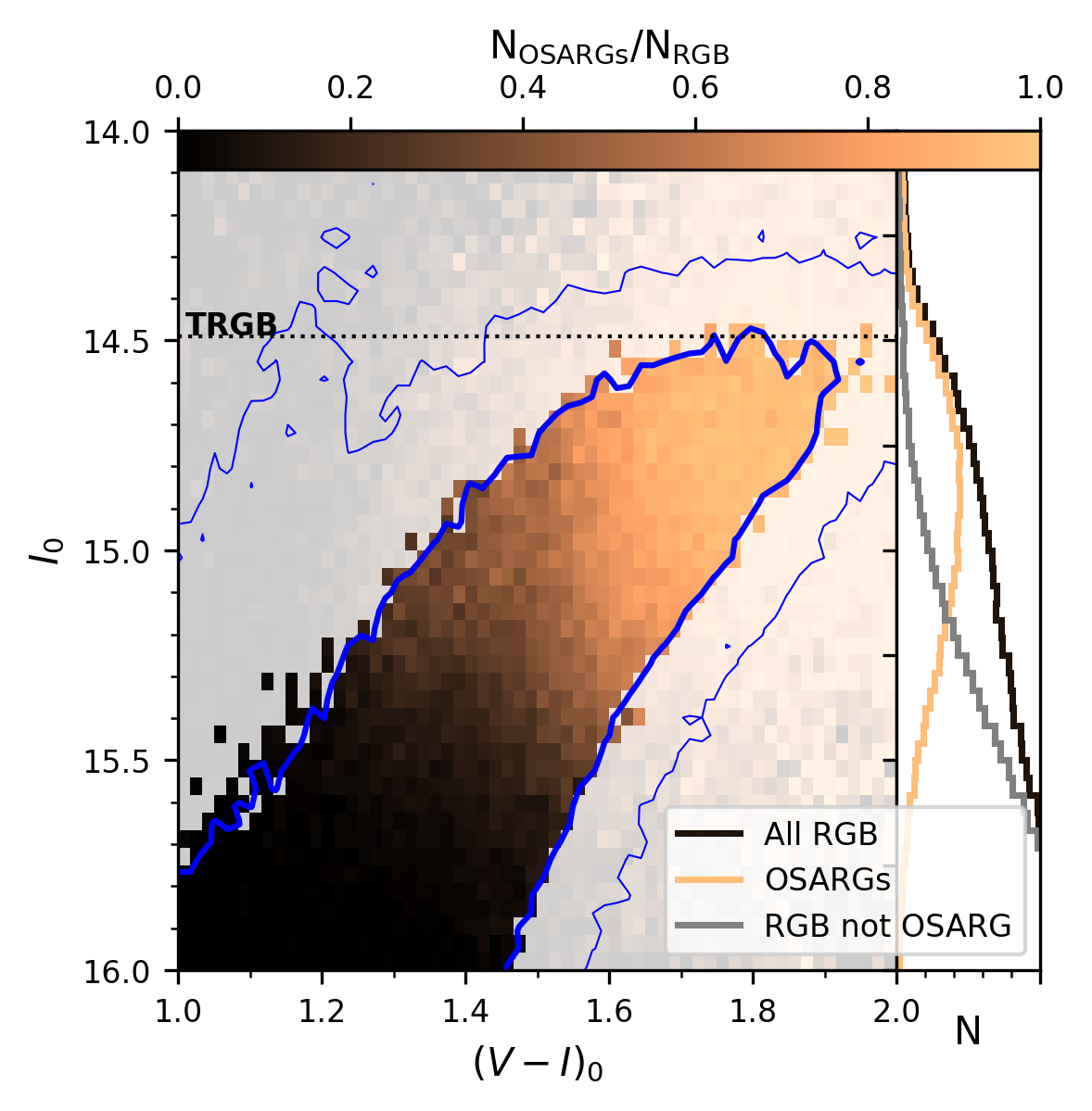
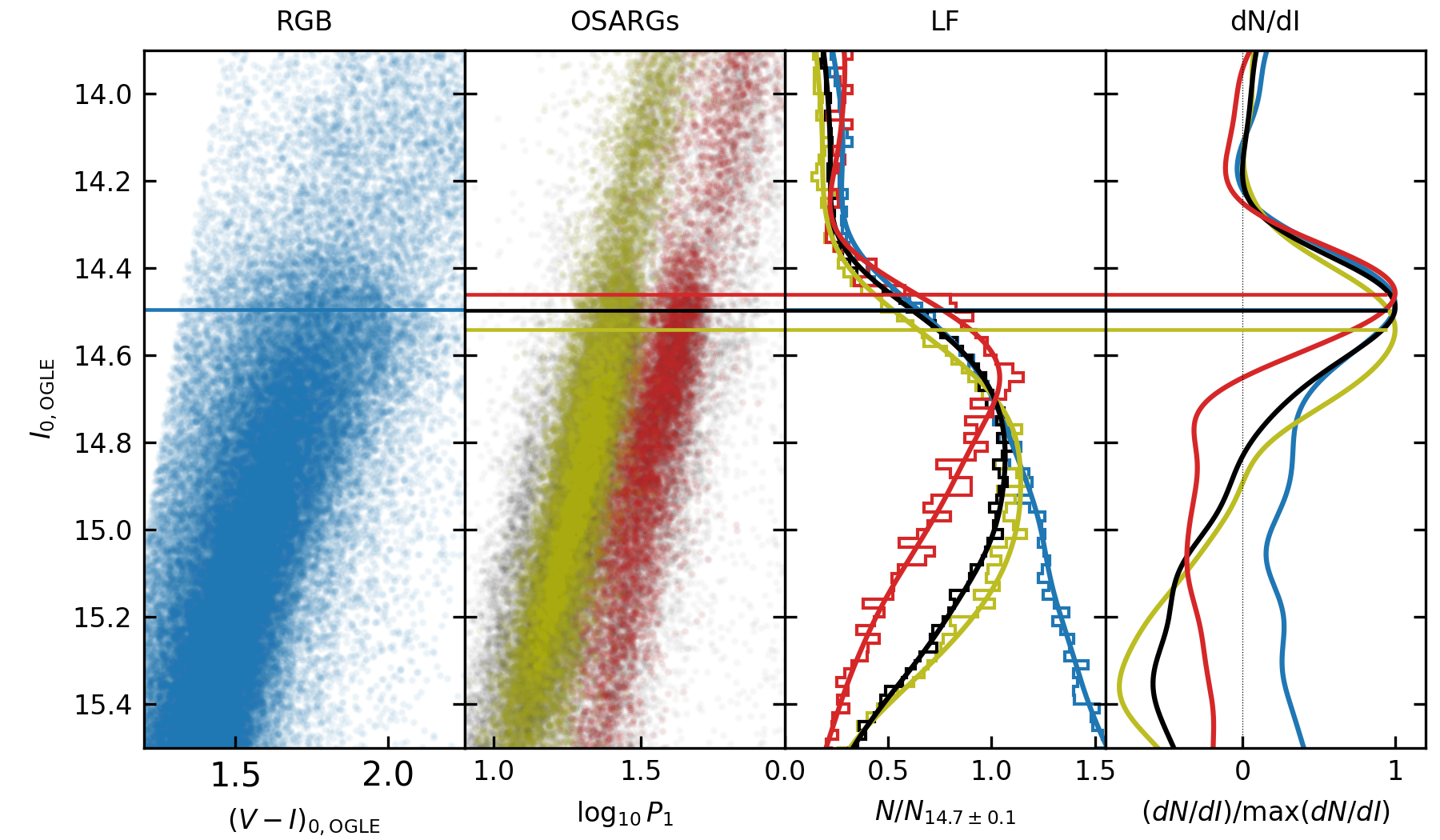
The tip of the red giant branch (TRGB) is an important standard candle for determining luminosity distances. Although several $10^5$ small amplitude red giant stars (SARGs) have been discovered, variability was previously considered irrelevant for the TRGB as a standard candle. Here, we show that all stars near the TRGB are SARGs that follow several period-luminosity sequences, of which sequence A is younger than sequence B as predicted by stellar evolution. We measure apparent TRGB magnitudes, m$_{\mathrm{TRGB}}$, in the Large Magellanic Cloud (LMC), using Sobel filters applied to photometry from the Optical Gravitational Lensing Experiment and the ESA Gaia mission, and we identify several weaknesses in a recent LMC-based TRGB calibration used to measure the Hubble constant. We consider four samples: all Red Giants (RGs), SARGs, and sequences A & B. The B-sequence is best suited for measuring distances to old RG populations, with M$_{\mathrm{F814W,0}}$ = -4.025 $\pm$ 0.014(stat.) $\pm$ 0.033(syst.) mag assuming the LMC's geometric distance. Control of systematics is demonstrated using detailed simulations. Population diversity affects m$_{\mathrm{TRGB}}$ at a level exceeding the stated precision: the SARG and A-sequence samples yield 0.039 mag and 0.085 mag fainter (at 5σ significance) m$_{\mathrm{TRGB}}$ values, respectively. Ensuring equivalent RG populations is crucial to measuring accurate TRGB distances. Additionally, luminosity function smoothing ($\sim$ 0.02 mag) and edge detection response weighting (as much as -0.06 mag) can further bias TRGB measurements, with the latter introducing a tip-contrast relation. We are optimistic that variable red giants will enable further improvements to the TRGB as a standard candle.
Motivation & Objective
- Calibrate the TRGB absolute magnitude using variable red giants (OSARGs) in the LMC.
- Investigate whether variability properties improve TRGB detection and reduce smoothing biases.
- Quantify the TRGB luminosity in multiple photometric systems and compare with existing calibrations.
- Derive H0 from the TRGB calibration and assess agreement with Cepheid-based and CMB-based measurements.
Proposed method
- Cross-match OGLE-III OSARGs with cleaned RGB samples in the LMC.
- Classify OSARGs into A-sequence and B-sequence subgroups based on dominant periods.
- Measure the TRGB with Sobel edge detection on GLOESS-smoothed luminosity functions.
- Use Gaia DR3 synthetic photometry to obtain I-band and F814W magnitudes and apply reddening corrections.
- Calibrate M_F814W,syn and M_I,syn using the LMC distance from detached eclipsing binaries.
- Estimate uncertainties with Monte Carlo resampling and quantify smoothing bias effects.
Experimental results
Research questions
- RQ1Does selecting OSARGs near the TRGB yield more precise TRGB magnitudes than using all RGB stars?
- RQ2What is the absolute TRGB magnitude in different photometric systems when anchored to the LMC distance?
- RQ3How does the new TRGB calibration affect the inferred H0 compared to Cepheid- and CMB-based values?
- RQ4Do astro-physical sample selections (A/B OSARG sequences) introduce systematic differences in TRGB calibrations?
Key findings
- OSARGs give the most precise TRGB measurement with m_F814W,syn = 14.491 ± 0.010 (stat) ± 0.010 (syst) mag.
- TRGB absolute magnitudes calibrated to the LMC distance yield M_F814W,syn = -3.986 ± 0.011 (stat) ± 0.028 (syst) mag and M_I,syn = -3.979 ± 0.011 (stat) mag.
- Using the LMC distance, the TRGB calibration implies H0 = 71.8 ± 1.5 km s^-1 Mpc^-1, in close agreement with Cepheid-based measurements and in tension with Planck’s early-Universe value by 2.8σ.
- Differences of up to ~0.041 mag between OSARG A/B sequences and ~0.087 mag between the A and B OSARG sequences show the impact of variability-based homogeneity on TRGB estimates.
- The results align with Gaia-based and EDD (Rizzi) calibrations, while differing from some Hoyt (CCHP) calibrations due to choices of R_I and sample selection.
- Calibrated M_I,OGLE and M_I,syn values are consistent with external calibrations within quoted uncertainties.
Read this paper
Open the full text in the Nubint reader and ask about any passage as you read.
Read this paper on NubintThis review was generated by AI from the original paper. Please check the paper before citing it.