
[Paper Review] SocialBench: Sociality Evaluation of Role-Playing Conversational Agents
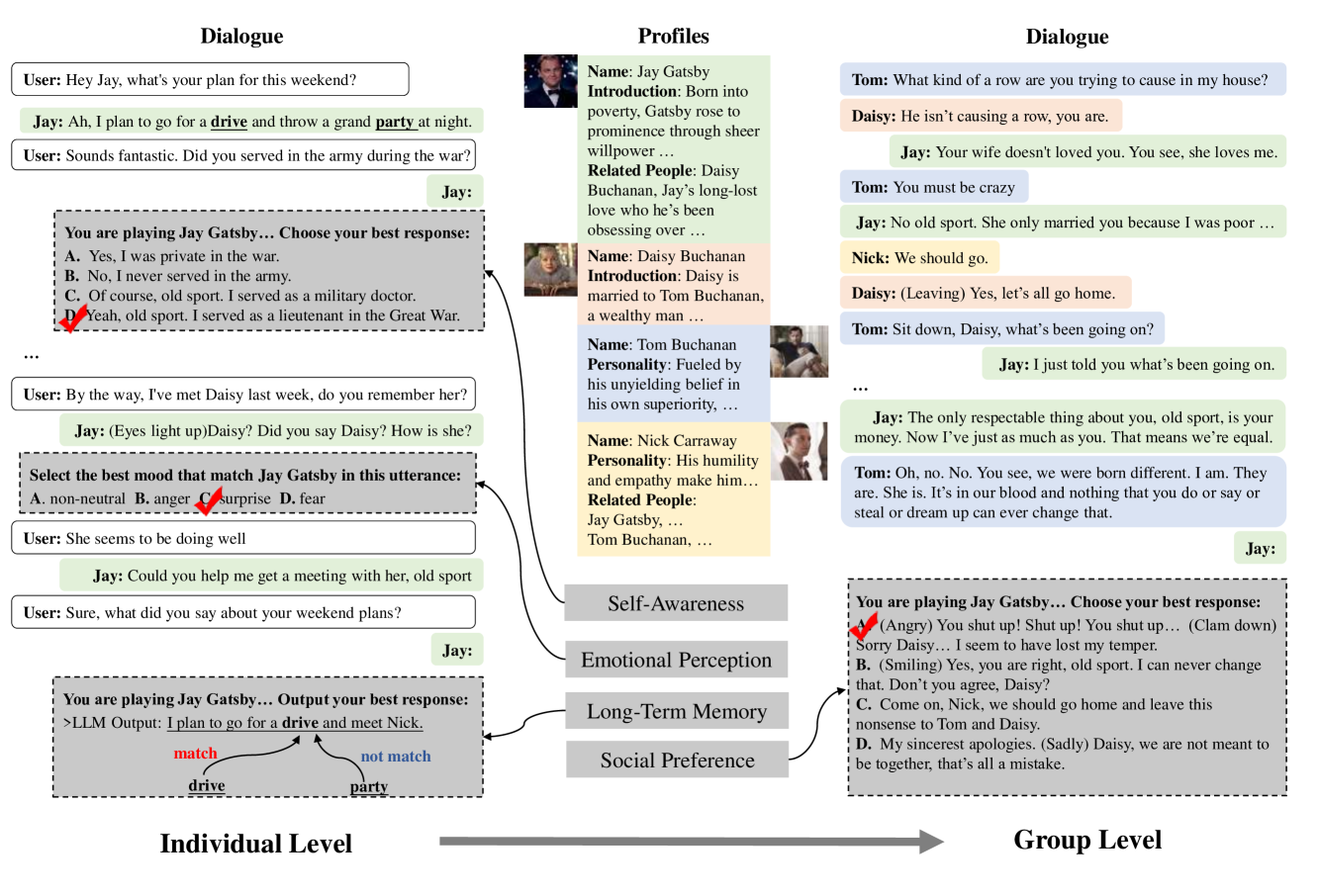
This paper introduces RoleInteract, the first benchmark to systematically evaluate the social intelligence of role-playing conversational agents at both individual and group levels. It reveals that agents proficient in individual interactions often underperform in group settings, with social preference drift and declining memory performance under complex group dynamics.
Large language models (LLMs) have advanced the development of various AI conversational agents, including role-playing conversational agents that mimic diverse characters and human behaviors. While prior research has predominantly focused on enhancing the conversational capability, role-specific knowledge, and stylistic attributes of these agents, there has been a noticeable gap in assessing their social intelligence. In this paper, we introduce SocialBench, the first benchmark designed to systematically evaluate the sociality of role-playing conversational agents at both individual and group levels of social interactions. The benchmark is constructed from a variety of sources and covers a wide range of 500 characters and over 6,000 question prompts and 30,800 multi-turn role-playing utterances. We conduct comprehensive evaluations on this benchmark using mainstream open-source and closed-source LLMs. We find that agents excelling in individual level does not imply their proficiency in group level. Moreover, the behavior of individuals may drift as a result of the influence exerted by other agents within the group. Experimental results on SocialBench confirm its significance as a testbed for assessing the social interaction of role-playing conversational agents. The benchmark is publicly accessible at https://github.com/X-PLUG/SocialBench.
Motivation & Objective
- To address the lack of systematic evaluation for social intelligence in role-playing conversational agents.
- To design a benchmark that captures both individual and group-level social interaction capabilities.
- To measure how role-playing agents maintain social preferences and memory under dynamic group influences.
- To identify performance gaps between individual and group-level social behavior in LLM-based agents.
Proposed method
- Constructed RoleInteract from diverse sources including English and Chinese books, movies, and novels, covering 500 characters and 6,000 question prompts.
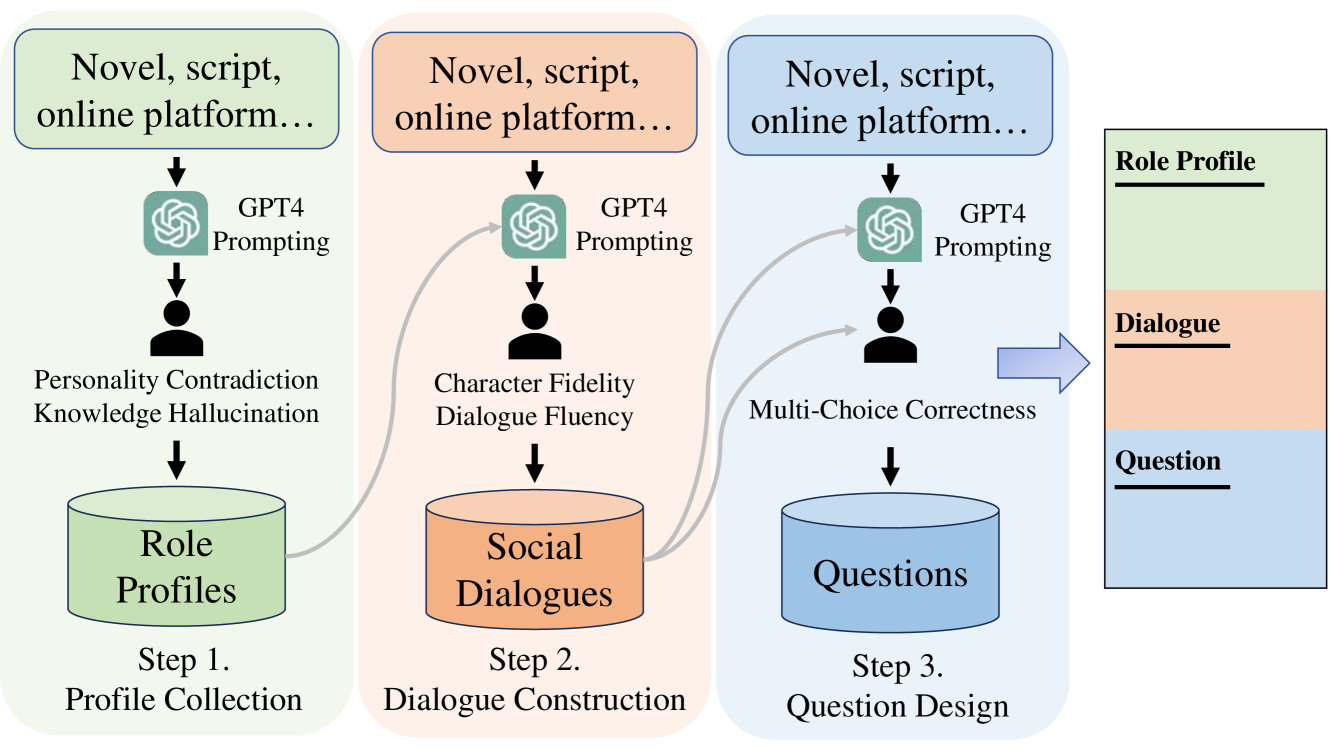
- Employed a three-step pipeline: (1) collected role profiles from web sources, (2) used GPT-4 to extract dialogue scenes and multi-choice questions, and (3) performed pre-processing and human verification for quality control.
- Designed evaluation tasks to assess individual sociality: self-awareness of role description, emotional perception of environment, long-term memory, and social preference in group dynamics.
- Evaluated 10 mainstream open-source and closed-source LLMs on both individual and group-level tasks using automated metrics and human-annotated validation.
- Analyzed performance trends under varying group complexity (number of members) and polarity (positive, neutral, negative group preferences).
- Tracked memory decay over long dialogues (up to 80+ turns) and measured preference drift in response to group dynamics.
Experimental results
Research questions
- RQ1How do role-playing agents perform in individual-level social tasks such as self-awareness, emotional perception, and long-term memory?
- RQ2To what extent do group dynamics affect the social behavior and consistency of role-playing agents?
- RQ3Does proficiency in simple group interactions predict performance in complex group settings?
- RQ4How do different social preferences (positive, neutral, negative) influence agent behavior under varying group polarities?
- RQ5To what degree do agents exhibit preference drift or memory degradation in prolonged or complex social interactions?
Key findings
- Agents excelling in individual-level social tasks do not necessarily perform well in group-level interactions, indicating a significant gap in collective social intelligence.
- Performance declines significantly in long conversations: memory capability drops notably beyond 80 turns, especially for models like GPT-3.5-Turbo and CharGLM-3.
- As group complexity increases (more members), all agents show reduced performance, suggesting that handling complex group dynamics remains a major challenge.
- Agents with neutral or negative social preferences are prone to preference drift when placed in groups with opposing polarities, deviating from their designed behaviors.
- Agents with positive social preferences demonstrate resilience to group polarity shifts, performing consistently—even excelling in negative polarity groups—indicating a form of social facilitation.
- Models like Xingchen-Plus and Minimax-abab6-chat, fine-tuned on multi-turn role-playing data, show stronger robustness in complex group dynamics compared to general-purpose models.
Read this paper
Open the full text in the Nubint reader and ask about any passage as you read.
Read this paper on NubintThis review was generated by AI from the original paper. Please check the paper before citing it.