
[Paper Review] Solving Linear Programs in the Current Matrix Multiplication Time
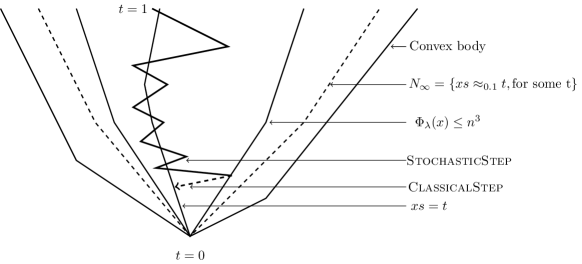
This paper presents a novel stochastic central path method that solves linear programs in time $ O^*(n^ ho ext{ poly}( ext{log}(n/ ho))) $, where $ \rho = \min(\omega, 2.5 - \alpha/2, 2 + 1/6) $, with $ \omega $ the matrix multiplication exponent and $ \alpha $ its dual. The method achieves this by maintaining a projection matrix under $ \ell_2 $-multiplicative weight updates and updating only $ \widetilde{O}(\sqrt{n}) $ coordinates per iteration, enabling near-optimal total coordinate updates.
This paper shows how to solve linear programs of the form $\min_{Ax=b,x\geq0} c^ op x$ with $n$ variables in time $$O^*((n^ω+n^{2.5-α/2}+n^{2+1/6}) \log(n/δ))$$ where $ω$ is the exponent of matrix multiplication, $α$ is the dual exponent of matrix multiplication, and $δ$ is the relative accuracy. For the current value of $ω\sim2.37$ and $α\sim0.31$, our algorithm takes $O^*(n^ω \log(n/δ))$ time. When $ω= 2$, our algorithm takes $O^*(n^{2+1/6} \log(n/δ))$ time. Our algorithm utilizes several new concepts that we believe may be of independent interest: $\bullet$ We define a stochastic central path method. $\bullet$ We show how to maintain a projection matrix $\sqrt{W}A^{ op}(AWA^{ op})^{-1}A\sqrt{W}$ in sub-quadratic time under $\ell_{2}$ multiplicative changes in the diagonal matrix $W$.
Motivation & Objective
- To break the long-standing $ O^*(n^{2.5}) $ runtime barrier for solving general linear programs, which has persisted since Vaidya's 1989 result.
- To leverage advances in matrix multiplication complexity to achieve faster linear programming algorithms, especially for dense instances.
- To design a stochastic interior-point method that reduces the number of coordinate updates per iteration while maintaining convergence guarantees.
- To develop a new framework for maintaining projection matrices under $ \ell_2 $-multiplicative weight changes in sub-quadratic time.
- To establish a natural runtime limit for linear programming that matches the best-known time for solving linear systems.
Proposed method
- Introduces a stochastic central path method that reduces the number of coordinate updates per iteration from $ O(n) $ to $ \widetilde{O}(\sqrt{n}) $, while preserving $ O^*(\sqrt{n}) $ total iterations.
- Develops a technique to maintain the projection matrix $ \sqrt{W}A^\top (AWA^\top)^{-1} A\sqrt{W} $ under $ \ell_2 $-multiplicative weight updates in sub-quadratic time.
- Employs a potential function $ \psi $ with specific properties: symmetric, non-decreasing in $ |x| $, and with bounded derivative and second derivative to control convergence.
- Uses a sketching-based approach to sample and update only $ \widetilde{O}(\sqrt{n}) $ coordinates per iteration, significantly reducing per-iteration cost.
- Applies a modified short-step central path method with a step size that allows for $ O^*(n) $ total steps while keeping per-step cost low.
- Leverages the dual exponent $ \alpha $ of matrix multiplication to refine the trade-off between matrix multiplication cost and iteration count.
Experimental results
Research questions
- RQ1Can the $ O^*(n^{2.5}) $ runtime for solving dense linear programs be improved using modern matrix multiplication techniques?
- RQ2Is it possible to maintain projection matrices under $ \ell_2 $-multiplicative weight changes in sub-quadratic time?
- RQ3Can a stochastic variant of the central path method reduce the number of coordinate updates per iteration without sacrificing convergence?
- RQ4What is the optimal trade-off between matrix multiplication cost and iteration count in interior-point methods?
- RQ5Does the current matrix multiplication exponent $ \omega $ set a fundamental limit on the runtime of linear programming algorithms?
Key findings
- The algorithm solves linear programs in $ O^*(n^\omega \log(n/\delta)) $ time for current values of $ \omega \sim 2.38 $ and $ \alpha \sim 0.31 $, matching the best-known time for solving linear systems.
- When $ \omega = 2 $, the runtime becomes $ O^*(n^{2+1/6} \log(n/\delta)) $, improving upon the previous $ O^*(n^{2.5}) $ bound.
- The method maintains the projection matrix under $ \ell_2 $-multiplicative weight updates in sub-quadratic time, a key technical innovation enabling the speedup.
- The total number of coordinate updates is reduced to $ O^*(n) $, nearly optimal, by updating only $ \widetilde{O}(\sqrt{n}) $ coordinates per iteration.
- The framework is general enough to be extended to other problems, including empirical risk minimization, cutting plane methods, and semi-definite programming.
- The result establishes a natural runtime barrier for linear programming that aligns with the best-known matrix multiplication complexity.

Read this paper
Open the full text in the Nubint reader and ask about any passage as you read.
Read this paper on NubintThis review was generated by AI from the original paper. Please check the paper before citing it.