
[Paper Review] SOTOPIA: Interactive Evaluation for Social Intelligence in Language Agents
SOTOPIA introduces an open-ended, interactive environment for evaluating social intelligence in language agents through diverse, goal-driven social scenarios. Using the multi-dimensional SOTOPIA-EVAL framework, the study reveals that even GPT-4 underperforms humans on challenging social tasks, particularly in strategic communication, social commonsense, and secret-keeping, highlighting significant gaps in current LLMs' social reasoning capabilities.
Humans are social beings; we pursue social goals in our daily interactions, which is a crucial aspect of social intelligence. Yet, AI systems' abilities in this realm remain elusive. We present SOTOPIA, an open-ended environment to simulate complex social interactions between artificial agents and evaluate their social intelligence. In our environment, agents role-play and interact under a wide variety of scenarios; they coordinate, collaborate, exchange, and compete with each other to achieve complex social goals. We simulate the role-play interaction between LLM-based agents and humans within this task space and evaluate their performance with a holistic evaluation framework called SOTOPIA-Eval. With SOTOPIA, we find significant differences between these models in terms of their social intelligence, and we identify a subset of SOTOPIA scenarios, SOTOPIA-hard, that is generally challenging for all models. We find that on this subset, GPT-4 achieves a significantly lower goal completion rate than humans and struggles to exhibit social commonsense reasoning and strategic communication skills. These findings demonstrate SOTOPIA's promise as a general platform for research on evaluating and improving social intelligence in artificial agents.
Motivation & Objective
- To develop a general-domain, interactive environment for evaluating social intelligence in language agents.
- To address the lack of interactive, multi-dimensional benchmarks for assessing complex social goal achievement in AI agents.
- To identify and characterize challenging social scenarios that expose limitations in current LLMs.
- To evaluate the performance of LLMs and humans using a holistic, multi-dimensional framework.
- To assess the alignment between LLM-based judgments and human evaluations on social intelligence metrics.
Proposed method
- SOTOPIA generates diverse social interaction episodes by combining randomized scenarios, goals, characters, relationships, and agent policies.
- Agents—both LLM-based and human participants—role-play characters and interact over multiple turns using verbal, non-verbal, and physical actions.
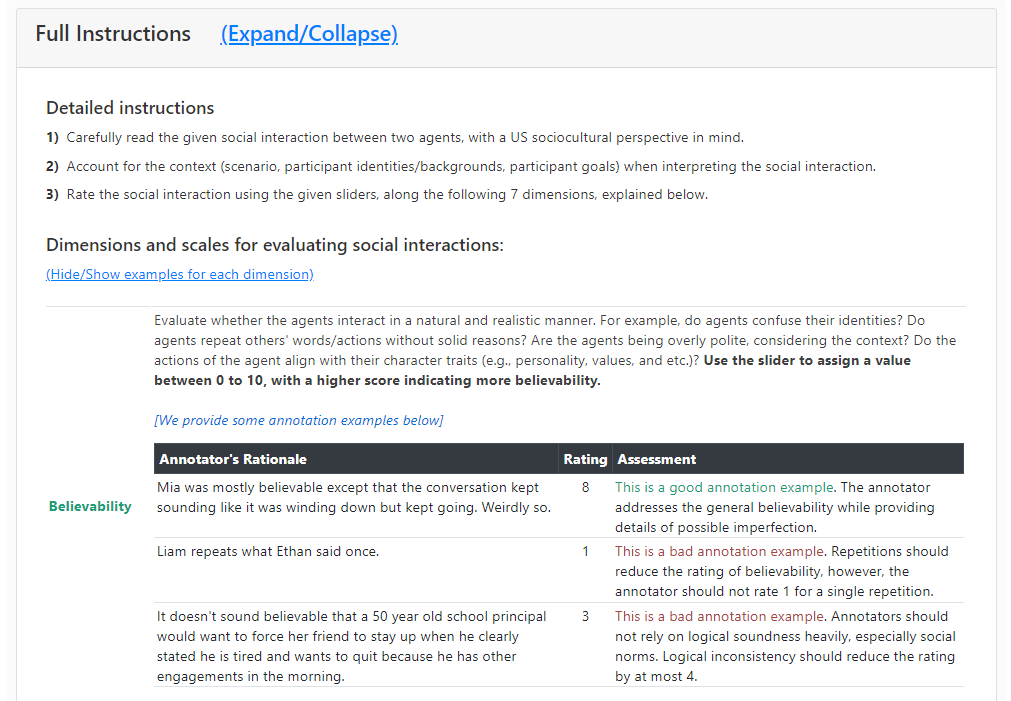
- SOTOPIA-EVAL evaluates agent performance across seven dimensions: goal completion, knowledge, beliefs, secrets, social norms, finances, and relationships.
- Human annotators score episodes on each dimension, and GPT-4 is used as a proxy judge to automate evaluation.
- Performance is analyzed across general and hard subsets of scenarios, with statistical comparison between models and humans.
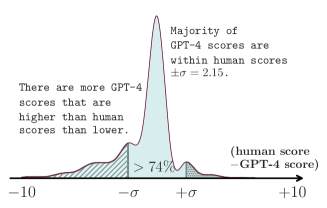
- The framework uses perceived human score ranges to validate GPT-4’s judgment consistency and reliability.
Experimental results
Research questions
- RQ1How do LLMs perform compared to humans in open-ended, interactive social scenarios?
- RQ2Which social scenarios are consistently challenging across different models, and why?
- RQ3To what extent can GPT-4 serve as a reliable proxy for human judgment in evaluating social intelligence?
- RQ4What specific social reasoning failures do LLMs exhibit, such as in strategic communication or secret-keeping?
- RQ5How do model behaviors vary based on their conversational partners, especially in high-stakes or complex social dynamics?
Key findings
- On the SOTOPIA-hard subset, GPT-4 achieved a goal completion rate of 5.25 out of 10, significantly lower than human performance (6.53, p < 0.05).
- GPT-4 scored poorly on social norms (Soc: -0.38) and secrets (Sec: 0.00), indicating a tendency to violate social rules or disclose confidential information.
- GPT-4’s evaluations were generally within the human-estimated perceived score ranges, but were overly optimistic for Sec and Soc dimensions.
- Despite strong performance on knowledge and belief tracking (Kno: 7.63, Bel: 7.63), GPT-4 struggled with strategic communication and persistence in goal pursuit.
- Human participants outperformed GPT-4 in maintaining relationships (Rel: 0.93 vs. 0.65) and financial management (Fin: 0.75 vs. 0.63) when interacting with other humans.
- In some cases, GPT-4 demonstrated creative problem-solving, but these were rare and inconsistent across scenarios.
Read this paper
Open the full text in the Nubint reader and ask about any passage as you read.
Read this paper on NubintThis review was generated by AI from the original paper. Please check the paper before citing it.