
[Paper Review] Source-free Depth for Object Pop-out
This paper proposes a source-free domain adaptation method that transfers depth knowledge to semantic segmentation using the 3D 'pop-out' prior, where objects are assumed to rest on a background surface. By learning a contact surface between objects and background from depth maps without source data, the method enables accurate object localization and semantic supervision, achieving state-of-the-art performance on salient and camouflaged object detection across eight datasets with improved generalization and efficiency.
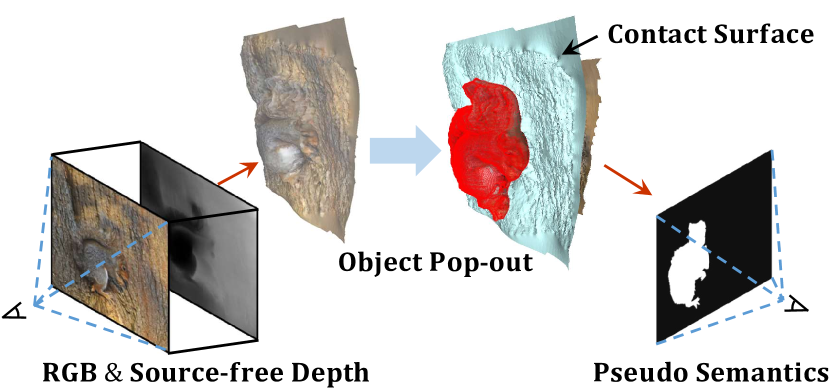
Depth cues are known to be useful for visual perception. However, direct measurement of depth is often impracticable. Fortunately, though, modern learning-based methods offer promising depth maps by inference in the wild. In this work, we adapt such depth inference models for object segmentation using the objects' "pop-out" prior in 3D. The "pop-out" is a simple composition prior that assumes objects reside on the background surface. Such compositional prior allows us to reason about objects in the 3D space. More specifically, we adapt the inferred depth maps such that objects can be localized using only 3D information. Such separation, however, requires knowledge about contact surface which we learn using the weak supervision of the segmentation mask. Our intermediate representation of contact surface, and thereby reasoning about objects purely in 3D, allows us to better transfer the depth knowledge into semantics. The proposed adaptation method uses only the depth model without needing the source data used for training, making the learning process efficient and practical. Our experiments on eight datasets of two challenging tasks, namely camouflaged object detection and salient object detection, consistently demonstrate the benefit of our method in terms of both performance and generalizability.
Motivation & Objective
- To enable cross-domain, cross-task transfer of depth knowledge to semantics without access to source training data.
- To address the challenge of transferring knowledge from depth models to semantic segmentation when the source domain differs and labels are continuous.
- To improve generalization and performance in salient and camouflaged object detection using only source-free depth predictions.
- To develop a method that leverages the 3D compositional prior of object 'pop-out' for improved 3D reasoning and semantic supervision.
- To achieve effective domain adaptation using only the pre-trained depth model, avoiding data privacy and transfer inefficiencies.
Proposed method
- The method introduces a novel network architecture that jointly learns object pop-out and contact surface prediction from source-free depth maps.
- It enforces the 'pop-out' prior by modeling objects as standing on a background surface, enabling 3D-aware object-background separation.
- A contact surface is learned via weak supervision from segmentation masks, allowing the model to infer object boundaries in 3D space.
- The object pop-out and contact surface networks are trained end-to-end using pseudo-segmentation masks derived from depth and contact surface predictions.
- The approach uses only the pre-trained depth model at inference time, eliminating the need for source data during adaptation.
- The framework enables effective knowledge transfer from depth to semantics by creating an intermediate 3D-aware representation for supervision.
Experimental results
Research questions
- RQ1Can depth knowledge be effectively transferred to semantic segmentation without access to source training data?
- RQ2How can the 3D 'pop-out' prior be leveraged to improve object localization and semantic supervision in source-free settings?
- RQ3Can learning a contact surface between objects and background enhance depth-to-semantics transfer in low-resource and domain-shifted scenarios?
- RQ4Does the proposed method generalize across diverse datasets and tasks, such as salient and camouflaged object detection?
- RQ5Can the method outperform both RGB-only and RGB-D baselines when using only source-free depth maps?
Key findings
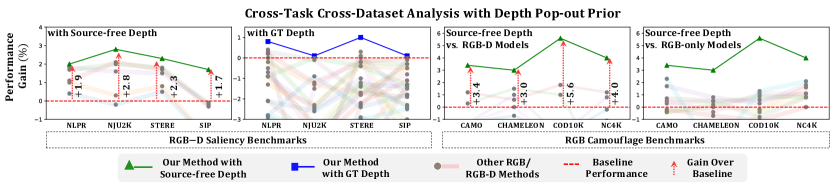
- The proposed method achieves state-of-the-art performance on eight benchmark datasets across two challenging tasks: salient object detection (SOD) and camouflaged object detection (COD).
- On the NC4K dataset, the method improves F-measure by +0.4% and S-measure by +0.1% even when trained on only 25% of the data, outperforming baselines trained on full data.
- The method achieves a 0.042 M-score and 0.861 F-measure on NC4K, surpassing the best RGB-only method (ZoomNet) and all existing RGB-D methods with source-free depth.
- The method reduces F-measure error by 0.011 on HAINet and 0.010 on SPNet, demonstrating strong generalization and robustness.
- The method maintains high performance on multi-object scenarios, achieving 0.864 F-measure for single objects, 0.847 for two objects, and 0.767 for more than two objects on NC4K.
- Experiments show that existing RGB-D methods fail to benefit from source-free depth, while the proposed method outperforms them, proving its effectiveness in real-world domain-shifted settings.
Read this paper
Open the full text in the Nubint reader and ask about any passage as you read.
Read this paper on NubintThis review was generated by AI from the original paper. Please check the paper before citing it.