
[Paper Review] SPAE: Semantic Pyramid AutoEncoder for Multimodal Generation with Frozen LLMs
This paper proposes Semantic Pyramid AutoEncoder (SPAE), a method that enables frozen large language models (LLMs) to perform multimodal image understanding and generation by converting images into interpretable, semantically rich lexical tokens via a learned vector quantizer. SPAE uses a multi-scale pyramid structure to encode both high-level semantics and fine-grained visual details, achieving a 25% absolute improvement in few-shot image classification accuracy over prior methods while enabling zero-shot image generation through in-context learning.
In this work, we introduce Semantic Pyramid AutoEncoder (SPAE) for enabling frozen LLMs to perform both understanding and generation tasks involving non-linguistic modalities such as images or videos. SPAE converts between raw pixels and interpretable lexical tokens (or words) extracted from the LLM's vocabulary. The resulting tokens capture both the semantic meaning and the fine-grained details needed for visual reconstruction, effectively translating the visual content into a language comprehensible to the LLM, and empowering it to perform a wide array of multimodal tasks. Our approach is validated through in-context learning experiments with frozen PaLM 2 and GPT 3.5 on a diverse set of image understanding and generation tasks. Our method marks the first successful attempt to enable a frozen LLM to generate image content while surpassing state-of-the-art performance in image understanding tasks, under the same setting, by over 25%.
Motivation & Objective
- To enable frozen LLMs to perform multimodal tasks involving images and videos without fine-tuning.
- To bridge the gap between visual modalities and the linguistic token space of frozen LLMs using interpretable, semantically meaningful representations.
- To develop a scalable, LLM-agnostic method that supports both image understanding and generation using only in-context learning.
- To improve reconstruction quality and semantic fidelity in visual-to-textual tokenization by leveraging a hierarchical, multi-scale pyramid structure.
Proposed method
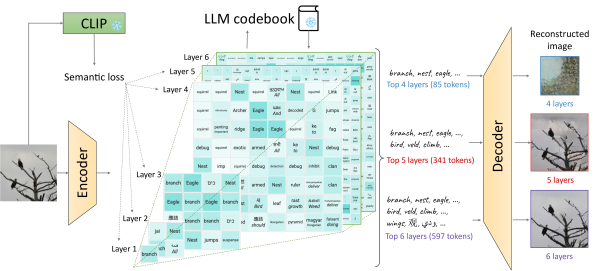
- SPAE employs a hierarchical, multi-scale pyramid structure where higher layers represent semantic concepts and lower layers encode fine-grained visual details.
- The model uses a learned vector quantizer to map image features into discrete, interpretable tokens drawn from the LLM’s vocabulary, enabling direct interaction with the frozen LLM.
- A dynamic semantic loss with per-layer thresholds ensures that semantic content is preserved at higher levels, while reconstruction fidelity is maintained at lower levels.
- The method integrates a perceptual loss from a pre-trained network to improve image reconstruction quality, though ablation shows it can be removed with minimal impact on classification.
- The framework supports adjustable token length: fewer tokens for understanding tasks, more for generation, enabling efficient use of context window constraints.
- The entire SPAE model is trained independently without backpropagation through the LLM, making it compatible with any frozen LLM.
Experimental results
Research questions
- RQ1Can a frozen LLM be effectively leveraged for image generation without any fine-tuning or parameter updates?
- RQ2How can visual content be mapped into a discrete, interpretable, and semantically meaningful token space compatible with a frozen LLM’s vocabulary?
- RQ3What architectural design enables both high-level semantic understanding and fine-grained reconstruction in a unified multimodal representation?
- RQ4To what extent does a hierarchical, pyramid-structured tokenization improve performance across diverse multimodal tasks compared to flat or standard VQ-VAE approaches?
- RQ5Can in-context learning with a frozen LLM achieve state-of-the-art performance in image understanding tasks when combined with a semantic-aware visual tokenizer?
Key findings
- SPAE achieves a 25% absolute improvement in few-shot image classification accuracy (65.1%) on mini-ImageNet compared to the prior state-of-the-art (40.1%) under the same in-context learning setting.
- The method enables zero-shot image generation via in-context denoising, marking the first successful attempt to use a frozen LLM for direct image generation without fine-tuning.
- Using a 6-layer pyramid structure with 597 tokens at the base layer yields the best trade-off between reconstruction quality (FID: 4.41) and semantic accuracy.
- Removing the perceptual loss surprisingly improves classification accuracy (69.5% vs. 65.1%) but degrades image reconstruction, indicating a trade-off between semantic and perceptual fidelity.
- The ablation study confirms that dynamic semantic weighting and per-layer thresholds significantly improve performance, especially in classification.
- The method is LLM-agnostic and successfully evaluated on both PaLM 2 and GPT-3.5, demonstrating broad compatibility with existing frozen LLMs.

Read this paper
Open the full text in the Nubint reader and ask about any passage as you read.
Read this paper on NubintThis review was generated by AI from the original paper. Please check the paper before citing it.