
[Paper Review] Sparse Distributed Memory is a Continual Learner
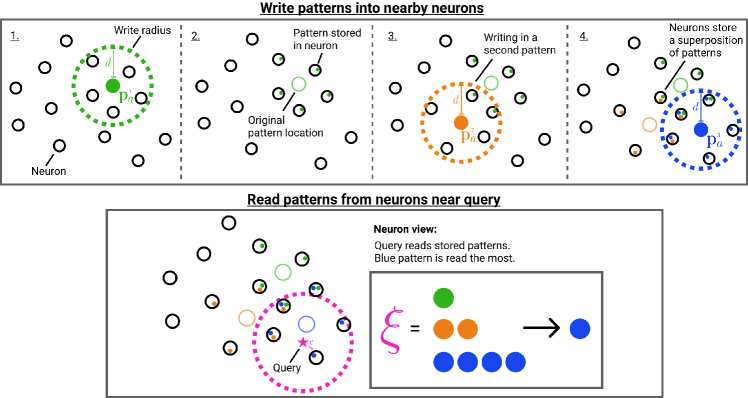
This paper proposes a modified Multi-Layered Perceptron (SDMLP) inspired by Sparse Distributed Memory (SDM) that achieves state-of-the-art continual learning performance on CIFAR-10 without memory replay or task boundaries. By integrating Top-K activation, L² normalization, non-negative weights, and bias-free training, the model forms specialized, sparse subnetworks that avoid catastrophic forgetting through organic manifold tiling and democratic neuron participation.
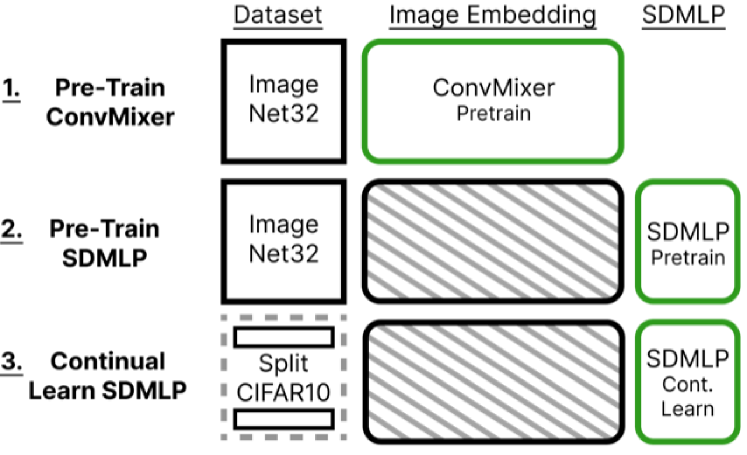
Continual learning is a problem for artificial neural networks that their biological counterparts are adept at solving. Building on work using Sparse Distributed Memory (SDM) to connect a core neural circuit with the powerful Transformer model, we create a modified Multi-Layered Perceptron (MLP) that is a strong continual learner. We find that every component of our MLP variant translated from biology is necessary for continual learning. Our solution is also free from any memory replay or task information, and introduces novel methods to train sparse networks that may be broadly applicable.
Motivation & Objective
- To develop a continual learning model that mimics biological neural networks without relying on memory replay or task information.
- To investigate whether core components of Sparse Distributed Memory (SDM) can enable robust continual learning in a standard MLP architecture.
- To identify and resolve structural challenges—like dead neurons and optimizer staleness—that emerge in sparse, continual learning models.
- To demonstrate that the combination of SDM-derived architectural constraints leads to emergent manifold tiling and subnetwork specialization.
- To establish a biologically inspired, memory-efficient continual learning framework that outperforms existing methods under strict constraints.
Proposed method
- Adopt a Top-K (k-Winner-Takes-All) activation function to restrict neuron activation to only the k most excited neurons per input, promoting subnetwork specialization.
- Enforce L² normalization and non-negativity on both weights and input data to constrain neurons to the data manifold, enabling democratic participation in learning.
- Eliminate bias terms to maintain symmetry and ensure that all neurons contribute equally to representation learning.
- Implement a GABA-switch-inspired initialization strategy to prevent neuron death during early training by temporarily reversing inhibitory effects.
- Address optimizer staleness in sparse networks by modifying training dynamics to prevent outdated momentum from updating inactive neurons.
- Combine the SDMLP with Elastic Weight Consolidation (EWC) to further enhance continual learning performance without task labels or memory replay.
Experimental results
Research questions
- RQ1Can a modified MLP based on Sparse Distributed Memory (SDM) achieve strong continual learning performance without memory replay or task boundaries?
- RQ2Which components of the SDM architecture are essential for preventing catastrophic forgetting in a continual learning setting?
- RQ3How do Top-K activation and L² normalization jointly enable manifold tiling and subnetwork specialization in the SDMLP?
- RQ4What are the structural challenges—like dead neurons and optimizer staleness—that arise in sparse, continual learning models, and how can they be biologically inspired to solve?
- RQ5To what extent does the SDMLP’s performance exceed existing methods in the class-incremental continual learning setting on CIFAR-10?
Key findings
- The SDMLP achieves state-of-the-art performance on CIFAR-10 in the class-incremental continual learning setting when memory replay is not allowed, outperforming existing methods under the same constraints.
- Every architectural component from SDM—Top-K activation, L² normalization, non-negative weights, and no bias—is necessary to prevent catastrophic forgetting; removing any one component degrades performance significantly.
- The model forms specialized subnetworks that tile the data manifold, with individual neurons learning to respond to specific image classes or even specific examples, resembling 'grandmother neuron' behavior.
- Neuron activation patterns show that SDMLP activates only a small, dynamic subset of neurons per task, preserving previously learned knowledge, whereas ReLU-based models activate nearly all neurons, increasing forgetting risk.
- The UMAP visualization confirms that neuron weights and data points are spatially aligned on the manifold, with neurons clustering around specific classes and their most activating examples.
- The GABA-switch-inspired initialization effectively prevents neuron death caused by Top-K activation, and the modified optimizer training strategy resolves staleness in sparse networks, both critical for sustained performance.
Read this paper
Open the full text in the Nubint reader and ask about any passage as you read.
Read this paper on NubintThis review was generated by AI from the original paper. Please check the paper before citing it.