
[Paper Review] Spatially Resolved Gene Expression Prediction from H&E Histology Images via Bi-modal Contrastive Learning
BLEEP (Bi-modal Embedding for Expression Prediction) predicts spatially resolved gene expression from H&E histology images using contrastive learning to align image and gene expression features in a shared low-dimensional embedding space. It achieves state-of-the-art performance on a human liver dataset, improving correlation with ground-truth expression by 39–120% over prior methods while preserving biological heterogeneity and reducing noise.
Histology imaging is an important tool in medical diagnosis and research, enabling the examination of tissue structure and composition at the microscopic level. Understanding the underlying molecular mechanisms of tissue architecture is critical in uncovering disease mechanisms and developing effective treatments. Gene expression profiling provides insight into the molecular processes underlying tissue architecture, but the process can be time-consuming and expensive. We present BLEEP (Bi-modaL Embedding for Expression Prediction), a bi-modal embedding framework capable of generating spatially resolved gene expression profiles of whole-slide Hematoxylin and eosin (H&E) stained histology images. BLEEP uses contrastive learning to construct a low-dimensional joint embedding space from a reference dataset using paired image and expression profiles at micrometer resolution. With this approach, the gene expression of any query image patch can be imputed using the expression profiles from the reference dataset. We demonstrate BLEEP's effectiveness in gene expression prediction by benchmarking its performance on a human liver tissue dataset captured using the 10x Visium platform, where it achieves significant improvements over existing methods. Our results demonstrate the potential of BLEEP to provide insights into the molecular mechanisms underlying tissue architecture, with important implications in diagnosis and research of various diseases. The proposed approach can significantly reduce the time and cost associated with gene expression profiling, opening up new avenues for high-throughput analysis of histology images for both research and clinical applications.
Motivation & Objective
- To address the challenge of predicting spatially resolved gene expression from H&E histology images without requiring expensive spatial transcriptomics.
- To overcome the ill-posed nature of the image-to-expression prediction problem by learning shared representations between image and expression modalities.
- To mitigate the curse of dimensionality in gene expression prediction by using a query-reference imputation strategy instead of per-gene regression.
- To improve robustness to experimental artifacts in spatial transcriptomics data through contrastive representation learning.
- To preserve and enhance biologically relevant gene-gene correlations and spatial heterogeneity in predicted expression profiles.
Proposed method
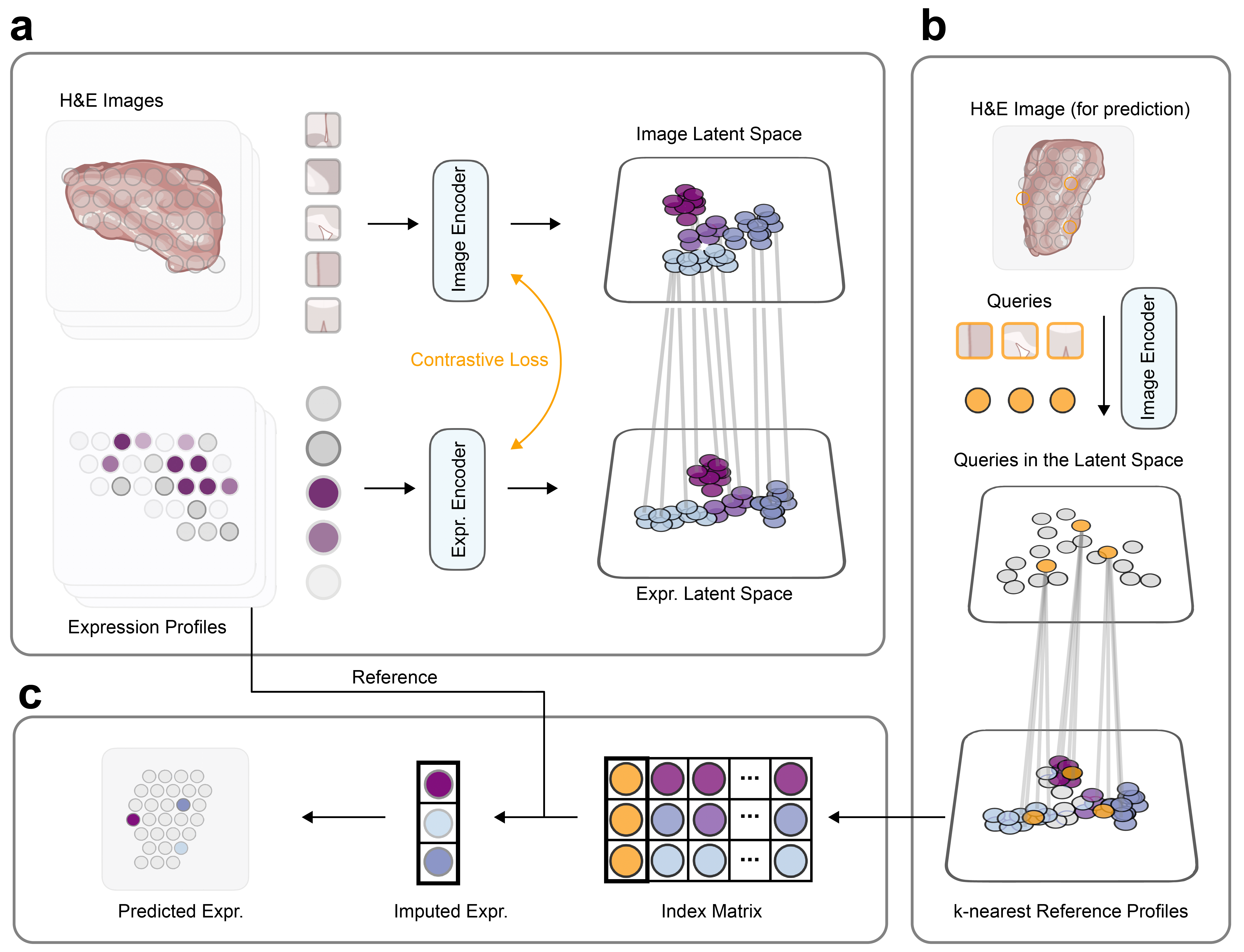
- BLEEP employs a contrastive learning objective inspired by CLIP to jointly embed H&E image patches and their corresponding spatial gene expression profiles into a shared low-dimensional space.
- The framework uses a dual-stream encoder: one for image features (ResNet-based) and one for gene expression features (MLP-based), both projected into a shared embedding space.
- During inference, the expression of a query image patch is imputed by computing a weighted average of the k-nearest neighbor expression profiles from a reference dataset in the joint embedding space.
- The contrastive loss encourages alignment between image and expression embeddings of paired samples while pushing apart non-paired samples, enhancing modality alignment.
- The method leverages a large reference dataset of paired H&E images and Visium spatial transcriptomics to train the joint embedding space.
- The imputation process reduces noise and enhances subtle biological signals by averaging over similar reference profiles, improving correlation with true expression.
Experimental results
Research questions
- RQ1Can a bi-modal contrastive learning framework effectively learn a shared representation between H&E histology images and spatial gene expression profiles?
- RQ2Does the query-reference imputation strategy in the joint embedding space outperform direct regression-based gene expression prediction in terms of correlation and noise resilience?
- RQ3To what extent does BLEEP preserve biological heterogeneity and gene-gene correlation structures in predicted expression profiles?
- RQ4How robust is BLEEP to experimental artifacts present in spatial transcriptomics data, such as batch effects or measurement noise?
- RQ5Can BLEEP improve the signal-to-noise ratio of spatial expression data by denoising through reference-based imputation?
Key findings
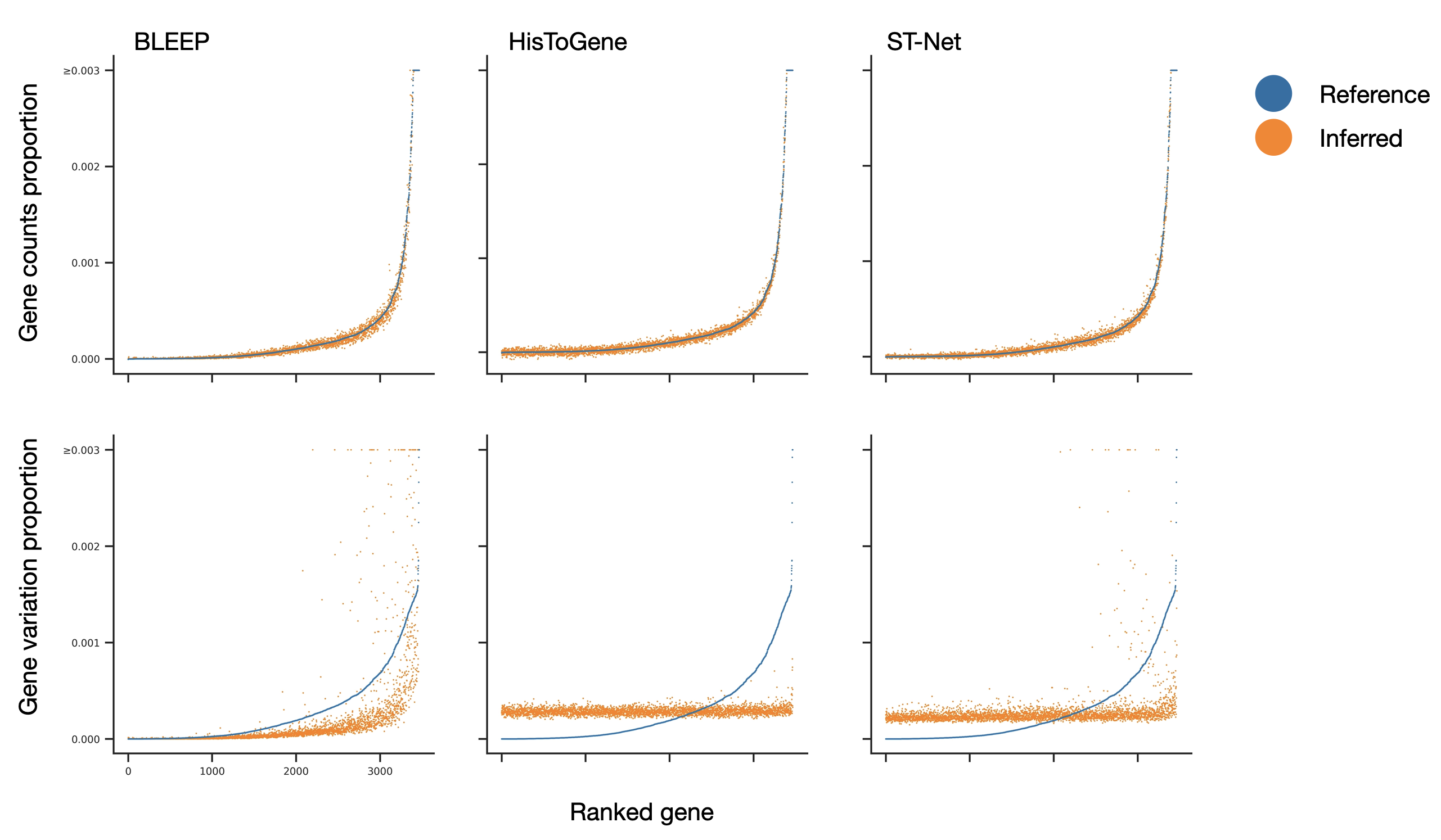
- BLEEP achieved an average correlation of 0.217 ± 0.002 with ground-truth expression across marker genes, significantly outperforming the second-best method by 39–120% improvement in correlation.
- The predicted expression profiles preserved and enhanced subtle positive and negative gene-gene correlations, with increased absolute correlation values due to noise reduction during imputation.
- BLEEP demonstrated lower variance in predicted expression profiles compared to the original Visium dataset, indicating effective denoising and smoothing of measurement noise.
- The method maintained high performance across all gene categories: marker genes (MG), highly expressed genes (HEG), and highly variable genes (HVG), with r = 0.217 ± 0.002, 0.175 ± 0.016, and 0.173 ± 0.011, respectively.
- The framework successfully captured spatial heterogeneity, as shown in visualizations of predicted expression patterns across liver tissue sections.
- BLEEP’s imputation process reduced the impact of experimental artifacts, resulting in more biologically coherent and consistent expression predictions.
Read this paper
Open the full text in the Nubint reader and ask about any passage as you read.
Read this paper on NubintThis review was generated by AI from the original paper. Please check the paper before citing it.